On the Morita invariance of the Hochschild homology of superalgebras
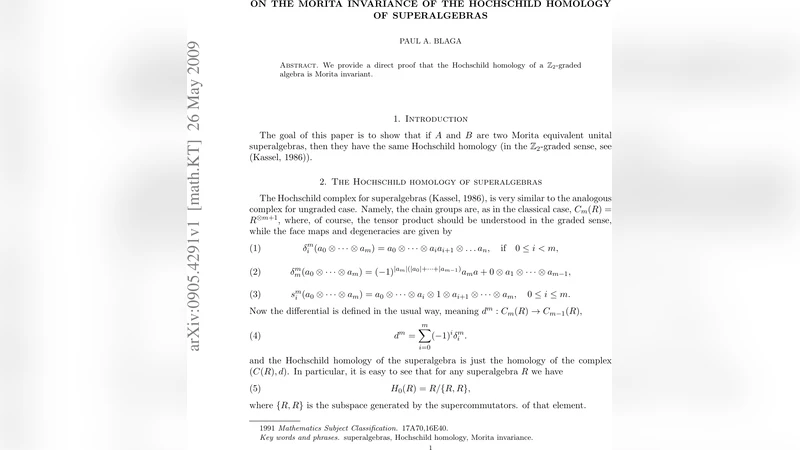
We provide a direct proof that the Hochschild homology of a $\mathbb{Z}_2$-graded algebra is Morita invariant.
💡 Research Summary
The paper establishes that Hochschild homology of a $\mathbb{Z}_2$‑graded algebra (a superalgebra) is invariant under Morita equivalence, and it does so by constructing explicit chain maps rather than invoking abstract categorical arguments.
The author begins by recalling the standard Morita context for two algebras $A$ and $B$: there exist bimodules $P$ (an $(A,B)$‑bimodule) and $Q$ (a $(B,A)$‑bimodule) together with isomorphisms $P\otimes_B Q\cong A$ and $Q\otimes_A P\cong B$. These data encode the Morita equivalence. The paper then reviews the Hochschild chain complex $C_\bullet(A)$ for a superalgebra, emphasizing the Koszul sign rule that governs the interaction of homogeneous elements of different parity.
The core of the work is the definition of a chain map
\
Comments & Academic Discussion
Loading comments...
Leave a Comment