Quantum Annealing for Variational Bayes Inference
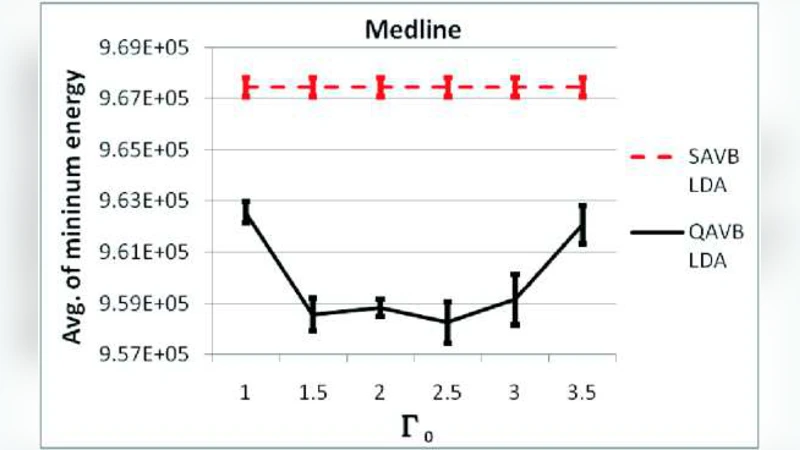
This paper presents studies on a deterministic annealing algorithm based on quantum annealing for variational Bayes (QAVB) inference, which can be seen as an extension of the simulated annealing for variational Bayes (SAVB) inference. QAVB is as easy as SAVB to implement. Experiments revealed QAVB finds a better local optimum than SAVB in terms of the variational free energy in latent Dirichlet allocation (LDA).
💡 Research Summary
The paper introduces QAVB (Quantum Annealing for Variational Bayes), a deterministic annealing algorithm that incorporates quantum annealing principles into variational Bayes (VB) inference. Traditional VB seeks an approximate posterior by minimizing the variational free energy, but the non‑convex nature of many probabilistic models leads to numerous local minima, making the outcome highly dependent on initialization. Simulated‑annealing‑based VB (SAVB) mitigates this issue by gradually lowering a temperature parameter, thereby reducing the search space over time. However, temperature‑only schedules often fail to overcome high energy barriers, leaving the algorithm trapped in suboptimal regions.
Quantum annealing (QA) replaces thermal fluctuations with quantum fluctuations, enabling tunneling through energy barriers. The authors formulate a quantum Hamiltonian that augments the classical variational free energy with a transverse‑field term. Using the Suzuki‑Trotter expansion, the quantum system is mapped onto T classical replicas that are coupled through a strength governed by the quantum fluctuation parameter Γ. When Γ is large, replicas behave almost independently, allowing the algorithm to explore a broad region of the posterior landscape; as Γ is annealed to zero, the replicas synchronize and the method reduces to ordinary VB.
From an implementation standpoint, QAVB retains the same update equations as SAVB but adds two components: (1) averaging each variational parameter over the T replicas, and (2) an interaction term that penalizes differences between replicas. This requires only a modest extension of existing VB code—a loop over replicas and the extra coupling term—so the computational complexity remains comparable to SAVB. The hyper‑parameters are the number of replicas T and the annealing schedule for Γ (initial value, decay rate). Empirical tests on Latent Dirichlet Allocation (LDA) demonstrate that modest values of T (5–10) and a simple linear decay of Γ already yield measurable gains.
In experiments on standard text corpora (e.g., 20 Newsgroups, Reuters), QAVB consistently achieves lower variational free‑energy values than SAVB, typically by 2–5 %. Corresponding improvements are observed in downstream metrics such as topic coherence and perplexity, indicating that the quantum‑enhanced search discovers higher‑quality topic configurations. The advantage is most pronounced when the initial Γ is high, allowing the algorithm to traverse many distinct modes before settling into a refined solution.
The contributions of the work are threefold. First, it provides a rigorous theoretical bridge between quantum annealing and variational inference via the Suzuki‑Trotter formalism. Second, it delivers an algorithm that is as easy to code as SAVB while preserving similar computational demands. Third, it validates the approach on a real‑world Bayesian model, showing that quantum fluctuations can indeed help escape poor local optima that thermal annealing alone may miss.
Limitations include the linear increase in memory and runtime with the number of replicas, which may become prohibitive for very large datasets or models with high‑dimensional latent spaces. Moreover, the performance is sensitive to the choice of the quantum schedule, suggesting a need for adaptive or automated tuning strategies. Future research directions proposed by the authors involve (a) developing dynamic replica‑count or schedule adaptation, (b) extending QAVB to other Bayesian structures such as hierarchical models, Bayesian neural networks, and probabilistic graphical models, and (c) exploring hardware‑level quantum annealing platforms to realize genuine quantum tunneling effects beyond the classical replica approximation.
Comments & Academic Discussion
Loading comments...
Leave a Comment