Multi-Cuts Solutions of Laplacian Growth
A new class of solutions to Laplacian growth with zero surface tension is presented and shown to contain all other known solutions as special or limiting cases. These solutions, which are time-dependent conformal maps with branch cuts inside the unit…
Authors: Ar. Abanov, M. Mineev-Weinstein, A. Zabrodin
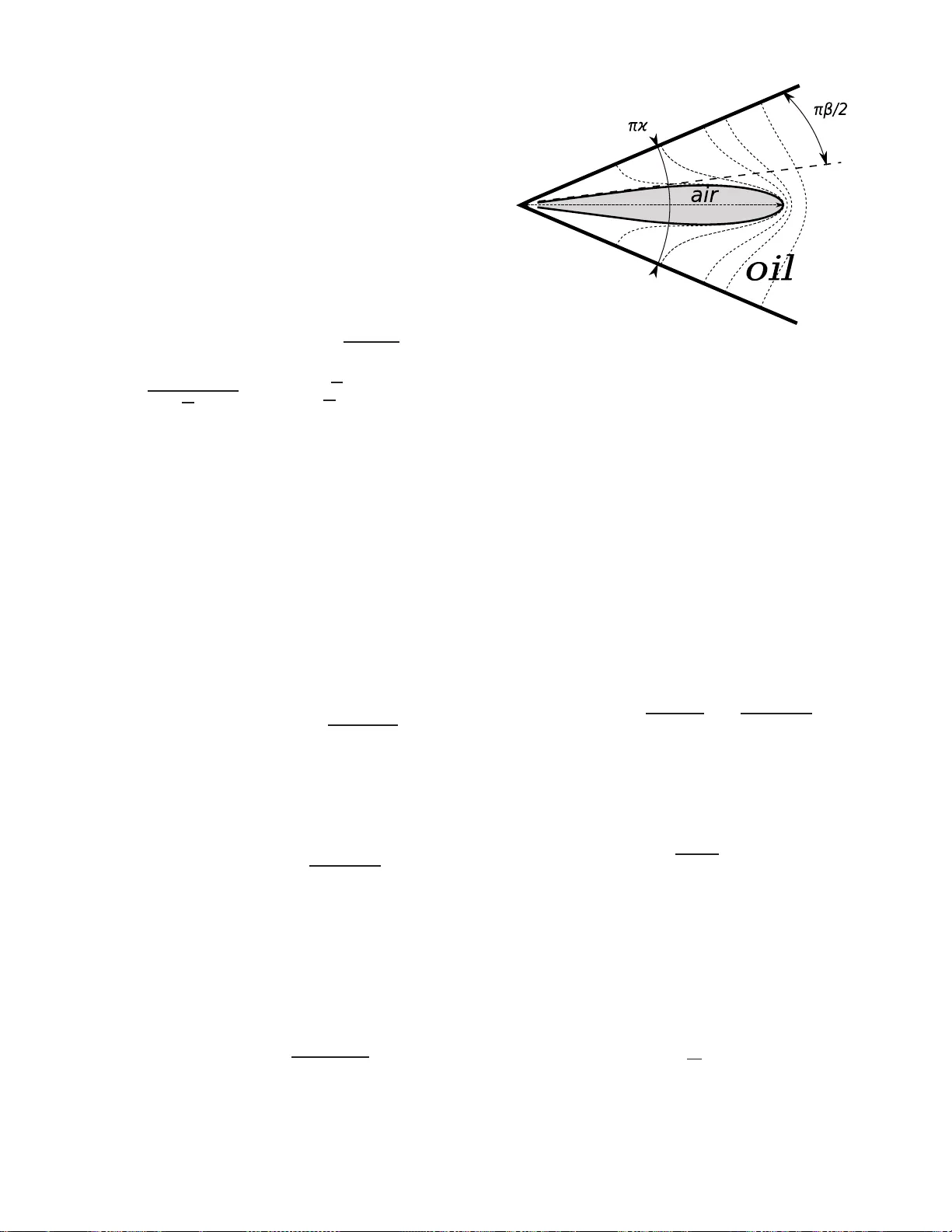
Multi-Cut Solutions of Laplacian Gro wth Ar. Abanov ∗ Dep ar tment of Physics, MS 4242, T exas A&M University, Col le ge Station, TX 77843-4242, USA M. Mineev-W einstein † L os A lamos Nat ional L ab or atory, MS-P365, L os Alamos, NM 8 7545, USA A. Za brodin ‡ Institute of Bio chemic al Physics, Kosygina str. 4, 119334 Mosc ow, Rus sia; also a t ITEP, Bol . Cher emushkinskaya str. 25, 117218 Mosc ow, R ussia (Dated: No vem ber 8, 2018 ) A new class of solutions to Laplacian gro wth ( LG) with zero surface ten si on is presented and sho wn to contain all other known so lutions as sp ecial or limiting cases. These solutions, which are time-dep endent conformal maps with branch cuts inside the unit circle, are gov erned b y a nonlinear integ ral equation and describ e oil fjords with non-parallel wa lls in viscous fingering exp eri ments in Hele-Shaw cells . Integral s of motion for th e m ulti-cut LG solutions in terms of singularities of the Sch w arz function are found , and the dynamics of densities (jump s) on the cuts are d eriv ed. The sub clas s of these solutions with linear Cauc hy den si ties on the cuts of th e S chw arz function is of particular interest, b ecause in this case the integral equation for th e conforma l map becomes linear. These solutions can also b e of physical imp ortance by represen ting oil/air in terfaces , whic h form oil fjords with a constant opening angle, in accordance with recent exp erimen ts in a Hele-shaw cell. P A CS num b ers: 02.30.Ik, 02.30.Zz, 05.45.-a Keyw ords: Laplacian growt h, harm onic momen ts, viscous fing ering domain, in terface, pattern, dynamics Cont ents I. In tro duction 1 I I. The Sc h w arz F unction and Integrals of Motion 2 I II. Ratio na l and Logarithmic Solutions 4 A. Rational So lutio ns 4 B. Logarithmic Solutions 5 C. “Mixed” Rationa l-Logarithmic Solutions 6 IV. Multi-Cut Solutions with Analytic Cauc hy Densities of General T yp e 6 A. Motiv ation 6 B. A Multi-Cut Ansatz for S + ( z ) 7 C. An Integral Equation for the C o nformal Map 8 D. The So lutio n Sc heme 9 V. Multi-Cut Solutions with Linear Cauc hy Densities 9 A. Cauch y Densities with a Pole at Infinity 9 B. Linear Cauch y Densities 10 C. Example: Z N -Symmetric Solutions with N Radial Cuts 10 VI. Discussion and Conclusion 12 ∗ abano v@tam u.edu † mariner@lanl.gov ‡ zabrodin@itep.ru VI I. Ac kno wledgement 12 A. Numerical solution of equation (64) 13 References 13 References 13 I. INTRO DUCTION Backgr ound and motivatio n: The Laplacian g r o wth (LG) is a free b oundary motion governed by gradient of a harmonic field. It describ es numerous physical pr o - cesses [1] with a moving boundary b etw een tw o immis- cible phases (an in terface) far fr o m eq uilibrium and pro- foundly in terconnects v arious branches of mathematica l ph ysics [2, 3]. LG in tw o dimensions is o f special imp or- tance since in the zero surface tension limit it has a re- mark a bly rich integrable structure [4 , 5, 6 ] and an impres- sive list of exact solutions in the form of conformal maps with p ole [7, 8, 9] and loga rithmic [10, 11, 12, 13] time- depe ndent singular ities (many of these solutions cease to exist in a finite time due to the interface instabil- it y .) In addition, there exist a family o f explicit s olu- tions [14, 15, 16] with time-indep enden t branch cuts with fixed endp oint s which describ e g ro wth of self-similar air ‘fingers’ in a wedge geometry (or in the plane with the rotational Z N -symmetry imp osed). Do other solutions exist, a pa rt from those mentioned ab o v e? Answering ‘yes’ to this question, w e hereby present a new family of conformal maps with time- depe ndent cuts, study their dynamics and provide ex- 2 amples. This family is the mos t gene r al solution to the LG problem (in the absence of surfa ce tension) which can b e written in terms of a nalytic functions. All ratio- nal, lo g arithmic and self-similar so lutions known so far (and mentioned ab ov e) are shown to b e sp ecial or limit- ing cases of these newly found ones. In this pap er we consider a simply co nnected exterior 2D LG problem with a sour ce/sink at infinity . In the context of Hele-Shaw flows [17] (the pro to t yp e of all 2D LG pro cesses [18]), it corr esponds to a finite bubble of an inviscid fluid (air) surr ounded b y a visco us fluid (oil) with a source or sink at infinit y . In what follows we ho ld to this hydrodynamic int erpretatio n. The standar d formulation of the exterior LG problem in 2D planar g eometry is as follows: v = −∇ p ∆ p = 0 in D ( t ) p = co nst V n = − ∂ n p at Γ( t ) p ( x, y ) = − Q 2 π log R , when R = p x 2 + y 2 → ∞ . (1) Here t is time, Γ( t ) is the b o undary (an oil/air in terface) of an infinite planar domain D ( t ) containing infinity and filled with oil, p is the pres sure field, v is velo cit y of o il, V n is norma l velocity o f the oil/air interface, ∂ n stands for normal deriv ative at the interface, and Q is a pumping rate assumed to be time-indep enden t (p ositiv e for the suction pro blem and negative for the injection one). The first equa tion in the s ystem (1) is the Da r cy law in scaled units, whic h determines the local velocity o f oil in the Hele- Sha w cell. The second eq ua tion follo ws from contin uity and incompressibility of oil, div v = 0. The third equation r esults fro m the fact that in fluids with negligible visc o sit y pressure is the same everywhere in the fluid, p = co nst, so, neglecting surface tension, one can s et p to b e the same constan t alo ng both sides o f the int erface. The fourth equation states that nor mal v elo c- it y o f fluid a t the interface and that of the interface itself coincide (con tin uity). The last equa tion gives the asymp- totic of p far awa y from the in terface in the presence o f a single sink of strength Q pla ced at infinit y . A reformulation o f the LG problem in ter ms of complex v aria bles and analytic functions is particularly ins truc- tive. W e co nclude the introduction by a brief review of the time-dep enden t co nformal map appro a c h. The c onformal map formulation . Let us int ro duce a time-dep e ndent conformal map, z = f ( w, t ), from the exterior of the unit circle, | w | ≥ 1, in an auxilia ry math- ematic al w -plane to the domain D ( t ) o ccupied by oil in the ph ysic al plane z = x + iy . The n the in terface at time t is a closed curv e sw ept b y f ( e iφ , t ) as φ runs from 0 to 2 π . Below we sometimes do not indicate the time depe ndence e x plicitly and write simply f ( w ). It is con- venien t to normalize the confor mal ma p b y the co ndition that ∞ is mapp ed to ∞ a nd the deriv ative a t infinit y is a real p ositive num ber r (the conformal r adius), so that the Laur els expansion at infinity has the form f ( w ) = rw + u 0 + u 1 /w + u 2 /w 2 + . . . (2) (the co efficients u i are in gener al complex n umbers). It is w ell known [19, 20] that the L G dynamics of the interface is equiv a len t to the following equa tion for f ( e iφ , t ): Im( ¯ f t f φ ) = Q 2 π , (3) where subscripts s tand for partial der iv ativ es a nd a bar for complex conjugation. This nonlinear equation is re- mark a ble b ecause it p ossesses an infinite num b er of con- serv a tion la ws [4] and an impres s iv e list of non-trivial so- lutions with moving singularities [7, 8, 9, 10, 11, 12, 13], which are either p oles or logarithmic branch p oin ts ly- ing strictly inside the unit circle . In all these case s the conformal map f ( w ) thus a dmit s an analytic contin ua- tion acr oss the unit circle, so the function f ( w ) is actually analytic no t o nly in its exterior but in some larger infinite domain containing it. Assuming that f ( w , t ) is analyt- ically extendable acr oss the unit cir cle for all t in some time int erv a l, one can analytically contin ue the LG equa- tion (3) itself. Set ¯ f (1 /w, t ) ≡ f (1 / ¯ w, t ), then equation (3) ca n be rewritten a s ∂ w f ( w, t ) ∂ t ¯ f (1 /w, t ) − ∂ t f ( w, t ) ∂ w ¯ f (1 /w, t ) = 1 /w (4) (w e hav e set Q = π that means a rese aling of time units). Under our a ssumption the functions f ( w, t ) and ¯ f (1 /w , t ) hav e a common domain o f analyticity co n ta ining the unit circle | w | = 1, and w in equation (4) is suppo sed to b e- long to this doma in. In fact, for rational and logarithmic solutions, this equation holds everywhere in the w -plane except for p oles and branch cuts of f ( w, t ) and ¯ f (1 /w , t ). W e no te in adv ance that the gener al m ulti-cut so lutio ns constructed b elow hav e the sa me pro perty . Namely , the functions f ( w , t ) and ¯ f (1 /w , t ) hav e a common do main of analyticit y where they actually solve the analytically contin ued LG eq ua tion (4) and no t just (3). As said earlier , there are a lso self-similar Z N - symmetric solutions [3, 14, 15, 16] con taining a time- independent fra ctional p o w er s ing ularit y which corre - sp onds to the interface se lf-intersection p oint at the ori- gin. In this cas e the analytic con tin uation is p ossible through every p oin t on the unit circle except tho se that are ma pped to the o rigin. Again, the functions f ( w , t ) and ¯ f (1 /w , t ) have a non- empt y common domain o f a n- alyticity and equation (4) is v alid everywhere in this do- main. II. THE SCHW ARZ FUNCT ION AND INTEGRALS OF MOTION It is known [2, 4, 5, 10, 12, 21] that the partial dif- ferential e q uation (4) can b e integrated in terms o f the Schwarz function . It is a n analytic function, S , which 3 connects f ( w ) a nd ¯ f (1 / w ) in their common domain of an- alyticity: ¯ f (1 /w ) = S ( f ( w )). Equiv alen tly , the Sch w arz function for a curv e Γ is an analytic function S ( z ) such that ¯ z = S ( z ) for z ∈ Γ [22]. In other words, S ( z ) is an analytic con tin uation o f the function ¯ z awa y from the curve. F or ana ly tic curves this function is known to b e well defined in a strip- lik e neighborho o d of the curve. If the curve dep ends on time, s o do es its Sc h w arz function, S = S ( z , t ). In terms of the Sch warz function the (analytically con- tin ued) LG equation (4) r eads [21] S t = ∂ z log w (5) where w = w ( z , t ) is the function in v erse to the f ( w , t ). Since ∂ z log w ( z ) is analytic everywhere in the oil domain D ( t ), both sides of equation (5) are fr ee of singular ities there. Ther e fo re, all sing ularities of S ( z , t ) located in D ( t ) are time-indep enden t. Equiv a len tly , the function S + ( z ) = I Γ( t ) S ( ζ ) ζ − z d ζ 2 π i (6) defined for z o utside D ( t ) by the integral of Cauch y type (where the in tegration contour Γ has the sta ndard a n ti- clo c kwise orientation) and ana lytically con tin ued to D ( t ) is constant in time: ∂ t S + ( z , t ) = 0 . This implies conser - v ation of harmonic moment s t k [4] which ar e coefficients of the T aylor ex pa nsion of S + ( z ) at z = 0: t k = 1 2 π ik I Γ( t ) ¯ z dz z k = − 1 π k Z D ( t ) dx dy z k , k = 1 , 2 , 3 , . . . , (7) where we assume, without loss of g eneralit y , that the co n- tour Γ( t ) e ncircles the origin. In particular, t 1 = S + (0). Besides, it is easy to see that the ph ysical time t is equal to the area of the air bubble divided by π : t = I Γ( t ) ¯ z dz 2 π i (8) Thu s the LG dynamics is a pro cess such that the area sur- rounded b y the int erface grows linea rly with time while the harmonic moments (7) (or the S + -part of the Sch warz function (6)) a re kept constant. It is impor tan t to note that the function S + (i.e., the infinite set of ha rmonic moments t k ) together with the v ariable t fix the whole Sch warz function S uniquely , at least lo cally in the v a r i- ety of closed analy tic con tours in the plane. In a cer tain sense (made more precise in [23]), these data serv e as lo cal co ordinates in the infinite dimensio nal v ariety of contours. It is also worth while to men tion that the function S − ( z ) = S ( z ) − S + ( z ) is analytic in D ( t ) and v anishes a t infinit y a s O (1 /z ) with the residue res ∞ [ S − ( z ) dz ] = − t (9) (the res idue at infinit y is defined as res ∞ [ dz /z ] = − 1). The decomp osition of the Sc hw a r z function S = S + + S − app ears to b e v ery useful. As it follows from pr operties of Ca uc hy-type in tegrals , the function S − ( z ) is giv en by the same in tegral (6) (with the opp osite sign), where z now belongs to D ( t ). The conformal map and the Sch w arz function are con- nected in the following w a y: S ( z ) = ¯ f (1 /w ) z = f ( w ) (10) These form ulas mak e it clear that if the functions f ( w ) and ¯ f (1 /w ) ha ve a common do main of analyticity con- taining the unit circle, then the Sc h w arz function is w e ll- defined. They a lso imply the one- to -one corres p ondence betw een singula r ities o f the function f ( w ) inside the unit disk and singularities o f the function S ( z ) in D ( t ) (which, by the pro perties of the Cauch y type integrals, are the same as singularities o f the function S + ( z )). Let us illustrate the one- to -one corr espondence b e- t ween s ingularities of f ( w ) and S + ( z ) by the example of po les in w hich ca se it is esp ecially tra nsparen t. Suppose that the confo r mal map f ( w ) has a p ole of o rder k at a po in t a inside the unit disk, so that the local b eha vior of f nea r a is f ( w ) = A ( w − a ) k + les s singular terms . (11) Then the function S = ¯ f (1 /w ) has a p ole of the s ame order at the p oin t w = 1 / ¯ a : S = ¯ f (1 / w ) = ¯ A ( w − 1 − ¯ a ) k + less singular ter ms . (12) Because the point 1 / ¯ a tog ether with its sma ll neig h bor- ho od lies o utside the unit disk (where f is confor mal), we can linea rize the denominator in (12) near z = f (1 / ¯ a ) and obtain S ( z ) = ¯ A f ¯ a (1 / ¯ a ) z − f (1 / ¯ a ) k + less singular terms (13) (here f ¯ a (1 / ¯ a ) ≡ ∂ w f (1 /w ) a t w = ¯ a ). Thus S ( z ) neces- sarily has a singula r it y a t z = f (1 / ¯ a ) of the same type as f ( w ) has a t w = a . Now we are r eady to outline the general strategy of int egratio n of the LG problem. T ak en initial data, i.e., a conformal map f ( w ) a t t = t 0 , one finds S + from (6) by rewriting it as integral ov er the unit circle in the mathe- matical plane: S + ( z ) = 1 2 π i I | w | =1 ¯ f (1 /w ) d f ( w ) f ( w ) − z . (14) In or der to obtain the LG dy namics, one then should solve the inv erse problem: g iven the S + ( z ) and time t , to r eco ver the co nformal map f ( w , t ). The last step is a 4 part of the in verse potential problem and thus is hard to implemen t in genera l. F o rmally , this is equiv alen t to a nonlinear integral equation which is easy to derive using the definition of the Sc h warz function in the form f ( ζ ) = ¯ S ( ¯ f (1 /ζ )). In tegrating b oth sides of this eq ualit y with the Cauc hy kernel 1 / ( w − ζ ) o ver the unit cir cle assuming that | w | > 1, and us ing the fact that the S − -part of the Sch warz function do es not contribute to the integral, we get the int egral equation f ( w ) = rw + u 0 + 1 2 π i I | ζ | =1 ¯ S + ( ¯ f (1 /ζ )) dζ w − ζ , | w | > 1 . (15) The same pro cedure at | w | < 1 gives a “complimen tary” equation rw + u 0 = 1 2 π i I | ζ | =1 ¯ S + ( ¯ f (1 /ζ )) dζ ζ − w + ¯ S − ( ¯ f (1 /w )) , | w | < 1 . (16) As their direct consequence, we can write the following useful for m ula e fo r the co efficien ts of the Laur els series (2): u j = 1 2 π i I | ζ | =1 ¯ S + ( ¯ f (1 /ζ )) ζ j − 1 dζ , j ≥ 0 , (17) r = 1 2 π i I | ζ | =1 ¯ S + ( ¯ f (1 /ζ )) ζ − 2 dζ + t r (18) Substituting them bac k in to (2) and using (15), w e get a set o f in tegral equations f ( w ) = rw + d X j =0 u j w − j + 1 2 π i I | ζ | =1 ζ d ¯ S + ( ¯ f (1 / ζ )) dζ w d ( w − ζ ) , | w | > 1 . (19) for any d = − 1 , 0 , 1 , 2 , . . . . Being taken tog ether with (17), all of them ar e equiv alent to the original equation (15) which is repro duced at d = 0. How ever, dep end- ing on the type of singular ities o f the function S + , one or ano ther fo rm may b e mor e co n v enient than other s. The choice d = − 1 g iv es an eq uation wher e no ne of the co efficien ts u j ent er explicitly : f ( w ) = rw + 1 2 π i I | ζ | =1 w ¯ S + ( ¯ f (1 /ζ )) dζ ζ ( w − ζ ) , | w | > 1 . (20) This equation combined with relatio n (18) accomplis he s int egratio n of the LG problem. Let f ( w ) = f ( w | r ) be a solution to equation (20) depending on the par ameter r , then the time dependence is found from (18) whic h determines r as an implicit function of t : t = r 2 − r 2 π i I | ζ | =1 ¯ S + ( ¯ f ( ζ | r )) dζ (21) Alternatively , one may use the r elation t = 1 2 π i I | w | =1 ¯ f (1 /w ) d f ( w ) (22) leading to the sa me results. In principle, this sc heme provides a general solution to the LG problem but in a ra ther implicit form. How ev er, for sev eral imp ortant classes of functions S + ( z ) it can be made more e x plicit. In all effectively so lv able cases, the r.h.s. of the integral equatio n simplifies dra stically after shrinking the integration contour to singula r ities of the function ¯ S + ( ¯ f (1 /ζ )) inside the unit disk. Some exa mples are given in the next section. II I. RA TIONAL AND LOGARITHMIC SOLUTIONS In this sec tio n we a pply the general metho d bas e d on equations (20) , (21) to construction of LG solutions with po les and log arithmic singularities. A. Rational Solutions By rational solutions we mean solutio ns to equa tion (4) whose only singularities are p oles inside the unit disk (not men tioning a simple pole at infinity). The v ery fact that the r a tional ansate is co ns isten t with the LG equation, i.e., that the num b er of p oles is conse rv ed and singulari- ties of other t ypes are not generated, is a consequence of the integral equation (1 5 ). Let us take S + to be a r ational function of a general form S + ( z ) = N X m =1 K m X k =1 T m,k ( z − z m ) k + T 0 , 0 + K 0 X k =1 T 0 ,k z k (23) where all the pole s z m are in D ( t ) and T m,k are arbitra ry complex c onstan ts. Then the function ¯ S + ( ¯ f (1 / ζ )) has a p ole a t 0 of order K 0 and p oles of orders K m at the po in ts a m such that z m = f (1 / ¯ a m ) and do es not have other sing ula rities inside the unit dis k . F or co n venience, we set a 0 = 0. Therefor e , the in tegral in the r.h.s. of (15) is equal to the sum of residues at these p oles. Calculating the residues, we obtain an expressio n for the conformal map in the form of a rational function of w with p oles o f orders not higher than K m at the po in ts a m inside the unit disk: f ( w, t ) = r ( t ) w + u 0 ( t ) + N X m =0 K m X k =1 A m,k ( t ) ( w − a m ( t )) k , (24) The pole at a 0 = 0 is distinguished among the other s bec ause it does not move. All other p oles as w ell as all co efficients dep end o n time. The co efficien ts A m,k are expressed thro ugh deriv a tiv e s of the function ¯ f (1 /w ) 5 at w = a m . The g eneral formulae are quite compli- cated. In fac t what we really need are inv er se formu- lae which expre s s the integrals of motion T m,k through time-dep e ndent co efficients of f ( w , t ). Obviously , T m,k = res z m ( z − z m ) k − 1 S + ( z ) dz , m 6 = 0 , and the function S + ( z ) here can b e substituted for the S ( z ) b ecause S − ( z ) is regula r in D ( t ). Passing then to the mathematical plane, w e obtain the full list of con- stants of motion: z m = f (1 / ¯ a m ( t ) , t ) , m 6 = 0 (25) T m 6 =0 ,k = res ¯ a − 1 m ( t ) ( f ( w, t ) − z m ) k − 1 ¯ f ( w − 1 , t ) d f ( w, t ) T 0 ,k = − r es ∞ ( f ( w, t )) − k − 1 ¯ f (1 /w , t ) d f ( w, t ) . W e note that T m,k hav e the meaning of “Whitham times” for a genera l Whitham hierarch y which cov ers the LG problem with zero sur face tensio n. Each Whitham time T m,k is “ coupled” to its own type o f singularity . F ro m this p oin t of view, for m ula e (25) a r e relations of the ho do- graph t yp e which pro vide a solution o f the full genus z e ro Whitham hiera rc h y in an implicit for m [24]. Algebraic equations (25) expre ss time-dep enden t pa- rameters r ( t ), u 0 ( t ), a m ( t ) and A m,k ( t ) implicitly via the constants of motion z m and T m,k . T o o btain a complete set o f relations, we also need the equation (2 2) cont aining time t explicitly . In o ur case the integral is reduced to a sum o f residues: t = − r es ∞ [ ¯ f ( w − 1 , t ) d f ( w, t )] − X m res ¯ a − 1 m ( t ) [ ¯ f ( w − 1 , t ) d f ( w, t )] Comparing w ith (25) at k = 1, we see that the r esidues at 1 / ¯ a m are just constants T m, 1 . Therefore, t = − r es ∞ [ ¯ f (1 / w, t ) d f ( w, t )] − X m T m, 1 . (26) So, we hav e N + K + 1 c o mplex algebraic equations, where K = P N m =0 K m , and one rea l a lgebraic equa tio n for N + K + 1 complex parameters and one r eal parameter which determine them as functions of time and N + K + 1 constants of motion. Given initial conditions in the form (23), a solution to this system allows one to recov er the time-dep e ndent conformal map, acco rding to the stra tegy outlined a t the end o f Section I I. In some impor tan t par ticular cases the general expres- sions giv en abov e b ecome simpler and more explicit. F or example, if no ne o f the p oles a m lies at the orig in (i.e., A 0 ,k = 0 for all k ≥ 1), then T 0 ,k = 0 for k ≥ 1, T 0 , 0 = f (0 , t ) and t = r ( t ) ¯ f ′ (0 , t ) − X m T m, 1 , (27) (here f ′ (0 , t ) is the deriv a tiv e of f ( w , t ) at w = 0). If, moreov er, all p oles in (24) are simple and none of them lies a t the origin ( K m = 1 for m 6 = 0 and K 0 = 0), then the expressions for T m, 1 and t acquire an esp ecially compact and explicit for m: T m, 1 = ¯ A m, 1 ( t ) ∂ w f (1 /w , t ) w = ¯ a m ( t ) = ¯ A m, 1 ( t ) − r ( t ) ¯ a 2 m ( t ) + X l A l, 1 ( t ) (1 − a l ( t )¯ a m ( t )) 2 ! , (2 8 ) t = r ( t ) ¯ f ′ (0 , t ) − X m T m, 1 = r 2 ( t ) + X l,m A l, 1 ( t ) ¯ A m, 1 ( t ) (1 − a l ( t )¯ a m ( t )) 2 . (29) B. Logarithmic Solutions F o r the clas s of logarithmic solutions, the function S + is taken in the form S + ( z ) = t 1 + N X m =1 ¯ A m log 1 − z z m , (30) where all the bra nc h points z m are in D ( t ) and t 1 , A m are a rbitrary complex constants (note that this t 1 is the first harmo nic momen t from (7)). If A 0 = − N X m =1 A m 6 = 0 , then there is also a branching at infinit y . T his function is m ulti-v alued and one should fix a single - v alued branch. In a neig hbo rhoo d of the o rigin, w e define it b y the con- dition that S + (0) = t 1 . In or der to con tinue it una m- biguously to D ( t ), it is necessar y to intro duce a system of cuts co nnecting a ll the bra nc h p oin ts in suc h a wa y that the domain D ( t ) \ { all cuts } b e s imply connected. There ar e man y wa ys to dr aw the cuts. Although all of them are ultimately eq uiv alen t, it would b e convenien t for us to meet some requir e men ts natural for the g ro wth problem: to resp ect the demo cracy among the br a nc h po in ts z m and to ensure that the cuts alw ays r emain in D ( t ). F or the former , let us fix a po in t q in D ( t ) and make cuts from q to all z m (and, if necessar y , to infin- it y). F or the la tter, it is natural to choos e q = ∞ since ∞ is the only p oin t in D ( t ) which remains there forever irresp ectiv ely of initial conditions. So , we fix a system of (non-intersecting) cuts from the p oint s z m to ∞ . No te that this c hoice of cuts implies that S + ( z ) do e s no t hav e a definite v alue a t z = ∞ , ev en if ∞ is a r egular p oin t, bec ause the limit depe nds on a particular w ay of tending z → ∞ . Reconstructing f from (1 5 ) in a s imilar w ay as for ra- tional solutions, w e introduce the p oint s a m such that f (1 / ¯ a m ) = z m inside the unit disk and notice that the int egral in (15) is shr unk to res idues of the differential d ¯ S + ( ¯ f (1 /ζ )) = N X m =1 A m d log( ¯ f (1 /ζ ) − ¯ f (1 / a m )) 6 which are easy to calculate. In this wa y one o btains f ( w, t ) = r ( t ) w + u 0 ( t ) + N X m =0 A m log( w − a m ( t )) , (3 1) N X m =0 A m = 0 . Again, we distinguish a p o ssible branc h po in t at the or i- gin and set a 0 = 0. By constructio n, the cuts of the function f ( w ) go from 0 to a m inside the unit disk. Sim- ilarly to the Sch warz function, f ( w ) with this choice of cuts do es not hav e a definite v alue at w = 0 , ev en if 0 is a regular p oin t, b ecause the limit dep ends on a par ticular wa y of tending w → 0. The co nstan ts of motion a re given b y t 1 = 1 2 π i I | w | =1 ¯ f (1 /w ) d f ( w ) f ( w ) = ¯ u 0 + N X m =1 ¯ A m log ¯ a m z m r , z m = f (1 / ¯ a m ( t ) , t ) = r/ ¯ a m ( t ) + u ( t ) + N X l =1 A l log(1 − a l ( t )¯ a m ( t )) , (32) in ag reemen t with pr evious results [10, 11, 12, 13]. F or- m ulae (21) and (22) allow one to derive few differently lo oking equiv alen t expressio ns for t . The simplest o ne reads t = r 2 + N X m =1 A m ¯ z m − ¯ u 0 − r a − 1 m . (33) The o thers can b e also useful in some situations : t = r ∂ w ( ¯ f ( w ) + ¯ A 0 log f (1 / w )) w =0 + X m ¯ A m z m , (34) t = r 2 + X l,m A l ¯ A m log(1 − a l ¯ a m ) . (35) The solution contains N + 1 complex ( a m and u 0 ) and one real ( r ) time-dep enden t parameter s. They a re to b e determined from the system of N + 1 complex equations (32) and one r eal equation (34). C. “Mixed” Rational-Logarithmic Solutions In a simila r wa y , one can also consider “ mixed” solu- tions with b oth p oles a nd log arithms. In this ca s e the function S + is S + ( z ) = N X m =1 K m X k =1 T m,k ( z − z m ) k + T 0 , 0 + K 0 X k =1 T 0 ,k z k + N X m =1 ¯ A m log 1 − z z m (36) where a s ingle-v alued branch is fixed by the condition that S + (0) = N X m =1 K m X k =1 T m,k z k m + T 0 , 0 = t 1 . (37) The equation (15) gives f ( w, t ) = r ( t ) w + u 0 ( t ) + N X m =0 K m X k =1 A m,k ( t ) ( w − a m ( t )) k + N X m =0 A m log( w − a m ( t )) , N X m =0 A m = 0 , (38 ) with the same con ven tion a 0 = 0. The constants of mo- tion z m , T m,k are expressed throug h the time-dep enden t parameters of the c o nformal map by means of formulas similar to (25). I n fact one can represent the “ho dogra ph relations” (25) in a for m whic h is suitable for logar ithmic and mixed cases as well: z m = f (1 / ¯ a m ( t ) , t ) T m 6 =0 ,k = − 1 k res 1 / ¯ a m ( t ) ( f ( w, t ) − z m ) k d ¯ f (1 / w, t ) , T 0 ,k 6 =0 = − 1 k res ∞ ( f ( w, t )) − k d ¯ f (1 /w , t ) , (39) The residue a t infinity is well defined since the differen tial d ¯ f (1 /w , t ) is single- v alued. No te that the co efficien t ¯ A m can b e formally under stoo d as T m, 0 : ¯ A m = − k T m,k at k = 0. An expression for T 0 , 0 follows fro m (37) and the int egral for m ula for t 1 in (32) v alid in all cas e s : T 0 , 0 = 1 2 π i I | w | =1 ¯ f (1 / w ) d f ( w ) f ( w ) − N X m =1 K m X k =1 T m,k z k m . (40) Different equiv alent versions of the for m ula for t can b e obtained from (21) or (22). Finally , we note that rational terms in f ( w ) can b e re- garded as a sp ecial (sing ular) limiting case of logarithmic ones with merging bra nc h points. F or instance, lim a 1 → a rw + A log w − a 1 w − a = r w + α w − a with A = α/ ( a − a 1 ). All logarithmic, rationa l and “mixed” solutions belong to the same class character- ized b y the proper t y that the first deriv a tiv e of S + is a rational function (or, equiv alently , the fir s t deriv ativ e o f S is a mesomor phic function in D ( t )) . IV. MUL TI-CUT SOLUTIONS WITH ANAL YTIC CAUCHY DENSITIES OF GENERAL TYPE A. Motiv ation It is k no wn that all ratio nal so lutions (except for tho se of the form f ( w , t ) = r ( t ) w + u ( t ) + A ( t ) /w , which de- scrib e a self-s imilar growth of ellipse) cease to ex ist in a 7 finite time, because the dynamics gives rise to a cusp-lik e singularity of the in terface. These ph ysically meaningless singularities just signify tha t the sur face tension effects can not b e negle c ted in a vicinity of highly c urv ed parts of the interface. Nevertheless, a c onsiderable sub class of the purely loga r ithmic solutions is well defined for all po sitiv e times a nd describes a non-singula r in terface dy- namics at zero surface tension [1 0, 11, 12, 13, 25]. F ur - thermore, e a c h loga rithmic ter m in (31) has a clear geo- metric in terpretation of a fjord o f oil with p ar al lel wal ls left b ehind the adv ancing in terface. Its vertex (the stag- nation p oint) is loc a ted at z k − A k log 2, the width is π | A k | , and the angle b e t ween its cen tral line and the r e al axis in the physical plane is a r g A k (for mo re details se e [12, 13, 25]). This interpretation was found to be in an excellent agr eemen t with some exp eriments (see FIG.2 in [26] and numerical work [2 7]) . How ev er, mor e often than not, fjords of oil left behind the moving fr o n ts ha ve non-p ar al lel wal ls . Moreover, their w alls are not alwa ys straight, but more o ft en c ur v ed, and a non-zer o opening angle a lo ng the fjord was observed [28, 29]. Suc h sha pes of fjords can no t be explained by co nformal maps with a finite num ber of logarithmic or ratio na l terms. This was a significant motiv atio n for us to search for a more general class of LG solutions. F rom mathema tical p oin t of view, it also lo oks quite natural to extend the method developed ab o ve to solutions with singula rities of mo re general type than just poles or logar ithmic branch p oints. Below we apply the strategy outlined a t the end of Section II to derive a closed set of equations for the case when S + ( z ) ha s branch cuts of gener al t yp e with analytic Cauch y dens ities outside the interface. W e start from a m ulti-cut ansatz for S + ( z ) and then de r iv e an integral equation for the c o nformal map f ( w ). B. A Multi-Cut Ansatz for S + ( z ) The function S + ( z , t ) for z in D ( t ) is defined as a n analytic contin uation fr om the air do main, where it is given by the in tegral of Cauchy type (6). In the pro - cess o f analytic contin uation one necess a rily encoun ters singularities. T ypical singularities are branc h p oin ts and po les. In order to keep the function S + ( z ) single-v alued one has to introduce a system of branch cuts. The an- alytic contin uation is a chieved by a deformatio n of the int egratio n contour. Moving it towards infinit y as far as po ssible, w e c an write: S + ( z ) = S + (0) + X cuts Z z [ S + ( τ )] cut τ ( τ − z ) dτ 2 π i − X p oles res z S + ( τ ) dτ τ ( τ − z ) + I | τ | = R,R →∞ z S + ( τ ) τ ( τ − z ) dτ 2 π i where [ S + ( τ )] cut denotes a disco n tinuit y (a jump) of the function [ S + ( τ )] a cross a br anc h cut. Let us deno te branch p oin ts by z m , by ana logy with logarithmic branc h po in ts from the previous section. As in that ca se, and for the same r easons, it is conv enient to make cuts Γ m from ∞ to z m . As b efore, w e assume that the num- ber o f branch p oin ts is finite. Assuming also that S + ( z ) do es not ha v e other singularities (in particular, p oles) in D ( t ), a single-v alued branch of this function can b e rep- resented as a sum of Cauch y t ype integrals with Cauch y densities P m ( τ ) alo ng the cuts plus a complex constant t 1 = S + (0): S + ( z ) = t 1 + X m Z z m ∞ , Γ m z P m ( τ ) τ ( τ − z ) dτ 2 π i . (41) The ansate (41) implies that the jump of S + on the cut Γ m is [ S + ( z )] = S + ( z + ) − S + ( z − ) = P m ( z ) , z ∈ Γ m (42) where z + (resp ectiv ely , z − ) tends to the p oin t z ∈ Γ m from the left (res p ectively , fr om the rig h t) side of the cut oriented from the low er limit of integration to the upp er one. There is a big freedom in how to draw the cuts. How- ever, if the Ca uc h y densities can b e a nalytically contin- ued from the cuts, then differen t c hoices of the cuts with the same endp oin ts ar e equiv ale n t. Indeed, conside r a n- other system o f cuts, ˜ Γ m , connecting the same p oin ts. Let ˜ P m be the Cauch y densities on these cuts. Subtra ct- ing the t wo in tegral represent ations o f the same function S + ( z ) one from the other, w e see that the “old” and “new” cuts combine in to close d loops and the Cauc hy in- tegrals ov er these loops v a nish for all z outside the lo ops. This means that the function ˜ P m is just an ana lytical contin ua tion o f the function P m , so P m ( τ ) should be re- garded as analytic function of the complex v ar ia ble τ defined b y analytic co n tinuation fro m the contour Γ m . Therefore, given analytic functions P m ( τ ) and branch po in ts , the choice of cuts Γ m (if a ll of them lie in D ( t )) is irrelev an t. F or the LG dynamics to b e reconstructed from the m ulti-c ut ansa te (41), all this mea ns that constants of motion a re the functions P m ( z ), the branch points z m and the co nstan t t 1 . Note that ∞ is a branch po in t unless P m P m ( z ) = 0. In this section, we consider only Cauch y densities that are ana ly tically extendable without singular ities from each cut to the whole domain D ( t ) including infinity . F or example, one may keep in mind functions regular in D ( t ) including infinity with fixed singular ities outside D ( t ). If the Cauch y densities are allowed to hav e singular ities in D ( t ), then the analy sis becomes substantially more com- plicated. In the next section, we extend the constr uction to the simplest pos sible singularity of the P m , a simple po le at infinity . This clas s of solutions includes the im- po rtan t case o f line ar densities . It is cle ar that for Cauch y densities which are constant in the ph ysical plane, P m ( z ) = 2 π i ¯ A m , the function S + is a linear combination of logarithms. So, the logarithmic solutions form a subset of the general mult i-cut o nes. On the other hand, the integral representation (41) sug gests that the m ulti-cut case ca n b e formally though t o f as a 8 limit of either rationa l o r (after integrating by parts in (41)) m ulti-logarithmic one, with infinitely many singu- larities forming a dense set of p oin ts co ncen trated alo ng contours. This remar k might be useful for the physical int erpretation of the mult i-cut s olutions. C. An Integral Equation for the Conformal Map The general form of the integral equation ob ey ed by the conformal map f ( w ) is (1 5) (or (20)). Similarly to the rational and logarithmic examples, it c an b e simplified by shrinking the integration contour to the cuts. Namely , plugging ¯ S + ( z ) = ¯ t 1 + X m Z ∞ ¯ z m z ¯ P m ( τ ) τ ( τ − z ) dτ 2 π i int o the r.h.s. of (15), we get f ( w ) = rw + u 0 + 1 2 π i X m I | ζ | =1 dζ w − ζ Z ∞ ¯ z m ¯ f (1 / ζ ) ¯ P m ( τ ) τ ( τ − ¯ f (1 / ζ )) dτ 2 π i = rw + u 0 − 1 (2 π i ) 2 X m Z ∞ ¯ z m dτ ¯ P m ( τ ) τ I | ζ | =1 ¯ f (1 /ζ ) dζ ( w − ζ )( ¯ f (1 /ζ ) − τ ) . Since τ lies in the co nformal reg io n D ( t ), there is a unique ζ ∗ inside the unit disk suc h that ¯ f (1 / ζ ∗ ) = τ . The last int egral can b e calcula ted b y tak ing the re s idue at the ζ ∗ (recall that w is outside). After that it is conv enient to change the in tegration v ariable τ → ξ connected with τ by the relation ¯ f (1 /ξ ) = τ . As a result, we obtain the following in tegral equatio n for the co nformal map [37]: f ( w ) = rw + u 0 − X m Z a m 0 ,γ m ¯ P m ( ¯ f (1 /ξ )) ξ − w dξ 2 π i . (43) Here the po in ts a m are s uc h that z m = f (1 / ¯ a m ). The int egratio n contours γ m are determined b y the change of the integration v aria ble. Specifica lly , consider a contour γ ∗ m from ∞ to 1 / ¯ a m in the mathematical plane, which is the pre-image of Γ m under the map f : Γ m = f ( γ ∗ m ), then γ m is the co n to ur connecting 0 and a m obtained as the inv ersion of the γ ∗ m with re spect to the unit cir- cle (the transfo r mation w → 1 / ¯ w ). All the parameter s in (43) except for co efficients of the functions ¯ P m ( z ) de- pend on t . The integration co ntours dep end on t as well. How ever, as is explained in the previous subsection, the int egral does not dep end on a particular shap e of the contours provided they do not intersect each other and the b oundary of the domain D ( t ). In what follows we do no t indicate the integration contours explicitly . Note that equation (43) can b e a nalytically contin ued inside the unit disk provided w do es not intersect the cuts from 0 to a m . In the logar ithmic case, P m ( z ) = 2 π i ¯ A m , the r.h.s. of equation (43) immediately gives the loga rithmic ansate FIG. 1: The corresp ondence betw een cut s in the mathemati- cal and ph ysical p la ne. for f with moving bra nc h p oin ts a nd constant co effi- cients. In fact it is the integral equation (43) that justifies the log arithmic ansate. Because o f imp ortance of the in tegral equa tion (43) we giv e here an alterna tive deriv ation “by hands” which is long er but less formal and probably mor e instructive. Using the same arg umen ts as in Sec tio n II I, one can see that for ea c h branch p oin t z m of the function S + ( z ) ther e is a corresp onding time-dep enden t br a nc h p oin t a m of the function f ( w ) determined b y the relation z m = f (1 / ¯ a m ). The conforma l map can then b e written a s f ( w ) = rw + u 0 + X m Z a m 0 ,γ m ρ m ( ζ ) ζ − w dζ 2 π i , (44) where ρ m ( ζ ) are time-dependent Cauch y de ns ities on the cuts γ m betw een 0 and a m . Let us fix a path Γ m from ∞ to z m lying en tirely inside the doma in D ( t ) in the physical plane. It is a n image of a path γ ∗ m connecting the p oin ts ∞ a nd 1 / ¯ a m outside the unit disk: Γ m = f ( γ ∗ m ). Let us r e fle c t γ ∗ m with resp ect to the unit circle (i.e., make the transformation w → 1 / ¯ w ). The r e flected path, γ m , connects the p oin ts 0 and a m inside the unit disk. W e take these γ m to b e the int egratio n paths in (44 ). T a k e a po in t w ∈ γ m and consider t wo po ints, w + and w − , whic h are limits to w fro m r espectively le ft and right sides of the branch cut γ m (oriented from 0 to a m ). Similarly to (42), w e hav e f ( w + ) − f ( w − ) = ρ m ( w ). The corres p onding p oin ts in the physical plane, z ± , tend from opp osite sides to the po in t z = f ( w ∗ ) ∈ Γ m , where w ∗ = 1 / ¯ w ∈ γ ∗ m is the image o f w under the inv er sion (see Fig. 1). Since conformal maps pr eserv e orientation, we can write z ± = f ( w ∗ ± ). Howev e r, the in version int erchanges the sides, i.e., w ∗ ± = 1 / ¯ w ∓ , so z ± = f (1 / ¯ w ∓ ). Acco rding to equations (10) r e written as S = ¯ f ( ¯ w ) z = f (1 / ¯ w ) , (45) the v alues of the Sc hw a rz function at z ± are S ( z ± ) = ¯ f ( ¯ w ∓ ) and the discontin uity of the Sc hw a rz function is th us [ S ( z )] = S ( z + ) − S ( z − ) = ¯ f ( ¯ w − ) − ¯ f ( ¯ w + ) = − ¯ ρ m ( ¯ w ). As singula rities of S + and S in D ( t ) ar e the same, this is exactly the discontin uity of the function S + ( z ). W e thus conclude that o n γ m it holds ρ m ( w ) = − ¯ P m ( z ) , z = ¯ f (1 / w ) (46) 9 F ur ther more, since the r.h.s. is ana ly tically extendable to the whole ¯ D ( t ) and the function ¯ f (1 /w ) se ts up a conformal equiv a lence b e t ween ¯ D ( t ) and the unit disk, the ρ m ( w ) is analytically ex tendable from the cut γ m to the whole unit disk. Therefore, (46) actually holds everywhere in the unit disk. Plugging it into (44), we obtain the non-linear integral equation (43) fo r f ( w, t ). D. The Soluti on Scheme T o summarize, we hav e the following for m ula s which express constants o f motion through the time-dep enden t conformal map: t 1 = 1 2 π i I | w | =1 ¯ f (1 /w ) d f ( w ) f ( w ) , z m = f (1 / ¯ a m ( t ) , t ) . (47) They lo o k exactly like the cor responding for m ulas (32) for the logarithmic c ase. The main difference is that in general any explicit representation of the function f is not a priori av ailable. It is defined implicitly via the integral equation (43) . In principle, these equations s upplemen ted by a for- m ula for t below give a solution to the pr oblem in an im- plicit form, lik e in rational o r logar ithmic cases. Howev e r, the general multi-cut construction is s ubs tan tially more complicated becaus e b efore applying the scheme outlined in section I II one has to find a solution to the integral equation (43) with requir ed a nalytic prop erties. Clearly , such a s olution dep ends on a m , u 0 and r as parameter s: f ( w ) = f ( w | r, u 0 , { a m } ). Then (47) is a sy stem of equa- tions to determine them through the c o nstan ts of motio n. The missing equation which includes t can b e obta ined from (21) or (22 ). One o f its for ms is t = r 2 − 1 2 π i X m Z a m 0 ¯ P m ( ¯ f (1 / ζ )) d ( ¯ f (1 /ζ ) − r / ζ ) , (48) Another form is t = r 2 − X l,m Z a l 0 dζ 2 π i Z a m 0 d ¯ w 2 π i ρ l ( ζ ) ρ m ( w ) (1 − ζ ¯ w ) 2 (49) where ρ m ( ζ ) = −P m ( ¯ f (1 /ζ )). It is an analog of (35) (compare also with (29)). Mean while, a form ula for t 1 similar to (48) also exists: ¯ t 1 = u 0 − 1 2 π i X m Z a m 0 ¯ P m ( ¯ f (1 /ζ )) d log( ζ ¯ f (1 /ζ )) , (50) which follows fr om (17) at j = 0. In the case of con- stant densities, fo r m ulae (48) and (50) immediately g iv e expressions (33) a nd (3 2 ) for t and t 1 from section I II B . V. M UL TI-CUT SOLUTIONS WITH LINEAR CAUCHY DENSITIES The aim of this section is to elabo rate the imp ortant case o f linear Ca uc hy densities of the Sch warz function in the physical plane. This class o f solutions is char- acterized by the prop erty that the s econd deriv ativ e of S + is a ratio nal function (or, equiv a len tly , the second deriv ative of S is a meso morphic function in D ( t )). The int egral equation fo r confor mal map which is in general non-linear, b ecomes linear in this case. In the con text of the universal Whitham hierarch y , so lutio ns o f this t yp e were discussed in [24] (section 7.2) and in [23] (section 3.8). This clas s also includes logarithms and p oles o n the background of the mu lti-cut functions. Ho wev er, the approach of the previous s ection is not directly applica ble bec ause the integrals b ecome divergent. These divergences ar e artificial a nd can b e curb ed for the price of in tro ducing one mo re time-dep enden t pa- rameter. The in tegral e quation should b e mo dified. W e start, in s ubsection V A, with a more gener a l situation when the Cauchy densities P m ( z ) are a nalytic every- where in D ( t ) except for a p ole a t infinit y . In subsec- tion V B we sp ecify the r esults to the mo st imp ortant case of purely linear Cauch y densities. In subsection V C we consider , as a n example, some specia l “finger” pat- terns with Z N rotational symmetry (which a r e equiv a- lent to so lutions in a wedge with angle 2 π / N ). Their asymptotic form at la rge t is given by the known family of Z N -symmetric s elf-similar “fingers” descr ibed by hy- per geometric solutions to the integral equation (43) (see [14, 30, 31, 32, 33, 34, 35]). A. Cauch y Densities w i th a P ol e at Infinit y Let us consider the ca se when P m ( z ) ar e analytic ev- erywhere in D ( t ) except for a simple p ole at infinity . One immediately sees that neither the m ulti-cut ansate (41) nor the integral equation (44) c an be dir e ctly applied to this case because the integrals diverge. Nevertheless, it is po ssible to mo dify these form ulas in suc h a w a y that the divergences disapp ear. T o this end, co nsider a modified m ulti-cut a nsate: S + ( z ) = t 1 + 2 t 2 z + X m Z z m ∞ , Γ m z 2 P m ( τ ) τ 2 ( τ − z ) dτ 2 π i , (51) where t 1 and t 2 are a rbitrary co mplex constants (the first and the s e cond harmo nic mo ments) and we adopt the same con ven tions ab out the cuts Γ m as befor e . A sing le - v alued bra nc h of this function is fix ed by the conditions S + (0) = t 1 , S ′ + (0) = 2 t 2 . Let us plug it into the integral equation (19) with d = 1. A simple calculation similar to the one done in section IV C yields the integral equation f ( w ) = rw + u 0 + u 1 w − X m Z a m 0 ζ ¯ P m ( ¯ f (1 /ζ )) w ( ζ − w ) dζ 2 π i (52) 10 The gener a l s c he me of solution remains the sa me, with the only difference that now we ha ve o ne more time- depe ndent para meter (the co efficient u 1 ). Accor dingly , we need an extra equation connecting it with integrals of motion. The necessary equations, whic h gener alize (33) and (32), can b e o btained from (17), (18). They ar e: 2 ¯ t 2 = u 1 r + 1 2 π i X m Z a m 0 ¯ P m ( ¯ f (1 /ζ )) d 1 ¯ f (1 /ζ ) − ζ r ¯ t 1 = u 0 − u 1 ¯ u 0 r − 1 2 π i X m Z a m 0 ¯ P m ( ¯ f (1 / ζ )) d log( ζ ¯ f (1 /ζ )) − ¯ u 0 ζ r t = r 2 − | u 1 | 2 − 1 2 π i X m Z a m 0 ¯ P m ( ¯ f (1 / ζ )) d ¯ f (1 / ζ ) − r ζ − ¯ u 1 ζ . (53) Let us briefly comment on a mor e general case of Cauch y densities with a hig her p ole at infinity (and ana- lytic everywhere else in D ( t )). It should be already clear how to pr oceed. If the leading term of P m ( z ) as z → ∞ is z d , then o ne should extract from S + ( z ) a p olynomial P d +1 k =1 k t k z k − 1 of degr ee d a nd r epresen t the remaining part (whic h is of or der O ( z d +1 ) as z → 0 ) as integrals along the cuts. Plugging this ansa te into (19), one ob- tains an integral equa tio n for the confor mal map co n ta in- ing a Laurels p olynomial rw + P d j =0 u j w − j in the r.h.s . So, apart from positions of branch p oin ts, ther e are d + 2 time-dep e ndent parameters r, u 0 , . . . , u d which are to b e connected with integrals of motion by fo r m ulae similar to (53). B. Linear Cauch y De nsities The case of linear homo geneous Cauch y densities is esp ecially impo rtan t. Set P m ( z ) = 2 π i c m z , (54) where c m are ar bitrary co mplex constants. The explicit form of the function S + is: S + ( z ) = t 1 + 2 t 2 z + z X m c m log 1 − z z m , (55) It is clear that the integral equation (52) becomes linear: f ( w ) = rw + u 0 + u 1 w + X m ¯ c m Z a m 0 ζ ¯ f (1 /ζ ) dζ w ( ζ − w ) . (56) F o r m ulae (12) rea d: 2 ¯ t 2 = u 1 r − X m ¯ c m Z a m 0 ¯ f (1 /ζ ) d 1 ¯ f (1 / ζ ) − ζ r ¯ t 1 = u 0 − u 1 ¯ u 0 r + X m ¯ c m Z a m 0 ¯ f (1 /ζ ) d log( ζ ¯ f (1 /ζ )) − ¯ u 0 ζ r t = r 2 − | u 1 | 2 + X m ¯ c m Z a m 0 ¯ f (1 /ζ ) d ¯ f (1 /ζ ) − r ζ − ¯ u 1 ζ (57) After so me simple transfor mations, they can b e bro ugh t to the form 2 ¯ t 2 = u 1 r + X m ¯ c m log a m ¯ z m r + 1 r Z a m 0 ¯ f (1 /ζ ) − r / ζ dζ (58) ¯ t 1 = u 0 − 2 ¯ u 0 ¯ t 2 + X m ¯ c m ¯ z m + ¯ u 0 log a m ¯ z m r − ¯ u 0 − r a m + Z a m 0 ¯ f (1 /ζ ) − r /ζ − ¯ u 0 dζ ζ (59) t = r 2 − 2 r ¯ u 1 ¯ t 2 + X m ¯ c m ¯ z 2 m 2 + r ¯ u 1 log a m ¯ z m r − ¯ u 2 0 2 − r ¯ u 1 − r 2 2 a 2 m − r ¯ u 0 a m + r Z a m 0 ¯ f (1 /ζ ) − r / ζ − ¯ u 0 − ¯ u 1 ζ dζ ζ 2 (60) Let us specify the scheme of solution to the cas e of lin- ear dens ities. Suppo se one is able to find a so lution to the linear integral equation (56) dep ending o n the par ame- ters a m , u 0 , u 1 and r : f ( w ) = f ( w | r , u 0 , u 1 , { a m } ) (with fixed c m ). Then, since f (1 / ¯ a m ) = z m are co nstan ts of motion, we get a system o f equations for a m , u 0 , u 1 and r which b ecomes closed after adding equations (58), (59), (60). This system determines the pa rameters as implicit functions o f t . W e conclude the subsection with a r emark that the solutions of the linear integral equation (56) for the con- formal map f ( w , t ), which corresp ond to linear Cauch y density of the Sch warz function defined b y (5 5 ), deser v e a s pecial name in view o f their imp ortance. So, in what follows we will re fer to them a s to hyp er-lo garithmi c so- lutions , since they contain lo garithmic solutions (31) a nd the Gaus s hyp er -geometric function (see (68) b elow) as particular cas es. C. Example : Z N -Symmetric Solutions with N Radial Cuts In this subsection we c onsider p erhaps the simplest non-trivial application of the linear in tegral equation de- 11 rived ab ov e : gr owing patterns with Z N rotational sym- metry whose Sch w arz function has ex actly N radial branch cuts in D ( t ) with linear Cauch y densities. Let ω = e 2 π i/ N be the primitive ro ot o f unit y of degr ee N . The Z N -symmetry implies S ( ω z ) = ω − 1 S ( z ). More- ov er, this relation holds for b oth + and − parts of the Sch warz function sepa rately: S ± ( ω z ) = ω − 1 S ± ( z ). This prompts us to choose the constants o f motion in the for m c m = cω − 2 m +2 , z m = λω m − 1 , m = 1 , 2 , . . . , N , (61 ) with rea l po sitiv e c onstan ts c a nd λ , s o the function S + is S + ( z ) = cz N − 1 X m =0 ω − 2 m log 1 − z ω − m +1 λ = − cz N − 1 (1 − 2 N ) λ N − 2 2 F 1 1 , 1 − 2 N 2 − 2 N , ( z /λ ) N , (62) where 2 F 1 is the Gauss hyper geometric function. F o r the confo r mal map the Z N -symmetry mea ns f ( ω k w ) = ω k f ( w ), so the expansio n of the function f ( w ) /w go es in p o w ers of w − N : f ( w ) / ( r w ) = 1 + X k ≥ 1 f k w − kN where f k ≡ u kN /r . The reality of c and λ in (62) implies that the coe fficien ts f k are re a l, i.e., ¯ f ( w ) = f ( w ). I n what follo ws we ass ume that N ≥ 3, so the co efficients u 0 and u 1 in the expansion of f ( w ) (2) are a lways identically zero. W e use the integral equa tion (56). Substituting our data, we get f ( w ) = rw + c N − 1 X m =0 ω 2 m Z aω m 0 ζ f (1 /ζ ) dζ w ( ζ − w ) (63) where a is a p oint betw een 0 and 1 suc h that f (1 /a ) = λ . Cho osing the integration paths to b e straight lines from 0 to aω m and using the Z N -symmetry , w e a r riv e at the equation f ( w ) = rw + cN Z ∞ 1 /a wf ( x ) dx 1 − w N x N , (64) where c is a cons ta n t a nd r , a dep end on time. Let f ( w ) = f ( w | r, a ) b e a solution to this integral eq uation with para meters r , a , then three pa rameters r , a and t are connected by tw o equa tions which determine r , a as implicit functions of t . The first of these equations is obtained from the fact tha t λ = f (1 /a ( t ) , t ) is a constant of mo tio n b y substituting w = 1 /a in to (64): r = λa − cN Z ∞ 1 /a f ( x | r , a ) dx 1 − x N a − N , (65) the second is one or another version of the for m ula for t in terms of f ( w ). FIG. 2: Laplacian Growth in w edge geometry . Air is pushed into oil trough the corner of t h e wedge. β is the fjord angle. W e ha ve obtained a one-parametric family of ex a ct so- lutions to the LG des c ribing growth of N symmetric air fingers o r, wha t is mathematically the same, growth of an air finger in the wedge with interior ang le 2 π / N (Fig. 2). It is not clear at the moment whether the conformal map f ( w ) is a v aila ble in a clo s ed analytic form. How ever, the solution can be ana lyzed numerically (see appendix A). What is the meaning of the par ameter c ? T o answer this question, consider the limit t → ∞ , wherein, as one can easily show, a → 1. Then equation (64) b ecomes ident ical to the linea r integral equation describing self- similar gr o wth of Z N -symmetric fingers (or finge rs in the wedge with interior angle 2 π / N ): f ( w ) = rw + N sin π β π Z ∞ 1 wf ( x ) dx 1 − w N x N (66) with the “b oundary conditio n” f (1) = 0. As shown in our earlier pap er [16], β is the interior ang le of the o il fjord b et ween t w o neighbor ing air fingers. Since c in (64) is a c o nstan t of motio n, w e conclude that se tt ing c = sin π β π (67) we can in terpret β a s the a symptotic fjord a ng le. Meanwhile, an analytic so lutio n of (66 ) in terms of the Gauss hyper geometric function is av aila ble : f ( w ) = rw (1 − w − N ) β 2 F 1 β , β − κ 1 − κ , w − N . (68) where κ = 2 N . F o r more details, s e e [16], where the self-simila r case was studied in detail. 12 The in tegral equatio n (64) is equiv a len t to an infinite system o f linear equations for the co efficien ts f k . T o r ep- resent it in this for m, let us introduce a function F via f ( w ) = rwF ( w − N ) , F ( w ) = ∞ X k =0 f k w k , f 0 = 1 , then the integral equation (64) b ecomes F ( w ) = 1 + c Z α 0 x − κ F ( x ) dx x − w − 1 , (69) where α = a N . Subs tituting the T aylor expansio n o f F and compar ing the co efficien ts, we get f j = − c ∞ X k =0 α j + k − κ j + k − κ f k , j ≥ 1 . (70 ) (How ever, b ecause the r .h.s. contains f 0 = 1, this is not a n eigenv alue equation but r a ther an inhomog eneous system o f linear equations.) It is also useful to note the formula for t , t = r 2 + 1 2 N cλ 2 + c r 2 X n ≥ 0 α n − κ f n n − κ , (7 1) which follows fr om (60). VI. DISCUSSION AND CONCLUSION In conclusion, let us brie fly comment on the following three ma jor p oin ts of this work: • The inv erse p oten tial problem in tegral equation, (15) (or (20)), • The equations for multi-cut so lutions, (41 ) and (43), • The equations for hyper -logarithmic solutions, (55) and (56). The inverse p otential pr oblem e quation (15): The formu- lation of the LG pr oblem as a linear growth of a domain area with conserved harmonic moment s requires to solve the in verse p otent ial problem, namely to find the confor- mal map f ( w ) from the function S + ( z ) = P ∞ k =1 k t k z k − 1 , whose T aylor co efficien ts ar e conserved harmonic mo- men ts of the growing domain and from the ar ea/time t . While it is straightforw ard to obtain S + ( z ) and t from f ( w ) (the dir ect p oten tial problem), it is a well-known challenge to do it the o ther way around (the inv erse p o- ten tial pr oblem) [3]. The reformulation of the in verse po ten tia l problem as the nonlinear in tegral equation (15) (or (20)) for the function f ( w ), assuming that S + ( z ) is known, app ears to b e ex tremely useful. In particular, it allows us to obtain some important classes of solutions to the LG proble m with prescrib ed integrals of motion (har- monic momen ts), including those with arbitr ary branch cuts as well as those with po le singularities. This inte- gral equation is also exp ected to be o f significant help in a future work on LG and r elated problems of interface dynamics. The e quation for multi-cut solutions, (43): A mathe- matical motiv ation fo r this w ork was a strong feeling that rational and logarithmic conformal maps do not exhaust the list of exact so lutions of LG at zero sur face tensio n. A physical motiv a tion came from a long standing need to describ e most gener a l moving interfaces in Hele-Shaw ex- per imen ts with neg ligible surface tension. As w as alr eady said in section IV A, while finite linear c o m binations of logarithms ca n describ e interface dynamics without finite time singula rities, they fail to desc r ibe an interface with non-para lle l fjords walls. This motiv ated us to lo ok for a mo r e general family of solutions to the LG equation (3). W e exp ect that the multi-cut solutions pre sen ted in this pap er do explain the exp erimen ts [28, 29, 36] where formation and development of oil fjords with non-pa rallel and/or non- s traigh t w alls was observed. Two s pecial kinds of branch p oints and cut s ingular- ities were already considered in e arlier w orks on Lapla- cian growth. F ra c tional time-independent branch p oin ts app eared in studies o f self-similar sing ular interfaces [14, 15, 16], while logar ithmic branch cuts with constant Cauch y densities app eared in [10, 11, 12, 13, 25]. W e hav e sho wn that a ll of them are just v arious sp ecial cases and limits of the presented g eneral construction. In the light of our approach, it also b ecomes c le a r why the p ole and loga rithmic solutions ar e sp ecial: the Cauch y densi- ties are particularly s imple in these cases, so the integral equation can be easily s olv ed. It a lso s ho ws a r o ad to obtain new families o f exact solutions. The e quation for hyp er-lo garithmi c solutions, (56): The ma thematical significance o f the hyper-lo g arithmic solutions is that they corresp ond to the linear integral equation (56), which ought to be mu ch more accessible to analytic tr eatmen t than the g eneral nonlinea r equa - tion (43) for m ulti-cut solutions. The physical impor - tance lies in the b e lief that the hyper -logarithmic solu- tions des c r ibe fjor ds with a constant op ening ang le, in agreement with viscous fingering exper imen ts [29]. The int erface dynamics simulated in a wedge, shown on Fig- ure 3, seems to confirm this belie f, if to co ns ider fjords central lines a s walls of virtual w edges in accorda nce with [28]. A thor o ugh geometric analysis of the corresp onding int erface dyna mics based o n the integral equation (56) will b e published elsewhere . VII. ACKNO WLEDGEMENT Ar.A is grateful to W elch F oundation for the pa r - tial s upport. His work was a lso partially suppo rted by NF PhD-0757 992 grant . All a utho r s gratefully ackno wl- edge a significant help from the pro ject 200704 83ER at 13 the LDRD progr ams of LANL: the w ork of M.M-W. on this problem was fully supp o rted b y this pr o ject, while t wo other a utho r s were partia lly supp orted by the sa me grant during their visits to LANL in 20 0 8. The work of A.Z. was a lso pa rtially supp orted by grants RFBR 08- 02-00 287, RFBR-06-0 1-92054- C E a , Nsh-303 5.2008.2 and NW O 047.01 7.015. A.Z. thanks the Galileo Ga lilei Insti- tute for Theoretical P h y sics for the ho spitalit y and the INFIN for pa r tial supp ort during the completion of this work. APPENDIX A: NUMERICAL SOLUTION OF EQUA T ION (64) Equation (64) with c given by (67) can be rewritten in the following wa y: f ( w, t ) = r ( t ) w − N sin π β π w I | ζ | =1 f ( ζ , t ) log (1 − a ( t ) ζ ) 1 − w N ζ N dζ 2 π i , f (1 /a ( t ) , t ) = λ, (A1) W e are lo oking for a solution cons is ten t with the Z N - symmetry: f ( w, t ) = r ( t ) w + ∞ X k =1 f k ( t ) w − N k +1 (A2) Equation (A1) then takes the form f n ( t ) = − r ( t ) sin π β π α n − κ ( t ) n − κ − N sin π β π ∞ X k =1 f k ( t ) α n + k − κ ( t ) n + k − κ . (A3) where κ = 2 / N , α = a N . Using the relation λ = f (1 /a ( t ) , t ) and re- denoting f k ( α ) ≡ f k ( t ( α )), r ( α ) ≡ r ( t ( α )), we get r ( α ) = α κ/ 2 λ − ∞ X k =1 f k ( α ) α k , (A4) and ∞ X k =1 f k ( α ) k α n + k n + k − κ − π ( n − κ ) sin π β α κ f n ( α ) = λα n + κ/ 2 (A5) This equation is easily solved n umerically for a ny giv en α . The conformal radius r and the time a r e then found from (A4) and (22) (or (71)) r espectively . The solution is shown in figur e 3. 0 0.5 1 1.5 r 0 0.5 1 1.5 2 t α 2/κ =0.999 α 2/κ =0.99 α 2/κ =0.9 α 2/κ =0.7 α 2/κ =0.3 α 2/κ =0.1 α 2/κ =0.01 α 2/κ =0.001 FIG. 3: (color online) The results of the n umerical solution of th e equation (64) for N = 6, β = 0 . 4 / N . The left panel sho ws the dep endence of t he area t on the conformal radius r , the right panel sho ws the grow ing finger at differen t times. REFERENCES [1] K .A .G illo w and S.D.Ho wison, A bibliograph y of free and mo ving boun dary problems for Hele-Sh a w and Stokes flow . http:// www.maths.o x .a c.uk/ ~ how ison/Hele-Shaw/ . [2] I . Kric heve r, M. Mineev-W einstein, P . Wieg- mann, and A. Zabrodin, Physica D 198 , 1 (2004), arXiv:nlin.SI/0311005. [3] B. Gustafsson and A. V asil’ev, Conformal and Poten- tial A nalysis in Hele-Shaw Cel ls (A dvanc es i n Mathemat- ic al Fluid Me chanics) , (Birkh¨ auser, Basel, 2006), 1st ed., ISBN 37643 77038. [4] S . Richardson, J. Fluid Mech., 56 , 609-618 (1972). [5] M. Mineev- W einstein, P . Wiegmann, A. Zabrodin, Ph ys. Rev. Lett., 84 , 5106–5109, (2000). [6] I .Kos tov, I.Krichev er, M.Mineev-W einstein, P .Wiegmann, and A .Za bro din, in R andom Matrix Mo dels and Their Applic ations , ed. by P .Bleher and A.Its, (Cam bridge: Cam bridge Academic Press, 2001), vol .40 of R andom Matric es and Their Applic ations (MSRI publi c ations) , pp. 28 5-299. [7] P . Kufarev, Doklady Ak ademii Nauk S SSR, 60 , 1333 (1948). [8] B. S hraima n, and D. Bensimon, Phys. R ev. A, 30 , 2840 (1984). [9] M. Mineev-W einstein, Physica D, 43 , 288 (199 0). [10] S. D. Howison, Journal of Fluid Mechanics, 167 , 439 (1986). [11] D. Bensimon, and P . Pelc ´ e, Phys. Rev. A, 33 , 4477 (1986). [12] M. B. Mineev-W einstein and S. P . Da wson, Phys. Rev . E 50 ,R24 (1994). [13] S. P . Dawson and M. B. Mineev-W einstein, Physica D, 83 , 383(1994 ). [14] M. Ben Amar, Ph ys. Rev. A , 44 , 3673 (1991). 14 [15] Y. T u, Ph ys. Rev. A, 44 , 1203 (1991). [16] Ar. Abanov, M. Mineev-W einstein, and A. Zabro din, Physica D, 235 , 62 (200 7). [17] H. S. Hele–Shaw , Nature, 58 , 1489 (1898). [18] D. Bensimon, L. P . K adanoff, S . Liang, B. I. Shraiman, and C. T ang, Rev. Mod. Phys., 58 , 97 7 (1986). [19] L. Galin, Dokl. Ak ad. Nauk. S.S.S.R., 47 , 246 (1945). [20] P . Polubarino va– Ko china, Dokl. Ak ad. Nauk. S .S.S.R., 47 , 254 (194 5). [21] S. D. Howis on, European Journal of Applied Mathemat- ics, 3 , 209 (1992). [22] P . J. D a vis, T he Schwar z f unc tion and its applic ations. (The Carus Math. Monographs, No. 17, The Math. As- sociation of America, Buffalo, N.Y., 1974. ) [23] I. Krichev er, A. Marshak o v, and A . Zabro din, Co mmun. Math. Ph ys., 259 , 1 (2005). [24] I. Krichev er, Commun. Pure App l. Math., 437 , 437 (1994). [25] S. P . Dawson and M. Mineev-W einstein, Phys. R ev . E, 57 , 3063 ( 19 98). [26] L. Paterson, Journal of Fluid Mechanics, 113 , 513 (1981). [27] L. M. Sander and P . Ramanlal and E. Ben Jacob, Ph ys. Rev. A, 32 , R 31 60 (1985). [28] E. Lageunesse and Y. Couder, Journal of Fluid Mec han- ics, 419 , 125 (2000). [29] L. Ristroph, M. Thrasher, M. Mineev-W einstein and H. L. Swinney , Physical R eview E, (RC), 74 , 015201-1 (2006). [30] H. Thome, M. Rabaud , V . Hak im, and Y. Couder, Physics of Fluids A: Fluid Dynamics, 1 , 224 (1989). [31] M. Ben Amar, Ph ys. Rev. A , 43 , 5724 (1991). [32] R. Com b esco t, Phys. Rev. A, 45 , 873 (1992). [33] L. Cummings, Euro. J. Appl. Math., 10 , 547 (1999). [34] S. Richardson, Euro. J. Appl. Math., 12 , 665 (2001). [35] I. Markina and A . V asil’ev, Euro. J. Appl. Math., 15 , 781 (2004). [36] O. Praud and H. L. S wi nney , Phys. Rev. E, 72 , 011406 2005). [37] Strictly sp eaking, it is a system of tw o in tegral equations for tw o functions, f ( w ) and ¯ f ( w ).
Original Paper
Loading high-quality paper...
Comments & Academic Discussion
Loading comments...
Leave a Comment