Variable binding, symmetric monoidal closed theories, and bigraphs
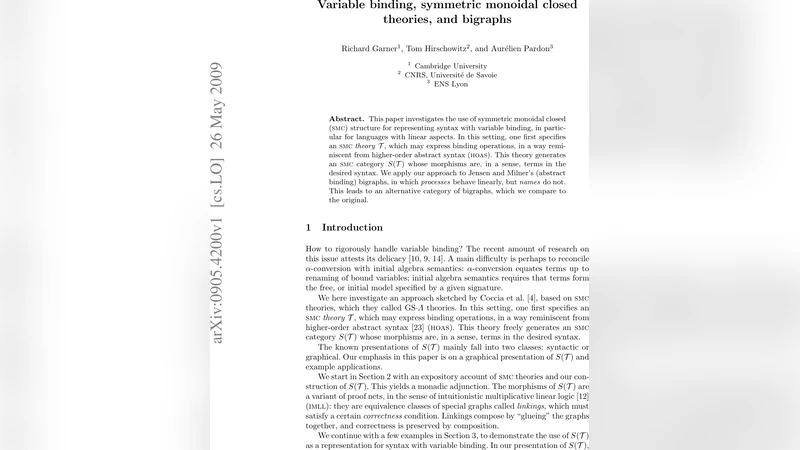
This paper investigates the use of symmetric monoidal closed (SMC) structure for representing syntax with variable binding, in particular for languages with linear aspects. In our setting, one first specifies an SMC theory T, which may express binding operations, in a way reminiscent from higher-order abstract syntax. This theory generates an SMC category S(T) whose morphisms are, in a sense, terms in the desired syntax. We apply our approach to Jensen and Milner’s (abstract binding) bigraphs, which are linear w.r.t. processes. This leads to an alternative category of bigraphs, which we compare to the original.
💡 Research Summary
The paper proposes a novel categorical framework for representing syntactic structures that involve variable binding, with a particular focus on languages that exhibit linear usage of resources. The authors observe that traditional approaches—such as name‑based binding, higher‑order abstract syntax (HOAS), or ad‑hoc linear logic encodings—tend to treat binding and linearity as separate concerns. This separation becomes problematic when one wishes to model languages where the same construct must simultaneously enforce a binding discipline and a linear consumption discipline (for example, the π‑calculus or session‑typed process calculi).
To address this, the authors turn to symmetric monoidal closed (SMC) categories. An SMC theory T consists of a set of base types and a collection of operation symbols, each equipped with an input and output type expressed using the monoidal tensor ⊗ and the internal hom ⊸. The key insight is that the internal hom can be interpreted as a binding operator: a term of type A ⊸ B can be read as “a term that, given a fresh variable of type A, produces a term of type B.” Because the tensor product records parallel composition, the linear usage of resources is automatically enforced by the typing discipline of the SMC: each occurrence of a resource appears exactly once in the tensor context.
From a given theory T the authors construct the free SMC category S(T). The construction proceeds by first defining a normal‑form graphical representation of morphisms (essentially string diagrams built from ⊗ and ⊸ nodes). Two diagrams are identified when they differ only by the structural equations of an SMC (associativity, unit, symmetry, and the adjunction between ⊗ and ⊸). Composition in S(T) is realized by plugging the output wires of one diagram into the input wires of another, respecting the linear discipline. This yields a category whose objects are SMC types and whose morphisms can be read as well‑typed terms with explicit binding structure.
Having built this general machinery, the authors apply it to the theory of abstract binding bigraphs introduced by Jensen and Milner. A bigraph consists of a place graph (capturing nesting of locations) and a link graph (capturing connectivity of names). In the original formulation, the two graphs are combined via a fairly intricate notion of “bigraphical morphism” that must respect name equivalence, scope extrusion, and linearity of edges. By interpreting the place graph as a tensor product of location types and the link graph as an internal‑hom construction, the authors obtain a new category of bigraphs, denoted B_S, that lives inside S(T). In B_S, an interface (a set of outer names) is simply an SMC object, and a bigraph itself is an SMC morphism built from the generating operations of the bigraph theory (e.g., “node”, “edge”, “link”). Composition of bigraphs coincides with the categorical composition in S(T), which automatically enforces the linear use of edges and the correct handling of name binding.
The paper then proves a comparison theorem: the original bigraph category B_original and the SMC‑based category B_S are equivalent on objects, and there is a faithful functor from B_original to B_S that is essentially surjective on morphisms up to the SMC’s structural equations. In other words, B_S provides a more canonical, algebraic presentation of bigraphs where the cumbersome side‑conditions of the original definition become mere consequences of the SMC axioms. Moreover, because S(T) is a free construction, type‑checking a bigraph reduces to a simple syntactic check of well‑formedness of its string diagram, offering potential implementation benefits.
Finally, the authors discuss future directions. They suggest that the SMC approach could be extended to richer settings such as multi‑sorted linear calculi, session‑typed process languages, or even quantum process algebras, where the interplay of binding and linear resource management is even more delicate. They also envision integrating the S(T) construction into existing bigraph tools, thereby providing a mathematically robust backend for simulation and verification. The paper concludes that symmetric monoidal closed categories furnish a unifying semantic foundation for binding‑rich, linear syntaxes, and that the bigraph case study demonstrates the practical payoff of this perspective.
Comments & Academic Discussion
Loading comments...
Leave a Comment