Orthomodular lattices, Foulis Semigroups and Dagger Kernel Categories
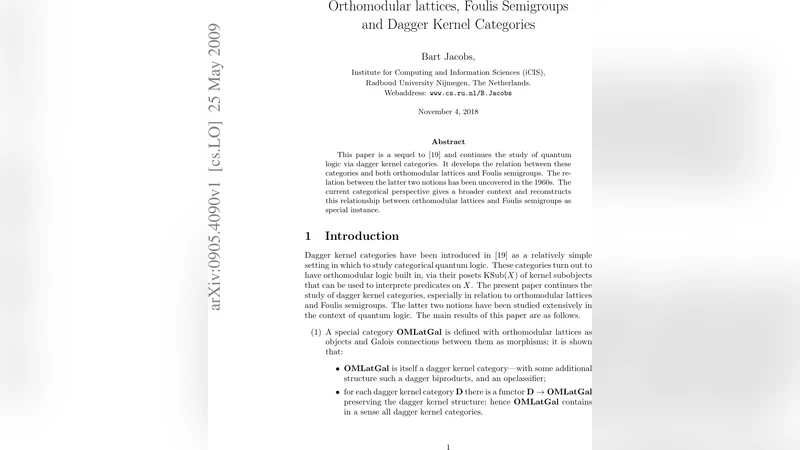
This paper is a sequel to arXiv:0902.2355 and continues the study of quantum logic via dagger kernel categories. It develops the relation between these categories and both orthomodular lattices and Foulis semigroups. The relation between the latter two notions has been uncovered in the 1960s. The current categorical perspective gives a broader context and reconstructs this relationship between orthomodular lattices and Foulis semigroups as special instance.
💡 Research Summary
The paper investigates quantum logic through the lens of dagger kernel categories, extending the authors’ earlier work (arXiv:0902.2355). A dagger kernel category is a category equipped with a dagger functor (an involutive, identity‑on‑objects contravariant endofunctor) and kernels that are stable under the dagger. Such categories naturally model quantum propositions: kernels represent sub‑objects (analogous to subspaces), and the dagger captures adjointness of quantum operations.
The authors first recall the definition and basic properties of dagger kernel categories, emphasizing how kernels give rise to a partial order and how the dagger provides a complement operation. They then turn to orthomodular lattices, the traditional algebraic structure for quantum propositions. By interpreting objects of a dagger kernel category as elements of a lattice and kernels as the lattice’s order relation, they show that the join (∨) corresponds to the categorical sum of kernels, the meet (∧) to their intersection, and the orthocomplement to the dagger of a kernel. This establishes a categorical representation of orthomodular lattices: the lattice axioms are satisfied precisely because kernels behave as sub‑objects in a dagger‑stable environment.
Next, the paper revisits Foulis semigroups, introduced in the 1960s to capture the algebraic interplay between orthomodular lattices and quantum measurements. A Foulis semigroup is a set equipped with a (generally non‑commutative) multiplication and an involution satisfying specific regularity conditions (e.g., a·a†·a = a). The authors demonstrate that the collection of kernels in a dagger kernel category, equipped with composition as multiplication and the dagger as involution, forms a Foulis semigroup. The regularity condition follows directly from the universal property of kernels and the dagger’s involutive nature.
The central results are two equivalences. First, the category of kernels in any dagger kernel category is equivalent to the category of orthomodular lattices with lattice homomorphisms preserving orthocomplement. This equivalence is constructive: given an orthomodular lattice, one can build a dagger kernel category whose kernels reproduce the lattice, and conversely, any dagger kernel category yields an orthomodular lattice of its kernels. Second, the automorphism group of this kernel category (i.e., the set of endofunctors preserving the dagger and kernels) is precisely a Foulis semigroup. Thus, the classical relationship between orthomodular lattices and Foulis semigroups is recovered as a special case of a more general categorical framework.
Beyond the formal equivalences, the authors discuss implications for quantum measurement theory and quantum computation. The dagger kernel structure captures the non‑deterministic, non‑reversible aspects of measurement, while the Foulis semigroup’s multiplication models sequential composition of measurement operations, including the inherent non‑commutativity. Orthomodular lattices, recovered as the lattice of kernels, retain their role as a logic of quantum propositions but now sit inside a richer categorical environment that can express dynamics and transformations.
Finally, the paper outlines future directions: extending dagger kernel categories to model quantum circuits, exploring enriched versions of Foulis semigroups for generalized measurements, and using the categorical equivalence to study completeness and decidability issues in quantum logic. In sum, the work provides a unified algebraic‑categorical picture that bridges orthomodular lattices, Foulis semigroups, and dagger kernel categories, offering new tools for the mathematical foundations of quantum theory.
Comments & Academic Discussion
Loading comments...
Leave a Comment