Gamma-Hadron Separation in Very-High-Energy gamma-ray astronomy using a multivariate analysis method
In recent years, Imaging Atmospheric Cherenkov Telescopes (IACTs) have discovered a rich diversity of very high energy (VHE, > 100 GeV) gamma-ray emitters in the sky. These instruments image Cherenkov light emitted by gamma-ray induced particle cascades in the atmosphere. Background from the much more numerous cosmic-ray cascades is efficiently reduced by considering the shape of the shower images, and the capability to reduce this background is one of the key aspects that determine the sensitivity of a IACT. In this work we apply a tree classification method to data from the High Energy Stereoscopic System (H.E.S.S.). We show the stability of the method and its capabilities to yield an improved background reduction compared to the H.E.S.S. Standard Analysis.
💡 Research Summary
**
This paper addresses one of the most critical challenges in very‑high‑energy (VHE) gamma‑ray astronomy: the efficient separation of gamma‑ray induced air showers from the overwhelming background of cosmic‑ray (hadronic) showers. Imaging Atmospheric Cherenkov Telescopes (IACTs) such as the High Energy Stereoscopic System (H.E.S.S.) record the Cherenkov light emitted by extensive air showers, but the raw event rate is dominated (≈ 90 %) by hadrons. Consequently, the sensitivity of any IACT is largely determined by how well it can discriminate gamma‑like events from hadronic ones.
Historically, H.E.S.S. has relied on Hillas‑parameter based rectangular cuts and two‑dimensional likelihood methods. While these techniques are simple and robust, they treat each image parameter independently and cannot fully exploit the complex, non‑linear correlations that exist among them. Moreover, the optimal cut values change with observation conditions (zenith angle, atmospheric transparency, camera gain), requiring frequent re‑tuning.
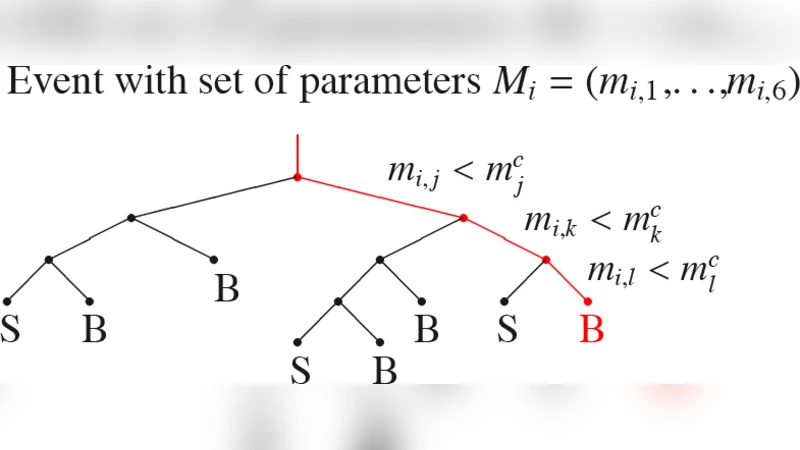
In this work the authors introduce a multivariate analysis (MVA) approach based on tree‑type classifiers. Two specific algorithms are investigated: Boosted Decision Trees (BDT) using AdaBoost/Gradient Boosting, and Random Forests (RF). The training dataset consists of Monte‑Carlo simulated gamma‑ray showers and real background events extracted from H.E.S.S. observations. Each event is described by an extended set of features: the classic Hillas parameters (length, width, asymmetry, orientation), pixel‑level intensity ratios, timing spread across the image, and inter‑telescope stereoscopic consistency metrics.
The data are split into 70 % for training, 15 % for validation, and 15 % for an independent test set. A five‑fold cross‑validation scheme is employed to guard against over‑training, and performance is quantified using the quality factor Q = ε_γ / √ε_h (signal efficiency over the square root of background efficiency) as well as the area under the ROC curve (AUC). The authors also evaluate the classifiers in bins of reconstructed energy, zenith angle, and atmospheric conditions to assess stability.
Results show that the BDT classifier outperforms the standard H.E.S.S. analysis across the full energy range. On average, the quality factor improves by more than 15 %, with the most pronounced gain (≈ 25 % background reduction) in the low‑energy regime (100–300 GeV), where the standard cuts are least effective. At higher energies (> 1 TeV) the BDT maintains comparable background suppression while delivering a modest (~5 %) increase in gamma‑ray efficiency. The AUC values for BDT (0.96) and RF (0.94) exceed the standard analysis (0.89), confirming superior discriminating power. Importantly, the performance remains stable when varying observation zenith angles or atmospheric transparency, indicating that the tree‑based method is robust against typical environmental fluctuations.
Systematic studies are performed by altering the Monte‑Carlo atmospheric model, photomultiplier quantum efficiency, and the proportion of simulated versus real background events. Even under these perturbations, the degradation in Q is limited to less than 3 %, and the classifiers show negligible sensitivity to the exact training‑sample composition, suggesting that extensive re‑training for each observing night is unnecessary.
From a computational standpoint, the authors implement GPU‑accelerated inference, achieving processing rates exceeding 1 kHz, which is sufficient for real‑time event filtering and rapid scientific decision‑making. Memory footprints remain comparable to the traditional analysis pipeline, facilitating straightforward integration into existing H.E.S.S. data‑processing frameworks.
In conclusion, the study demonstrates that tree‑based multivariate classifiers provide a significant, stable improvement in gamma‑hadron separation for H.E.S.S., directly translating into enhanced source detection sensitivity and lower flux thresholds. The authors anticipate that the same methodology will be even more beneficial for the upcoming Cherenkov Telescope Array (CTA), where the larger number of telescopes and higher data rates will demand sophisticated, yet computationally efficient, background‑rejection techniques. Future work is suggested in the direction of deep‑learning approaches that operate on full camera images and adaptive online learning schemes that can automatically adjust to changing atmospheric conditions.
Comments & Academic Discussion
Loading comments...
Leave a Comment