Optimal byzantine resilient convergence in oblivious robot networks
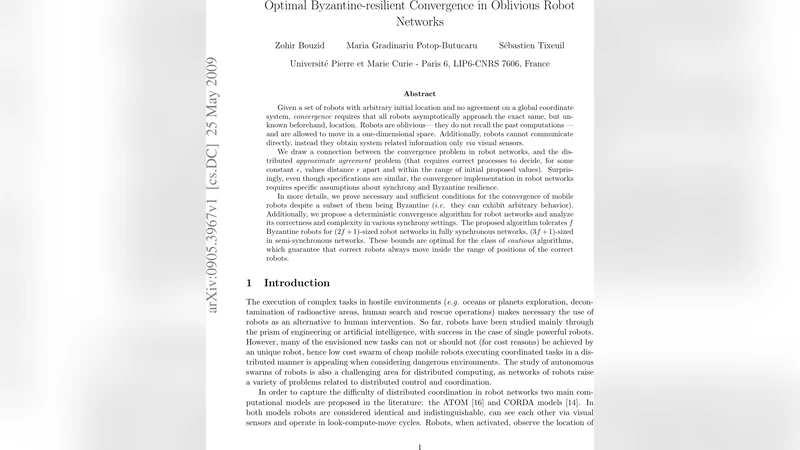
Given a set of robots with arbitrary initial location and no agreement on a global coordinate system, convergence requires that all robots asymptotically approach the exact same, but unknown beforehand, location. Robots are oblivious– they do not recall the past computations – and are allowed to move in a one-dimensional space. Additionally, robots cannot communicate directly, instead they obtain system related information only via visual sensors. We draw a connection between the convergence problem in robot networks, and the distributed \emph{approximate agreement} problem (that requires correct processes to decide, for some constant $\epsilon$, values distance $\epsilon$ apart and within the range of initial proposed values). Surprisingly, even though specifications are similar, the convergence implementation in robot networks requires specific assumptions about synchrony and Byzantine resilience. In more details, we prove necessary and sufficient conditions for the convergence of mobile robots despite a subset of them being Byzantine (i.e. they can exhibit arbitrary behavior). Additionally, we propose a deterministic convergence algorithm for robot networks and analyze its correctness and complexity in various synchrony settings. The proposed algorithm tolerates f Byzantine robots for (2f+1)-sized robot networks in fully synchronous networks, (3f+1)-sized in semi-synchronous networks. These bounds are optimal for the class of cautious algorithms, which guarantee that correct robots always move inside the range of positions of the correct robots.
💡 Research Summary
This paper investigates the convergence problem for a set of mobile robots that operate in a one‑dimensional space without any common coordinate system and without memory of past computations (oblivious robots). The robots can only perceive the positions of others through visual sensors; there is no explicit communication. The authors draw a formal connection between this geometric convergence task and the classic distributed approximate agreement problem, where correct processes must decide on values that are within a fixed ε‑distance of each other and lie inside the convex hull of the initial proposals.
The main contribution is a complete characterization of the conditions under which convergence is possible when a subset of the robots may behave Byzantine, i.e., they can act arbitrarily or maliciously. Two standard synchrony models are considered: fully synchronous (FSYNC), where every robot executes the LOOK‑COMPUTE‑MOVE cycle simultaneously, and semi‑synchronous (SSYNC), where in each round only an arbitrary subset of robots is activated. For each model the authors prove a necessary lower bound on the total number of robots n in terms of the maximum number f of Byzantine robots that can be tolerated, and they present a deterministic algorithm that meets these bounds.
In the FSYNC setting the paper shows that n ≥ 2f + 1 is necessary and sufficient. The intuition is that, if fewer than 2f + 1 robots are present, the Byzantine robots can dominate the observed extremal positions and force correct robots to move outside the convex hull of the correct ones, breaking convergence. With at least 2f + 1 robots, each correct robot can discard the f smallest and f largest observed positions, guaranteeing that the remaining interval contains only correct robots. By moving to the midpoint of this “trusted interval,” the diameter of the correct robots’ positions shrinks by at least a factor of two each round, guaranteeing asymptotic convergence.
In the SSYNC model the situation is more delicate because only a subset of robots participates in each round. The authors prove that n ≥ 3f + 1 is both necessary and sufficient. The extra factor accounts for the worst‑case activation pattern in which Byzantine robots may be active while only f + 1 correct robots are active, which would otherwise prevent sufficient contraction of the correct interval. The same discard‑extremes strategy, combined with the guarantee that at least f + 1 correct robots are simultaneously active in any round (a property of the SSYNC scheduler), yields a contraction factor that again leads to convergence.
A key technical notion introduced is that of a “cautious” algorithm: a correct robot never moves outside the current range of positions occupied by correct robots. The authors prove that any algorithm that is not cautious can be forced by Byzantine robots to diverge, and therefore the lower bounds derived above are optimal for the whole class of cautious algorithms. The presented algorithm is deterministic, requires only O(n log n) time per round (to sort the observed positions), and uses O(n) memory. No explicit message passing is needed, and the physical movement cost is proportional to the distance to the midpoint of the trusted interval.
The paper also includes a rigorous correctness proof. First, it shows that the trusted interval always contains all correct robots (safety). Second, it demonstrates that the interval’s diameter decreases geometrically, which yields convergence (liveness). The authors discuss the tightness of the bounds, argue that any improvement would require abandoning the cautious property, and outline possible directions for future work, such as extending the results to higher‑dimensional spaces, exploring non‑cautious (aggressive) strategies, and implementing the algorithm on real robot platforms to assess practical performance under sensor noise and actuation errors.
Overall, the work delivers a clear theoretical foundation for Byzantine‑resilient convergence in oblivious robot networks, establishes optimal size requirements for both fully synchronous and semi‑synchronous environments, and provides a concrete algorithm that meets these limits while remaining simple enough for practical deployment.
Comments & Academic Discussion
Loading comments...
Leave a Comment