Module theory over Leavitt path algebras and $K$-theory
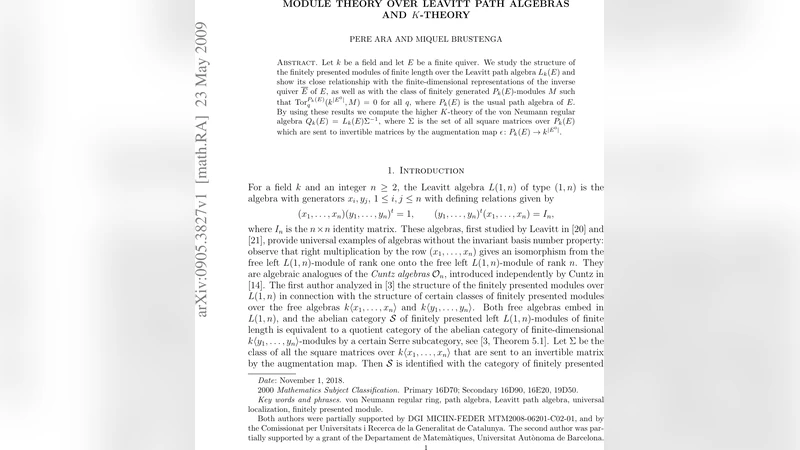
Let $k$ be a field and let $E$ be a finite quiver. We study the structure of the finitely presented modules of finite length over the Leavitt path algebra $L_k (E)$ and show its close relationship with the finite-dimensional representations of the inverse quiver $\overline{E}$ of $E$, as well as with the class of finitely generated $P_k(E)$-modules $M$ such that ${\rm Tor}_q^{P_k (E)}(k^{|E^0|},M)=0$ for all $q$, where $P_k(E)$ is the usual path algebra of $E$. By using these results we compute the higher $K$-theory of the von Neumann regular algebra $Q_k (E)=L_k (E)\Sigma^{-1}$, where $\Sigma $ is the set of all square matrices over $P_k (E)$ which are sent to invertible matrices by the augmentation map $\epsilon \colon P_k (E)\to k^{|E^0|}$.
💡 Research Summary
The paper investigates the module theory of Leavitt path algebras associated with a finite quiver E over a field k and uses these results to compute the higher algebraic K‑theory of a related von Neumann regular algebra. After recalling the definition of the Leavitt path algebra Lₖ(E) and its basic properties (notably its regularity despite being built from a non‑invertible path algebra), the authors focus on the subcategory ℱ consisting of finitely presented Lₖ(E)‑modules of finite length. They prove that ℱ is equivalent to the category of finite‑dimensional representations of the opposite quiver \overline{E}. The equivalence is constructed by tensoring a module M∈ℱ with the augmentation module k^{|E⁰|} over Lₖ(E); the resulting vector space inherits a natural \overline{E}‑module structure, and this process is fully faithful and essentially surjective.
The second major component introduces the ordinary path algebra Pₖ(E) together with the augmentation map ε : Pₖ(E)→k^{|E⁰|}. The set Σ consists of all square matrices over Pₖ(E) that become invertible after applying ε. Localising Pₖ(E) at Σ yields a ring Σ⁻¹Pₖ(E) which the authors identify with the Leavitt path algebra Lₖ(E). This identification allows them to translate properties of Lₖ(E)‑modules into statements about Pₖ(E)‑modules. In particular, they establish a Tor‑vanishing criterion: a finitely generated Pₖ(E)‑module M satisfies Tor_q^{Pₖ(E)}(k^{|E⁰|}, M)=0 for every q≥0 if and only if M belongs to ℱ (equivalently, if M is ε‑flat). This criterion characterises ℱ as precisely the class of modules that become projective after localisation at Σ.
With the module-theoretic groundwork in place, the authors turn to the computation of higher K‑theory. They consider the von Neumann regular algebra Qₖ(E)=Lₖ(E)Σ⁻¹, obtained by inverting the same set Σ inside Lₖ(E). Because Qₖ(E) is regular and, in fact, semisimple, its K‑groups are accessible. The authors show that K₀(Qₖ(E)) is a free abelian group of rank equal to the number c(E) of strongly connected components of the underlying graph, i.e., K₀(Qₖ(E))≅ℤ^{c(E)}. The group K₁(Qₖ(E)) is generated by the cycles of E; each independent cycle contributes a copy of ℤ, so K₁(Qₖ(E))≅ℤ^{β₁(E)} where β₁(E) is the first Betti number of the graph. For n≥2, regularity implies that Kₙ(Qₖ(E))≅Kₙ(Pₖ(E)), and the latter are known from classical results on path algebras. Consequently, the higher K‑theory of Qₖ(E) is completely determined by elementary combinatorial data of the quiver.
The paper concludes by emphasizing the conceptual significance of the equivalence between ℱ and Repₖ(\overline{E}) and the Tor‑vanishing condition. This bridge allows one to replace the often‑intractable non‑regular Leavitt path algebra by a regular localisation where K‑theory calculations become elementary. Moreover, the approach suggests a general strategy for handling K‑theory of other non‑regular algebras built from combinatorial data: identify a suitable flatness/Tor condition, pass to a regular localisation, and exploit the resulting semisimple structure. The results thus enrich the interplay between graph algebras, representation theory, and algebraic K‑theory, opening avenues for further exploration of non‑commutative spaces arising from directed graphs.
Comments & Academic Discussion
Loading comments...
Leave a Comment