Desperately seeking mathematical proof
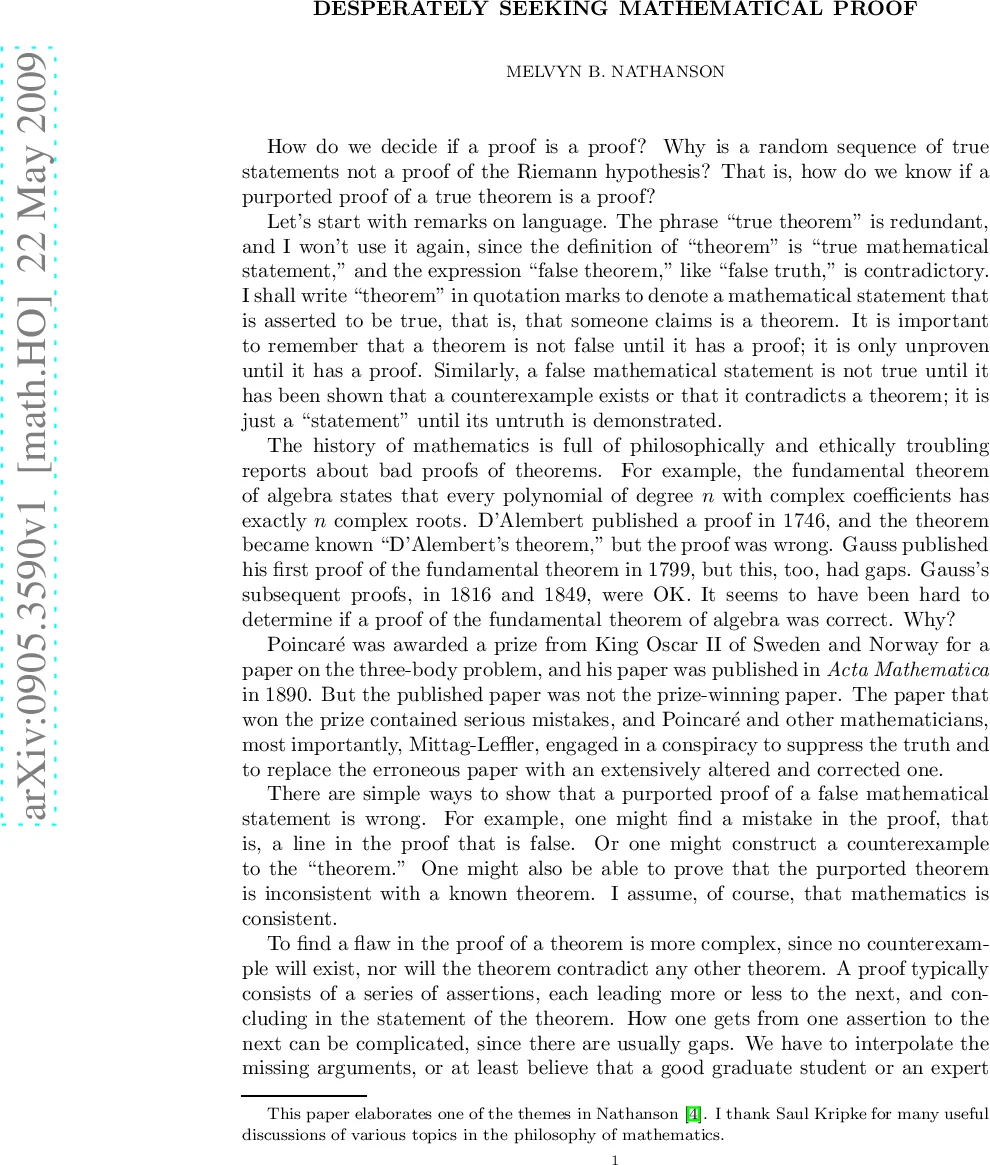
Remarks on mathematical proof and the practice of mathematics.
💡 Research Summary
Melvyn B. Nathanson’s essay “Desperately Seeking Mathematical Proof” is a reflective meditation on what it means for a mathematical argument to be a proof, why proofs can be unreliable, and how the mathematical community’s social practices shape our confidence in results. He begins by clarifying terminology: a “theorem” is, by definition, a true statement, whereas a “claimed theorem” is merely a statement that someone asserts to be true. Until a proof is supplied, a theorem remains unproved; similarly, a false statement remains a mere statement until a counterexample or contradiction is exhibited.
Historical anecdotes illustrate the difficulty of judging correctness. D’Alembert’s 1746 proof of the Fundamental Theorem of Algebra was wrong; Gauss’s early proofs also contained gaps, only later versions becoming acceptable. Poincaré’s prize‑winning paper on the three‑body problem was initially published with serious errors, and a conspiratorial effort replaced it with a corrected version. These cases show that even celebrated results can survive for decades with hidden flaws.
Nathanson emphasizes that a proof is a chain of assertions, and gaps—implicit steps that the author expects the reader to fill—are ubiquitous. He cites Massey’s textbook, where the author leaves the precise statement and proof of a characterization of π₁(X) to the reader, trusting that a competent graduate student can interpolate the missing arguments. Such gaps are not inherently wrong, but they make verification dependent on the reader’s expertise.
Human error is another source of unreliability. Quoting Hume, Nathanson notes that even the most expert mathematician cannot place absolute confidence in a result without peer scrutiny. Confidence grows with repeated checking and communal approval.
A central theme is the distinction between “elementary” and “non‑elementary” proofs. By “elementary” he does not mean restricted to elementary number theory, but rather proofs that are easy to check and therefore less prone to hidden mistakes. Complex analytic or cohomological arguments may establish a theorem, but a later elementary proof often provides deeper insight and greater reliability. He argues that the mathematical community values short, elegant proofs, sometimes more than the original, longer ones, and that the “Book proof”—the ideal, perfectly clear proof—remains a quasi‑religious aspiration.
Social dynamics in seminars are examined. Frequently, speakers claim steps are “obvious,” discouraging questions; audiences often remain silent, applauding despite limited understanding. By contrast, Gel’fand’s seminars were interactive, with constant interruptions and elementary examples, fostering genuine comprehension. Such practices influence whether gaps are exposed or concealed.
Philosophically, Nathanson aligns with a realist view: mathematical objects exist in an external world, and mathematics is the science of discovering their properties, akin to physics. This stands opposed to a formalist view that treats mathematics as a game played with arbitrary axioms. He quotes Wittgenstein to illustrate that even a discovered contradiction would lead us to modify our conception of arithmetic rather than abandon it outright.
Finally, he likens the body of mathematical knowledge to a social network of clans and kinship structures. New theorems that fit comfortably into existing structures are readily accepted, whereas “outsider” results demand more rigorous proofs and face greater resistance.
In sum, the paper argues that proofs are inherently incomplete and sometimes erroneous; their reliability depends on the ease of verification, the social mechanisms of peer review, and the philosophical stance that mathematics describes a real, albeit not fully axiomatizable, world. Mathematics, therefore, is a living discipline that balances deductive rigor with pragmatic, community‑driven validation.
Comments & Academic Discussion
Loading comments...
Leave a Comment