SimClust - A Program to Simulate Star Clusters
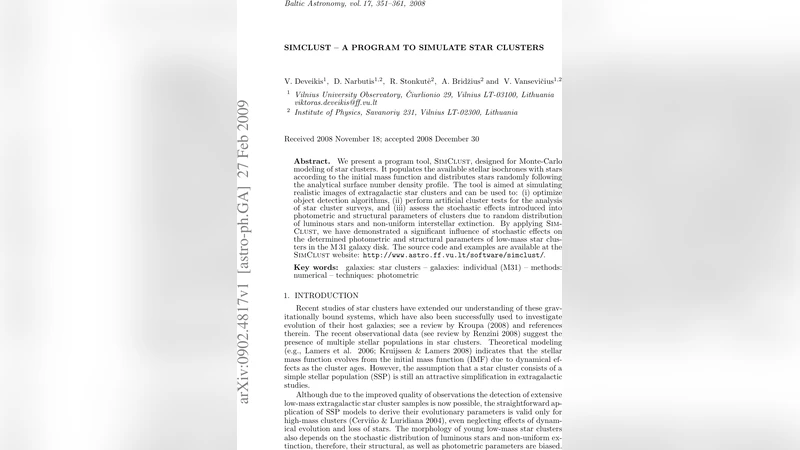
We present a program tool, SimClust, designed for Monte-Carlo modeling of star clusters. It populates the available stellar isochrones with stars according to the initial mass function and distributes stars randomly following the analytical surface number density profile. The tool is aimed at simulating realistic images of extragalactic star clusters and can be used to: (i) optimize object detection algorithms, (ii) perform artificial cluster tests for the analysis of star cluster surveys, and (iii) assess the stochastic effects introduced into photometric and structural parameters of clusters due to random distribution of luminous stars and non-uniform interstellar extinction. By applying SimClust, we have demonstrated a significant influence of stochastic effects on the determined photometric and structural parameters of low-mass star clusters in the M31 galaxy disk. The source code and examples are available at the SimClust website: http://www.astro.ff.vu.lt/software/simclust/
💡 Research Summary
The paper introduces SimClust, a Monte‑Carlo based software package designed to generate realistic synthetic images of unresolved star clusters in external galaxies. The workflow begins with the selection of a stellar isochrone set (e.g., Padova, BaSTI) that matches the desired age and metallicity. Users then specify an initial mass function (IMF) – such as Kroupa or Salpeter – and either a total cluster mass or a target number of stars. The program draws stellar masses from the IMF, maps each mass onto the chosen isochrone, and thus assigns absolute magnitudes and colours to every synthetic star.
Spatial distribution follows analytical surface‑density profiles (e.g., spherical King, elliptical Plummer, or custom profiles). By providing core radius, concentration, ellipticity, and centre coordinates, SimClust randomly places stars in two‑dimensional space using a high‑quality random number generator. Optional features include a minimum inter‑stellar separation, addition of a uniform background field, and spatially varying extinction to mimic non‑uniform dust lanes.
The imaging stage incorporates instrumental characteristics: filter transmission curves, point‑spread functions, detector gain, read‑out noise, and sky background. Each synthetic star is convolved with the PSF and its flux is converted to pixel values, after which extinction and background are applied. The final product is a FITS image that can be fed directly into standard photometric pipelines.
Three primary scientific applications are highlighted. First, SimClust can be used to benchmark and optimise automated cluster detection algorithms by injecting large numbers of artificial clusters into real survey images and measuring completeness and false‑positive rates. Second, it enables artificial‑cluster tests for large‑scale surveys (e.g., PHAT, LEGUS), allowing researchers to quantify selection biases and construct completeness functions as a function of cluster mass, age, and crowding. Third, and most importantly, the code quantifies stochastic sampling effects: in low‑mass clusters a handful of luminous stars dominate the integrated light, causing significant scatter in colour and magnitude that is not captured by deterministic simple‑stellar‑population (SSP) models. By running many realisations with identical physical parameters, SimClust provides both the statistical dispersion and systematic bias of derived photometric and structural parameters.
The authors demonstrate the impact of stochasticity on a sample of low‑mass clusters (10³–10⁴ M⊙) in the M31 disk. Simulated clusters with the same true age and mass exhibit colour variations up to ±0.3 mag and core‑radius fluctuations of 10–20 % solely due to random placement of bright stars. These variations translate into substantial uncertainties when fitting observed photometry with SSP models, underscoring the necessity of accounting for stochastic effects in extragalactic cluster studies.
SimClust is released under an open‑source GPL license, with source code, documentation, and example scripts available at http://www.astro.ff.vu.lt/software/simclust/. The package is modular, allowing users to extend it with custom IMF prescriptions, alternative surface‑density laws, or instrument models, making it a versatile tool for the broader community engaged in star‑cluster analysis.
Comments & Academic Discussion
Loading comments...
Leave a Comment