Accuracy of Star Cluster Parameters from Integrated UBVRIJHK Photometry
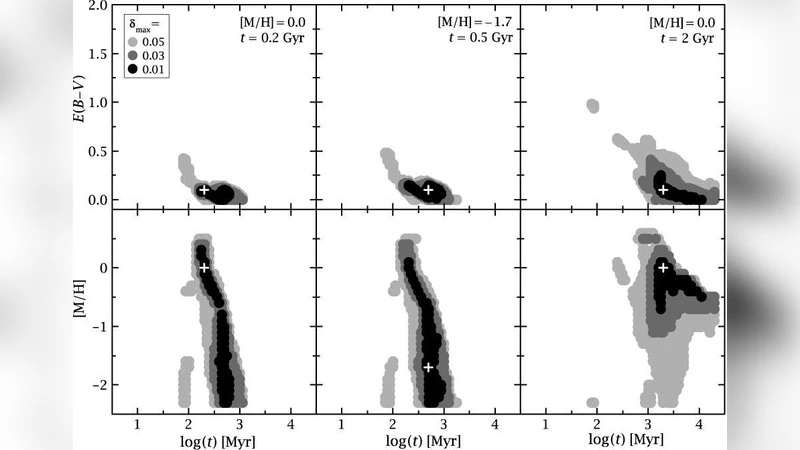
We investigate the capability of the UBVRIJHK photometric system to quantify star clusters in terms of age, metallicity and color excess by their integrated photometry in the framework of PEGASE single stellar population (SSP) models. The age-metallicity-extinction degeneracy was analyzed for various parameter combinations, assuming different levels of photometric accuracy. We conclude, that most of the parameter degeneracies, typical to the UBVRI photometric system, are broken in the case when the photometry data are supplemented with at least one infrared magnitude of the JHK passbands, with an accuracy better than ~0.05 mag. The presented analysis with no preassumptions on the distribution of photometric errors of star cluster models, provides estimate of the intrinsic capability of any photometric system to determine star cluster parameters from integrated photometry.
💡 Research Summary
The paper investigates how well the combined UBVRIJHK photometric system can recover the fundamental parameters of unresolved star clusters—age, metallicity, and line‑of‑sight extinction—using only integrated broadband magnitudes. The authors adopt the PEGASE single‑stellar‑population (SSP) framework to generate a dense grid of synthetic clusters spanning ages from a few Myr to 13 Gyr, metallicities from
Comments & Academic Discussion
Loading comments...
Leave a Comment