From vectors to mnesors
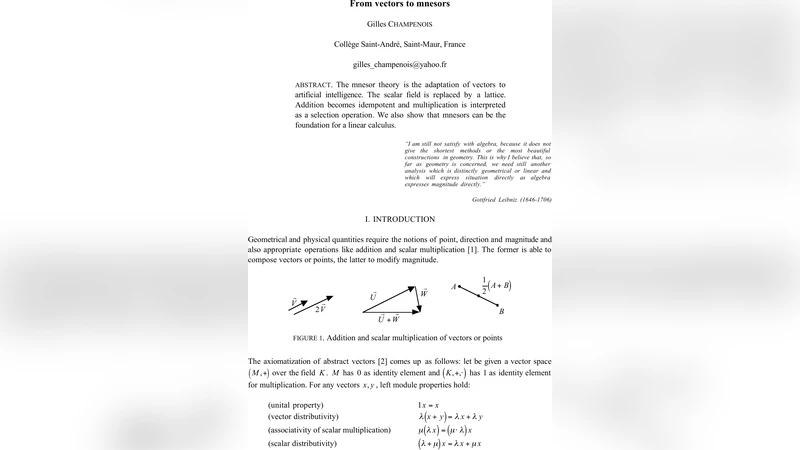
The mnesor theory is the adaptation of vectors to artificial intelligence. The scalar field is replaced by a lattice. Addition becomes idempotent and multiplication is interpreted as a selection operation. We also show that mnesors can be the foundation for a linear calculus.
💡 Research Summary
The paper proposes a novel algebraic structure called a “mnesor” that adapts the classical vector space framework to the needs of artificial intelligence and information processing. In traditional linear algebra a vector space is built over a scalar field K, with addition and scalar multiplication governing magnitude and direction. The author argues that for information‑centric tasks, precision and ordering are more relevant than magnitude, and therefore replaces the scalar field with a lattice L equipped with join (⊕) and meet (⊗) operations. Elements of L are called “granulars” and act as filters rather than scaling factors.
A mnesor space consists of a monoid (M, +) with identity 0 and a lattice (L, ⊕, ⊗) with top element τ (and optionally a bottom ε). The fundamental axioms are:
- Unital property: x τ = x for any mnesor x.
- Mnesor distributivity: (x + y) λ = x λ + y λ for any granular λ.
- Associativity of granular multiplication: x λ μ = x (λ ⊗ μ).
- Granular distributivity: x λ + x μ = x (λ ⊕ μ).
From these axioms several key properties follow. First, addition is idempotent: x + x = x. This reflects the fact that merging identical information does not create redundancy. Second, a “priority” law holds: x + y + x = x + y, meaning that once an element is present it cannot be re‑added to change the result. Third, the notion of a prefix (or suffix) is introduced: if a = x + y then x is a prefix of a and y a suffix. The relation “x is a prefix of y” is equivalent to x + y = y and defines a partial order ≤ on M. This order is compatible with both addition and granular multiplication: if x ≤ y then x + a ≤ y + a and x λ ≤ y λ for any a∈M, λ∈L. Moreover, every mnesor is non‑negative (x ≥ 0) because 0 + x = x.
A crucial absorption property states that for any x, y∈M there exists a granular α such that (x + y) α = x. This replaces the usual subtraction in vector spaces; α acts as a filter that removes the contribution of y while preserving x.
The paper further defines stabilizers and annihilators. A granular λ is a stabilizer of x if x λ = x; τ is always a stabilizer, and the set of all stabilizers of x forms a sublattice τₓ of L. Dually, λ is an annihilator of x if x λ = 0; the annihilators also constitute a sublattice εₓ. If L possesses a bottom element ε, then x ε = 0 for every x, providing a universal annihilator.
Illustrative examples use column vectors of country names. The lattice elements represent intergovernmental organizations such as the EU, NATO, or the United Nations. Multiplying a column vector by EU retains only the countries that belong to the EU, demonstrating the filtering interpretation of granular multiplication. The non‑commutativity of addition is shown by ordering the entries differently; the result depends on the order because the column list preserves sequence.
Overall, the mnesor framework reinterprets linear operations as information‑oriented processes: addition becomes an aggregation that automatically eliminates duplicates, and granular multiplication becomes a selective filter governed by a lattice of predicates. By establishing a coherent algebraic system with well‑defined identities, distributivity, and order properties, the paper lays the groundwork for a “linear calculus” suitable for AI applications such as knowledge representation, database querying, and reasoning systems. Future work is suggested to develop algorithms that exploit mnesor algebra and to explore concrete applications in semantic networks and constraint solving.
Comments & Academic Discussion
Loading comments...
Leave a Comment