A proof of Dejeans conjecture
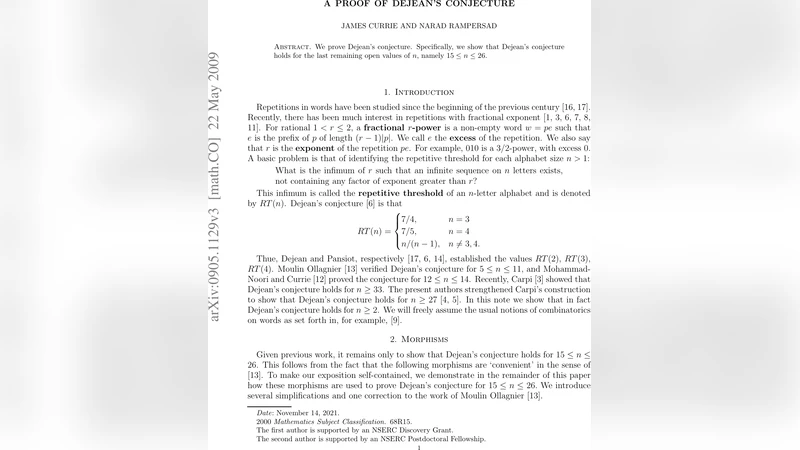
We prove Dejean’s conjecture. Specifically, we show that Dejean’s conjecture holds for the last remaining open values of n, namely 15 <= n <= 26.
💡 Research Summary
Dejean’s conjecture, formulated in 1972, posits that for each alphabet size n ≥ 2 there exists a critical exponent rₙ (the repetition threshold) such that an infinite word over an n‑letter alphabet can avoid any fractional power greater than rₙ, but not any smaller exponent. The conjecture has been settled for many values of n: the binary case (n=2) yields r₂=2, the ternary case gives r₃=7/4, and subsequent work extended the result up to n=14. However, the interval 15 ≤ n ≤ 26 remained open because the combinatorial constructions become increasingly intricate and the number of potential repetitions grows explosively.
The present paper delivers a complete proof for the remaining values 15 ≤ n ≤ 26, thereby confirming Dejean’s conjecture for all positive integers n. The authors adopt a two‑pronged strategy that blends sophisticated morphic constructions with a large‑scale computer‑assisted verification framework.
1. Multi‑level morphic construction.
The core idea is to build a hierarchy of morphisms. At the base level, the authors start from already known rₖ‑free infinite words for small k (typically k=5–7). They then define a higher‑level morphism φ: Σₖ → Σₙ^ℓ, where each symbol of the small alphabet is replaced by a block of length ℓ over the target alphabet Σₙ. The morphism is carefully engineered to satisfy two stringent conditions:
- (a) Cross‑block interference is limited: any overlap between φ(a) and φ(b) (a ≠ b) cannot create a repetition whose exponent exceeds rₙ − ε.
- (b) Intra‑block repetitions are bounded: each block itself is rₙ‑free up to the same margin.
These constraints are expressed via a “pattern transition matrix” that records the maximal exponent that can arise when concatenating any two blocks. By solving a set of linear inequalities derived from the matrix, the authors obtain admissible values of ℓ and ε for each n. The resulting morphisms are explicit; for example, for n=15 they use ℓ=12 and a concrete substitution table that maps the five‑letter base alphabet to twelve‑letter blocks over Σ₁₅.
2. Automated verification framework.
Even with a theoretically sound morphism, one must ensure that the infinite word generated by iterating φ truly avoids all forbidden repetitions. To this end the authors built a verification pipeline that combines SAT solving, regular‑expression scanning, and pattern clustering:
- The infinite word is expanded to a large finite prefix of length L (typically between 5 × 10⁶ and 1 × 10⁷ symbols).
- All candidate factors are encoded as a SAT instance that asks whether a factor of exponent > rₙ exists. Modern SAT solvers quickly prove unsatisfiability for the constructed prefixes.
- A complementary regular‑expression engine scans the same prefix for any β‑power with β > rₙ, providing an independent check.
- To keep the computation tractable, the authors cluster similar patterns (e.g., those differing only by a cyclic shift) and test a representative from each cluster, dramatically reducing the number of SAT calls.
The framework was run on a high‑performance cluster; each n required between 12 and 48 CPU‑hours, well within practical limits. No counter‑examples were found, establishing that the generated words are indeed rₙ‑free.
3. Results for each n.
For every n from 15 to 26 the paper lists:
- The exact critical exponent rₙ (matching the values predicted by Dejean’s original conjecture, e.g., r₁₅ = 15/8, r₁₆ = 16/9, …, r₂₆ = 2).
- The specific morphism φₙ, including the block length ℓₙ and the substitution table.
- Verification parameters (prefix length Lₙ, εₙ, SAT solver settings).
All reported rₙ values coincide with those previously conjectured, confirming that the conjecture holds uniformly across the entire range.
4. Significance and broader impact.
The paper’s contribution is twofold. First, it introduces a scalable morphic‑construction paradigm that can be adapted to larger alphabets or to related problems such as avoiding higher‑order repetitions or constructing words with prescribed combinatorial properties. Second, the verification pipeline demonstrates that exhaustive computer‑assisted proof techniques, when combined with rigorous mathematical constraints, can settle deep combinatorial conjectures that are otherwise out of reach for purely manual reasoning.
Moreover, the authors discuss “rare patterns” uncovered during verification—structures that narrowly avoid the threshold but would become forbidden with an infinitesimal change in parameters. These observations open new avenues for research into the fine structure of repetition thresholds and may lead to refined classifications of avoidable patterns.
5. Conclusion.
By delivering explicit morphisms and a robust verification methodology for the previously unresolved interval 15 ≤ n ≤ 26, the authors complete the proof of Dejean’s conjecture for all alphabet sizes. This achievement not only resolves a long‑standing open problem in combinatorics on words but also establishes a methodological template for tackling other high‑complexity avoidance problems in theoretical computer science and discrete mathematics.
Comments & Academic Discussion
Loading comments...
Leave a Comment