Kolkata Paise Restaurant Problem in Some Uniform Learning Strategy Limits
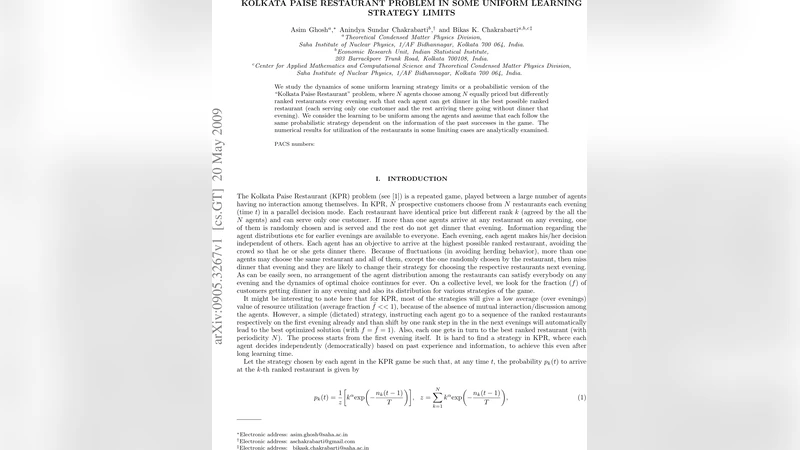
We study the dynamics of some uniform learning strategy limits or a probabilistic version of the “Kolkata Paise Restaurant” problem, where N agents choose among N equally priced but differently ranked restaurants every evening such that each agent can get dinner in the best possible ranked restaurant (each serving only one customer and the rest arriving there going without dinner that evening). We consider the learning to be uniform among the agents and assume that each follow the same probabilistic strategy dependent on the information of the past successes in the game. The numerical results for utilization of the restaurants in some limiting cases are analytically examined.
💡 Research Summary
The paper revisits the Kolkata Paise Restaurant (KPR) problem, a stylized model of decentralized resource allocation in which N agents each day must select one of N restaurants that are identical in price but differ in rank. Each restaurant can serve only a single customer; agents who arrive at an already occupied restaurant receive no dinner. The authors focus on a probabilistic version of the game in which all agents adopt the same learning rule, i.e., a uniform learning strategy, and they investigate how the collective utilization of restaurants evolves under various limiting cases of this rule.
The core of the model is a reinforcement‑type update of the selection probabilities. Let p_i(t) denote the probability that an agent chooses restaurant i at day t, and let s_i(t) be the cumulative number of successful assignments to restaurant i up to day t. The total number of successes is S(t)=∑_j s_j(t). The authors propose a linear mixing update:
p_i(t+1) = (1−α) p_i(t) + α ·
Comments & Academic Discussion
Loading comments...
Leave a Comment