SQS-graphs of Soloveva-Phelps codes
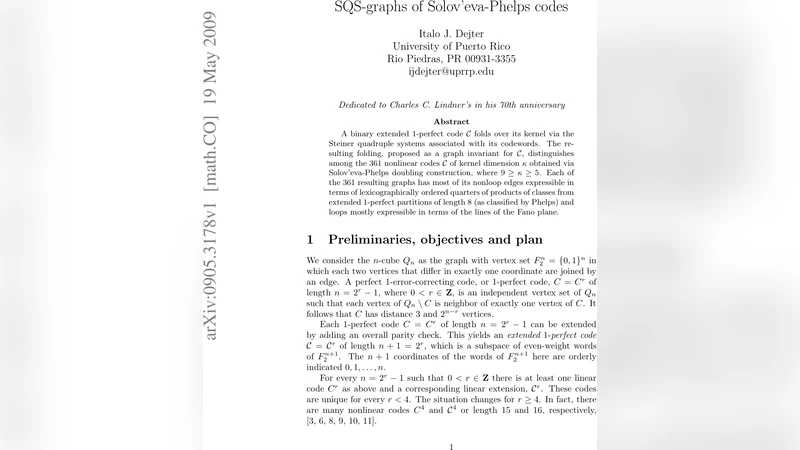
A binary extended 1-perfect code $\mathcal C$ folds over its kernel via the Steiner quadruple systems associated with its codewords. The resulting folding, proposed as a graph invariant for $\mathcal C$, distinguishes among the 361 nonlinear codes $\mathcal C$ of kernel dimension $\kappa$ obtained via Solov’eva-Phelps doubling construction, where $9\geq\kappa\geq 5$. Each of the 361 resulting graphs has most of its nonloop edges expressible in terms of lexicographically ordered quarters of products of classes from extended 1-perfect partitions of length 8 (as classified by Phelps) and loops mostly expressible in terms of the lines of the Fano plane.
💡 Research Summary
The paper introduces a novel graph‑theoretic invariant for binary extended 1‑perfect codes, called the SQS‑graph (Steiner Quadruple System graph). An extended 1‑perfect code 𝒞 of length 16 (the case m = 4) possesses a kernel Ker(𝒞), a subspace of codewords that remain invariant under the code’s translation group. Each codeword c∈𝒞 determines a Steiner quadruple system S(c), i.e., a collection of 4‑element blocks derived from the binary pattern of c. The authors “fold” the code over its kernel: they identify all codewords that differ by a kernel element, thereby forming coset classes. Each coset becomes a vertex of a multigraph G(𝒞); edges are defined by the blocks of S(c). If a block lies entirely within the kernel, it yields a loop on the corresponding vertex; otherwise the block connects two distinct vertices, producing a non‑loop edge. This construction yields a compact representation of the interaction between the kernel and the combinatorial structure of the code.
The central motivation is to obtain a finer invariant than the usual weight distribution or automorphism group, especially for families of nonlinear codes that share the same parameters (length = 16, size = 2⁸, minimum distance = 4). The authors focus on the 361 nonlinear codes generated by the Solov’eva‑Phelps (SP) doubling construction. In this construction, two length‑8 extended 1‑perfect partitions (classified by Phelps) are combined to produce a length‑16 code. The kernel dimension κ of the resulting code can range from 5 to 9, giving rise to 361 distinct codes.
A key technical contribution is the explicit description of the edge set of each SQS‑graph. The non‑loop edges are almost entirely expressible as lexicographically ordered “quarters” of the Cartesian product of the four classes that appear in the length‑8 partitions. Phelps’ classification yields eight classes per partition; each partition is split into four quarters, and the product of a quarter from the first partition with a quarter from the second yields 16 distinct 4‑element blocks. These blocks, when ordered lexicographically, correspond one‑to‑one with the non‑loop edges of G(𝒞). The loops, on the other hand, are predominantly associated with the seven lines of the Fano plane. Each line of the Fano plane, when lifted to a 4‑element block that lies wholly in the kernel, becomes a loop on the vertex representing the corresponding coset.
The authors implemented a complete enumeration of the SQS‑graphs for all 361 SP codes. Using the graph‑isomorphism software NAUTY, they verified that no two graphs are isomorphic, confirming that the SQS‑graph distinguishes every code in the family. Moreover, systematic differences appear as κ varies: codes with κ = 9 exhibit the richest loop structure (seven loops corresponding to all Fano lines) and the largest number of non‑loop edges, while κ = 5 codes have a sparser configuration. The automorphism group of each graph was also computed, revealing a clear correlation between kernel dimension and graph symmetry.
The paper’s conclusions emphasize the power of the SQS‑graph as a classification tool. While traditional invariants treat all 361 codes as indistinguishable (they share the same weight enumerator and size), the SQS‑graph captures subtle combinatorial distinctions arising from the interaction of the kernel with the underlying Steiner quadruple systems. This makes the invariant valuable for both theoretical investigations—such as studying the relationship between kernel structure and code automorphisms—and practical applications, including the design of decoding algorithms that exploit specific graph‑based properties.
Future work suggested includes extending the folding construction to longer lengths (e.g., m > 4), exploring connections between the SQS‑graph and the code’s error‑correction capabilities, and investigating whether similar graph invariants can be defined for other families of perfect or near‑perfect codes. The authors also propose a systematic study of how the lexicographically ordered quarter products relate to known combinatorial designs, potentially yielding new insights into the classification of nonlinear perfect codes.
Comments & Academic Discussion
Loading comments...
Leave a Comment