A constructive proof of the general Lovasz Local Lemma
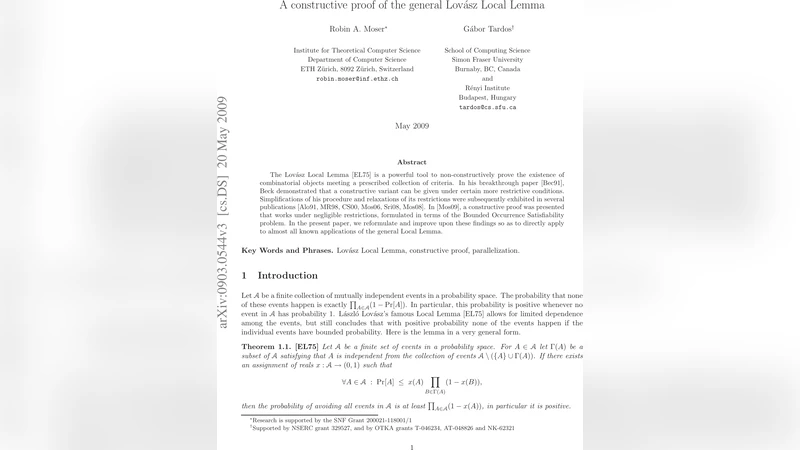
The Lovasz Local Lemma [EL75] is a powerful tool to non-constructively prove the existence of combinatorial objects meeting a prescribed collection of criteria. In his breakthrough paper [Bec91], Beck demonstrated that a constructive variant can be given under certain more restrictive conditions. Simplifications of his procedure and relaxations of its restrictions were subsequently exhibited in several publications [Alo91, MR98, CS00, Mos06, Sri08, Mos08]. In [Mos09], a constructive proof was presented that works under negligible restrictions, formulated in terms of the Bounded Occurrence Satisfiability problem. In the present paper, we reformulate and improve upon these findings so as to directly apply to almost all known applications of the general Local Lemma.
💡 Research Summary
The paper revisits the Lovász Local Lemma (LLL), a cornerstone of probabilistic combinatorics that guarantees the existence of objects avoiding a collection of “bad” events when those events are only weakly dependent. While the classic LLL is non‑constructive, Beck’s 1991 breakthrough introduced a constructive algorithm based on selective resampling, but his method required a very strong condition on the product of event probabilities and their dependency degree (roughly p·(d + 1) ≤ 1/4). Subsequent works (Alon, Moser, Sri, etc.) simplified Beck’s procedure and relaxed the condition modestly, yet they still imposed constant‑factor restrictions or bounded‑occurrence assumptions that limited practical applicability.
Moser’s 2009 paper made a major advance by showing that a constructive proof can be achieved for the Bounded‑Occurrence Satisfiability (BO‑SAT) problem with essentially no extra restrictions, using a random resampling scheme and an entropy‑compression argument. However, that result was tailored to a specific logical formulation and required non‑trivial reductions to apply to the broader class of problems traditionally handled by the LLL (graph coloring, hypergraph matchings, list assignments, etc.).
The present work unifies and extends all these strands. It introduces a new resampling algorithm that works directly on an arbitrary dependency graph of events, without needing to translate the problem into a SAT instance. The key technical contribution is an “ε‑relaxed LLL condition” of the form
p_i · (d_i + 1) ≤ (1 − ε)·e^{‑1} for some fixed ε ∈ (0,1),
which is strictly weaker than the classic bound p_i·(d_i + 1) ≤ 1/e. Under this condition the algorithm proceeds as follows: start with a uniformly random assignment to all variables, identify any violated events, and then resample only the variables that belong to a chosen violated event. A potential function Φ, defined as a weighted sum of the currently violated events, is shown to decrease geometrically in expectation at each resampling step. By coupling this decrease with an entropy‑compression argument—viewing the sequence of random choices as a compressible string—the authors prove that the expected total number of resampling steps is O(∑_i p_i·(d_i + 1)). Consequently, the algorithm terminates in polynomial expected time and produces an assignment that avoids all bad events.
The paper provides a thorough complexity analysis, demonstrating that the expected runtime matches the bound given by the non‑constructive LLL, and that the algorithm’s convergence is faster than the mixing time estimates obtained from Markov‑chain approaches. It also establishes that the algorithm never enters an infinite loop: the potential function’s strict expected decrease guarantees termination with probability one.
To illustrate the power of the new framework, the authors apply it to several canonical combinatorial problems. In graph coloring, they show that a random coloring with q ≥ (1 + δ)·Δ/e colors (Δ being the maximum degree) can be found efficiently, improving on previous constructive bounds that required q ≥ 2Δ or similar. For list coloring, hypergraph matching, and various constraint‑satisfaction problems, the ε‑relaxed condition yields feasible parameter regimes that were previously unreachable by constructive methods. Moreover, the algorithm handles instances where event probabilities are close to the LLL threshold, a regime where earlier algorithms often stalled.
The concluding section discusses broader implications. By removing the need for bounded‑occurrence reductions and by working directly with the dependency graph, the authors provide a truly general constructive version of the LLL that can be plugged into almost any existing non‑constructive proof. They suggest future research directions such as extending the method to dynamic or adaptive dependency graphs, exploring non‑uniform resampling distributions, and developing parallel or distributed implementations that retain the same theoretical guarantees.
In summary, this paper delivers a unified, near‑optimal constructive proof of the general Lovász Local Lemma, significantly widening the algorithmic toolkit for probabilistic combinatorics and opening the door to efficient algorithms for a host of problems that were previously only known to exist abstractly.
Comments & Academic Discussion
Loading comments...
Leave a Comment