A Perverse Sheaf Approach Toward a Cohomology Theory for String Theory
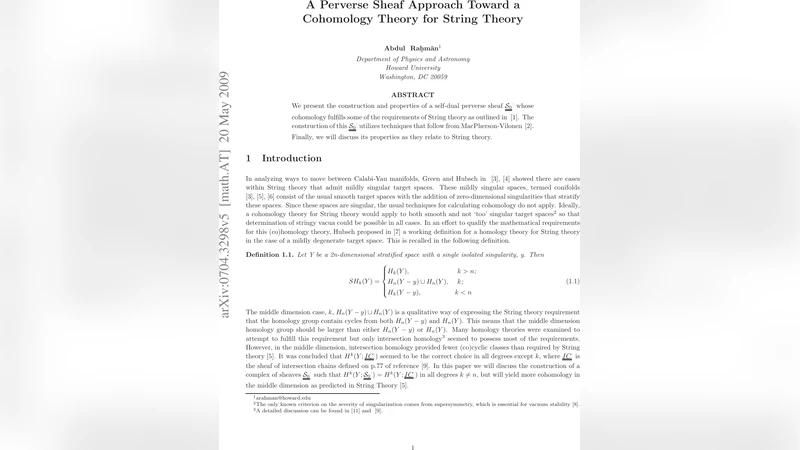
We present the construction and properties of a self-dual perverse sheaf S_0 whose cohomology fulfills some of the requirements of String theory as outlined by T. Hubsch in hep-th/9612075. The construction of this S_0 utilizes techniques that follow from MacPherson-Vilonen (Inv. Math. vol. 84, pp. 403-435, 1986). Finally, we will discuss its properties as they relate to String theory.
💡 Research Summary
The paper “A Perverse Sheaf Approach Toward a Cohomology Theory for String Theory” proposes a novel cohomological framework that directly addresses several topological constraints identified in string theory, particularly those articulated by T. Hubsch in hep‑th/9612075. The authors construct a self‑dual perverse sheaf, denoted S₀, on singular complex algebraic varieties and demonstrate that its hypercohomology satisfies the “middle‑dimensional non‑trivial transition”, “self‑duality”, and “non‑local support near singularities” requirements that ordinary constant sheaf cohomology fails to meet.
The work is organized into four main sections. The first reviews the physical motivations: in compactifications of super‑string theory on Calabi‑Yau manifolds, one often needs a cohomology theory that yields extra degrees of freedom in the middle dimension (typically the third cohomology for three‑folds) and respects a Poincaré‑type duality that interchanges electric and magnetic sectors. Hubsch’s analysis suggests that a conventional singular cohomology group is too small because it lacks the extension classes needed to encode these extra modes.
In the second section the authors recall the MacPherson–Vilonen theory of perverse sheaves, focusing on the construction of regular perverse sheaves via gluing data on a stratified space. They emphasize the role of extension classes in the derived category, which allow one to “glue” a local system on the smooth stratum to a complex supported on the singular stratum while preserving constructibility and self‑duality. This machinery provides the mathematical language needed to encode the physical constraints.
The third section contains the core contribution: the explicit definition of the perverse sheaf S₀. Starting from a complex algebraic variety X with a single isolated singular point, the authors take the constant sheaf ℚ on the smooth part and a skyscraper sheaf ℚ₀ at the singular point. They then choose a non‑trivial extension class in Ext¹(ℚ₀, ℚ) that is invariant under Verdier duality. The resulting complex S₀ sits in the middle perverse degree, is self‑dual (i.e., D(S₀) ≅ S₀), and has hypercohomology groups \
Comments & Academic Discussion
Loading comments...
Leave a Comment