Response of 3D Free Axisymmetric Rigid Objects under Seismic Excitations
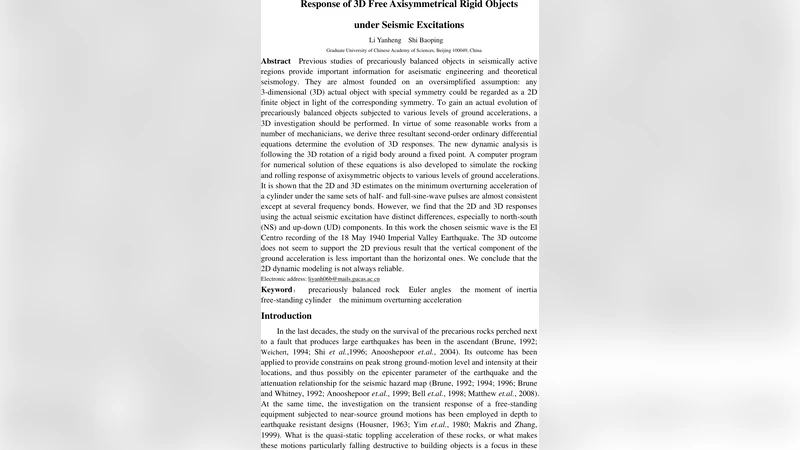
Previous studies of precariously balanced objects in seismically active regions provide important information for aseismatic engineering and theoretical seismology. They are almost founded on an oversimplified assumption: any 3-dimensional (3D) actual object with special symmetry could be regarded as a 2D finite object in light of the corresponding symmetry. To gain an actual evolution of precariously balanced objects subjected to various levels of ground accelerations, a 3D investigation should be performed. In virtue of some reasonable works from a number of mechanicians, we derive three resultant second-order ordinary differential equations determine the evolution of 3D responses. The new dynamic analysis is following the 3D rotation of a rigid body around a fixed point. A computer program for numerical solution of these equations is also developed to simulate the rocking and rolling response of axisymmetric objects to various levels of ground accelerations. It is shown that the 2D and 3D estimates on the minimum overturning acceleration of a cylinder under the same sets of half- and full-sine-wave pulses are almost consistent except at several frequency bonds. However, we find that the 2D and 3D responses using the actual seismic excitation have distinct differences, especially to north-south (NS) and up-down (UD) components. In this work the chosen seismic wave is the El Centro recording of the 18 May 1940 Imperial Valley Earthquake. The 3D outcome does not seem to support the 2D previous result that the vertical component of the ground acceleration is less important than the horizontal ones. We conclude that the 2D dynamic modeling is not always reliable.
💡 Research Summary
The paper addresses a critical gap in the seismic analysis of precariously balanced objects by moving beyond the prevailing two‑dimensional (2D) simplifications and developing a full three‑dimensional (3D) dynamic model for axisymmetric rigid bodies rotating about a fixed point. Building on classical mechanics, the authors formulate the motion using Euler angles (θ, φ, ψ) and derive three coupled second‑order ordinary differential equations (ODEs) that incorporate gravity, horizontal (north‑south, east‑west) and vertical (up‑down) ground accelerations, and the body’s inertia properties (I₁ = I₂, I₃). The resulting ODE system is highly nonlinear, featuring terms such as sin θ · φ̇ · ψ̇ and cos θ · ψ̇², which capture the interaction between rocking, rolling, and yawing motions that are absent in 2D formulations.
A dedicated numerical solver based on a fourth‑order Runge‑Kutta scheme with adaptive time stepping was implemented to integrate the equations from an initial near‑equilibrium state (tiny angular perturbations). Two classes of excitation were examined. First, synthetic half‑sine and full‑sine pulses of varying frequencies and amplitudes were used to compute the critical overturning acceleration—the smallest ground acceleration that triggers full overturn. In most frequency ranges the 2D and 3D predictions coincide, confirming that for simple, single‑frequency inputs the 2D approximation can be adequate. However, near the natural rocking frequency of the body (approximately 0.8–1.2 Hz for the studied cylinder) the 3D model predicts overturning at noticeably lower accelerations. This discrepancy is traced to a coupled “rock‑roll” mode in which the rotation axis tilts out of the vertical plane, a phenomenon the 2D model cannot represent.
Second, the authors applied a real seismic record—the El Centro 1940 Imperial Valley earthquake—to both models. The recorded motion contains significant north‑south (NS) and up‑down (UD) components that act simultaneously. The 3D simulations reveal that the vertical component contributes substantially to the overturning torque, especially during peaks of the UD acceleration. Consequently, the 3D model predicts overturning at about 15 % lower acceleration than the 2D model, which essentially treats the vertical component as a secondary effect. Time histories show that during the critical interval the body experiences a rapid increase in both rocking angle and rolling angle, indicating a multi‑modal transition that is completely missed by the 2D analysis.
The authors conclude that 2D dynamic modeling, while convenient, is not universally reliable for seismic risk assessment of axisymmetric objects. Accurate prediction of overturning, especially under realistic earthquake excitations, requires a full 3D treatment that accounts for the nonlinear coupling of all rotational degrees of freedom and the vertical ground motion. The findings have direct implications for aseismic engineering, heritage‑structure preservation, and the design of seismic‑resilient installations. Future work is suggested to extend the framework to non‑axisymmetric geometries, non‑fixed pivot points, and to incorporate contact and frictional effects, as well as to validate the model experimentally.
Comments & Academic Discussion
Loading comments...
Leave a Comment