Obtainable Sizes of Topologies on Finite Sets
We study the smallest possible number of points in a topological space having k open sets. Equivalently, this is the smallest possible number of elements in a poset having k order ideals. Using efficient algorithms for constructing a topology with a …
Authors: Kari Ragnarsson, Bridget Eileen Tenner
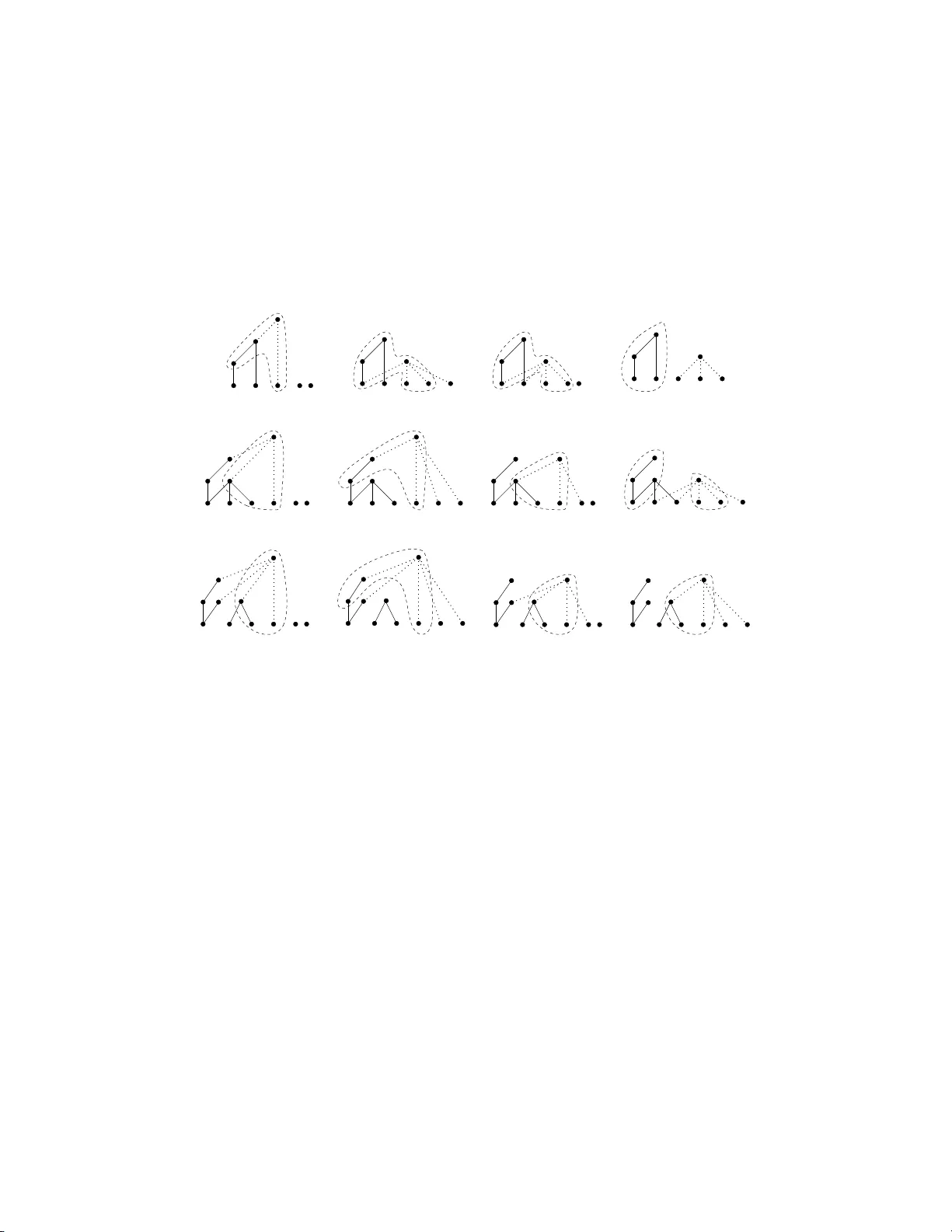
OBT AINABLE SIZES OF TOPOLOGIES ON FINITE SETS K ´ ARI RAGNARSSON AND BRIDGET EILEEN TEN NER Abstract. W e study the smallest p ossible n umber of p oint s in a top ological space ha ving k op en sets. Equiv a len tly , this is the smallest p ossible n umber of elemen ts in a poset hav ing k order i deals. Using efficien t a lgorithms for constructing a top ology wi th a prescribed size, we show that this n umber has a logarithmic upper bound. W e deduce that there exists a topology on n points ha ving k op en s ets, f or all k in an interv al which is exponent ially large i n n . The construction algorithms can be mo dified to produce top ologies where the smallest neighborhoo d of eac h p oint has a minimal size, and we gi v e a range of obtainable s i zes for such top ologies. 1. Introduction Finite top o logical spaces present many interesting combinatorial questions. The most f undamental of these concerns the n um ber T ( n ) o f different topolog ies on n po ints. This nu mber has been deter mined b y exhaustive enumeration for n ≤ 16 ([3]). The general question is very difficult, and it is uncertain whether a formula for T ( n ) will e ver be obtained, a lthough asymptotic estima tes exist. Er n´ e show ed in [5] and [6] that T ( n ) is asymptotically equal to T 0 ( n ), the n um ber of T 0 -top ologies (or, equiv alently , partial orde r s) on n p oints, which together with the asymptotic b ounds for the la tter, due to Kleitman and Rothschild in [12] and [13] provide a s ymptotic bo unds for T ( n ). More over, Ern ´ e gav e the asymptotic estimate 2 n/ 2+ O (log 2 n ) for the average ca rdinality of top olo gies on n p oints in [7]. The en umeration of top olo gies on n p oints can b e refined b y coun ting T ( n, k ), the num ber of top olo gies on n points having k op en sets. Just as for T ( n ), this is a long-sta nding op en problem, although s ome sp ecial case s are known. The most impo rtant contributions are due to Ern´ e and Stege, who in [10] computed the v alues of T ( n, k ), for n ≤ 11 and arbitra ry k , as well as the rela ted num ber s of T 0 and connected top ologies , and the co rresp onding nu m be r s of homeomor phism class e s. Their r e s ults in pa rticular yield all num b er s T ( n, k ) for k ≤ 12 , which were la ter calculated indep e ndent ly by Benoumhani [2]. Mo reov er, Ern´ e and Stege computed the num ber s T ( n, k ) for k ≤ 23 in [1 1]. When k is large in r elation to n , then certainly T ( n, k ) = 0 for k > 2 n . In fact T ( n, k ) = 0 for many large v alues of k ≤ 2 n . As a first step in this direction, Sharp [19] and Stephen [24] show ed that T ( n, k ) = 0 when 3 · 2 n − 2 < k < 2 n . Stanley [21] computed T ( n, k ) for k ≥ 7 · 2 n − 4 , and Kolli [15] did likewise for k ≥ 3 · 2 n − 3 . Additional car dinalities for large k were c o mputed by Parchmann ([1 6] and [17]), and V ollert characterized when T ( n, k ) > 0 for k ∈ [2 n − 2 , 2 n ] (see [25]). F or a given n , it is then natur al to ask: what is the smalles t v a lue of k so that T ( n, k ) = 0? 2000 Mathematics Subje ct Classific ation. Primar y 06A07; Secondary 54A99, 05A99. 1 2 K ´ ARI RAGNARSSON AND BRIDGET EILE EN TENNER Definition 1.1 . F or an integer n ≥ 1, let f ( n ) ≥ 2 b e the s mallest integer so tha t there ex is ts no top o logy on n p oints having f ( n ) op en sets. Equiv a lent ly , f ( n ) is the larg est n um ber so that t here exists a top olog y on n po ints with k open sets fo r all 2 ≤ k < f ( n ). It was known a s early as the 197 0s that f ( n ) < 2 n − 2 for n > 8 (see Parchmann [1 6] and [17]). Particular exa mples suppo rting this r esult ar e given b elow. These examples a lr eady o ccur in V olle r t’s thesis [25], and muc h more co mprehensive material ca n b e found in the pap er s by Ern´ e and Stege ( see [9, 1 0, 11]) . F or example, [10] yields f ( n ) f or all n ≤ 11. F rom the as ymptotic b ounds established by Erd¨ os and Ern´ e for clique num bers o f graphs (see [4]), in pa rticular, for a ntic ha in num ber s o f p osets, it follows that the quotient f ( n ) / 2 n tends to 0 when n becomes larg e. On the other hand, in [2 5], V ollert der ived the lower b ound f ( n ) ≥ 2 n/ 2+1 using arg ument s similar to those in Corollar ies 2.17 a nd 3.4 b elow. Example 1.2. Ther e is no top ology o n 9 p oints having 127 op en sets. That is, T (9 , 127) = 0. Example 1.3. There is no top olo gy o n 10 p oints having 191 op en sets . That is , T (10 , 191) = 0. W e repro duced these r esults by letting Stembridge’s MAPLE pack ag e [23] count the o rder ideals in all isomorphism c la sses of p os ets with at mo st 10 elements. The relationship b etw een p o sets a nd top o logies is discuss e d in Section 2. In this pap er w e obtain exp o nent ial low er bo unds fo r f ( n ), and thus a larg e int erv al of integers k for which T ( n, k ) > 0. T o this e nd we intro duce and examine the fo llowing s equence. Definition 1 . 4. F or an int eger k ≥ 2, let m ( k ) b e the smallest p o s itive int eger such that there exists a top olo gy on m ( k ) p oints having k op en sets. The ab ov e examples ca n b e refo r mulated as: m (127 ) > 9 and m (191) > 10 . In Section 3 we obtain lo garithmic upp e r b ounds for m ( k ), the main r esult being the fo llowing. Theorem. F or al l k ≥ 2 , m ( k ) ≤ (4 / 3 ) ⌊ log 2 k ⌋ + 2 . The pro of is constructive. That is, we pr ovide an algor ithm to construct a top ology with k op en se ts using no more than (4 / 3) ⌊ log 2 k ⌋ + 2 p oints. As f ( n ) is the smallest v alue of k such that m ( k ) > n (cf. Remark 2.7), the theo rem yields the fo llowing b o und for f ( n ). Corollary . F or al l n ≥ 1 , f ( n ) > 2 3( n − 2) / 4 . That is, T ( n, k ) > 0 for al l k ∈ [2 , 2 3( n − 2) / 4 ] . Thu s this pap er fo cuses o n the v alues { m ( k ) } , and finding a clo se upp er b o und for the se q uence. T he MAP LE pr ogra m [23] can compute the initial v a lues o f this sequence, presented in T able 1 fo r k ∈ [2 , 35]. This is seq uence A13 7813 of [20]. The numerical tables computed by E rn´ e and Stege in [10] g ive m ( k ) at leas t for k ≤ 379, and f (11) = 379 . The same computatio n also gives us the v alues of f ( n ) fo r n ∈ [1 , 10]. These v alues ar e display ed in T able 2, where they ar e also compa red to the result o f OBT AINABLE SIZES OF TOPOLOGIES ON FINI TE SETS 3 k 2 3 4 5 6 7 8 9 10 11 1 2 13 1 4 15 1 6 17 18 19 m ( k ) 1 2 2 3 3 4 3 4 4 5 4 5 5 5 4 5 5 6 k 20 21 2 2 23 2 4 25 26 27 28 29 30 31 32 3 3 34 3 5 m ( k ) 5 6 6 6 5 6 6 6 6 7 6 7 5 6 6 7 T able 1. The minim um num ber of p o int s m ( k ) needed to make a topo logy having k op en sets, as computed by [23], fo r k ∈ [2 , 35]. Theorem 3.11. The table indica tes, as exp ected, that the b ound is no t strict. How e ver, these data p oints do not contradict the p oss ibilit y that 2 3( n − 2) / 4 may give the co rrect gr owth rate fo r f ( n ). n 1 2 3 4 5 6 7 8 9 10 f ( n ) 3 5 7 1 1 19 2 9 47 7 9 127 191 ⌊ 2 3( n − 2) / 4 ⌋ + 1 1 2 2 3 5 9 14 23 39 65 T able 2. The v alues of f ( n ) for n ≤ 10. The b ottom r ow is the size o f the s mallest to p o logy not o btained by Theorem 3.1 1. That is, the b ottom row is 1 more than the bound 2 3( n − 2) / 4 obtained in Theorem 3.11, rounded down to the near est integer. W e co nc lude this introduction by outlining the or g anization of the pap er. In Section 2 we recall ba s ic definitions and describ e machinery we will us e throug hout the pr o ofs. This includes the corresp ondence betw een topo logies a nd p o sets, under which op en sets corr esp ond to orde r ideals. W e also develop metho ds to compute the num ber of order ideals in a p o set. In Sectio n 3 we prov e the main theor ems, giving pro ofs of log arithmic upp er b ounds for m ( k ), and co nsequently exp onential low er b o unds for f ( n ). The pro ofs are constructive in that we explicitly s how how to construct a to po logy on n p oints having k o p en se ts for k ∈ [2 , 2 3( n − 2) / 4 ]. In Section 4 we apply the cons tructions from Section 3 to the situation where the minimal neighborho o d of ea ch p oint must hav e at least m p oints, and obtain a similar int erv a l of obtaina ble top olo gy sizes. In Section 5 w e dis c uss instances wher e the constructio ns in Section 3 are mor e efficient, giving top ologies on fewer p oints than the b ounds sug g est. Finally , in Section 6, we make genera l observ a tions abo ut the s equences, { m ( k ) } and { f ( n ) } , comparing them to other known sequences . 2. Machiner y In this section we define and discus s some of the basic ob jects s tudied in this pap er. Man y of these definitions and results are well known, but they are presented again her e for the sake of completeness. W e b egin by recalling the definition of a to po logy . Definition 2. 1 . A top olo gy on a set X is a collection T of subse ts of X , such that ∅ , X ∈ T , and T is closed under a r bitrary unio n and finite intersection. Elements 4 K ´ ARI RAGNARSSON AND BRIDGET EILE EN TENNER in T are ca lled op en sets . The size of a to po logy is the num ber of op en sets. In other words, the size of the top olog y is the c a rdinality of T . The following class o f to po logies is of sp ecia l imp orta nc e in this article . Definition 2. 2. A T 0 top olo gy on a s et X is a top olog y on X such that, for any pair of distinct p o ints in X , there ex is ts an o p en set co ntaining o ne of these p oints and not the other. In other w ords, any t wo p oints in a T 0 top ology can be distinguis hed top ologica lly . In this pap er we are only concerne d with top olog ie s o n finite s ets X . A s X has only finitely ma ny subsets, a top o logy on X is in fact closed under ar bitrary int ersection. Co nsequently , for a p oint x ∈ X , we can form the minimal op en set containing x by taking the intersection U x = \ U ∈T x ∈ U U. These minimal o pe n sets deter mine T , since U = [ x ∈ U U x for a ll U ∈ T . F or distinct x and y , minimality implies tha t the sets U x and U y are either disjoint, or one is co ntained in the other. Th us we can make the follo wing definition. Definition 2.3. F o r a top olo g y T on a finite set X , let P ( T ) b e the preor de r relation on X obtained by setting x ≤ y when U x ⊆ U y . This ass ignment is a well-known bijection, as r ecorded in the following lemma . F or more ba ckground, the reader is referred to Alexandroff ’s work [1]. Lemma 2.4. F or a finite set X , the assignment T 7→ P ( T ) gives a bije ctive c or- r esp ondenc e b etwe en top olo gies on X and pr e or ders on X . U nder t his assignment, T 0 top olo gie s c orr esp ond to p artial or ders. There is a standard wa y to collapse a topolo gy T o n a set X int o a T 0 top ology of the s ame size. First, let X 0 be the s et of equiv alence classes formed b y the relatio n “ x ∼ y if U x = U y ”, and let π : X → X 0 be the canonical pr o jection. One then obtains a T 0 top ology T 0 on X 0 by setting (1) T 0 = { π ( U ) | U ∈ T } . The size of T 0 is clear ly equa l to the size of T . F urthermor e, P ( T 0 ) is the p ose t obtained from the preo rder P ( T ) in the standa r d w a y by identifying elements x and y such that x ≤ y and y ≤ x . Example 2.5. Let T b e the top ology on { 1 , . . . , 8 } with minimal op en sets U 1 = { 1 } , U 2 = { 2 } , U 3 = { 1 , 2 , 3 } , U 4 = { 1 , 2 , 4 } , U 5 = { 5 } , U 6 = { 1 , 2 , 4 , 5 , 6 } , and U 7 = U 8 = { 1 , 2 , 4 , 5 , 6 , 7 , 8 } . This is not a T 0 top ology b ecause the p oints 7 and 8 are not distinguis hable top olog ically . The induced T 0 top ology , T 0 , is homeomorphic to the top ology on { 1 , . . . , 7 } with minimal op en s ets U 1 = { 1 } , U 2 = { 2 } , U 3 = { 1 , 2 , 3 } , U 4 = { 1 , 2 , 4 } , U 5 = { 5 } , U 6 = { 1 , 2 , 4 , 5 , 6 } , and U 7 = { 1 , 2 , 4 , 5 , 6 , 7 } . The p os et P ( T 0 ) is depicted in Figure 1. OBT AINABLE SIZES OF TOPOLOGIES ON FINI TE SETS 5 Figure 1. The pos et P ( T 0 ) co rresp onding to the T 0 top ology T 0 induced by the top ology T in Example 2.5. The following lemma describ es the relationship b etw een the sequences m ( k ) and f ( n ), and indicates the role of T 0 top ologies. Lemma 2.6 . L et k ≥ 2 b e an inte ger. (a) m ( k ) is the minimum nu mb er su ch that t her e exists a T 0 top olo gy on m ( k ) p oints having k op en sets. (b) If T ( n, k ) > 0 for some n , then T ( n ′ , k ) > 0 for al l n ′ > n . Pr o of. (a) A topo lo gy T with k op en sets on a minimal num b er of po ints mu st b e a T 0 top ology , for otherwise T 0 , as defined in equation (1) , is a top ology with k op en sets on fewer po ints. Th us adding the T 0 restriction do e s not incr ease the minimal nu m be r of p oints needed for a top ology with k op en sets. (b) Supp ose T is a top olog y o f size k o n a s et X with n p o int s. P ick a p oint x ∈ X that is minimal in the preorder P ( T ), and form the top o lo gy T ′ by inserting n ′ − n additional p oints into U x . Then T ′ is a to po logy o f s ize k on n ′ po ints. R emark 2.7 . F ro m the previo us lemma, it follows that f ( n ) is the smallest int eger such that m f ( n ) > n . W e str ess that the analo gous statement is not true for T 0 top ologies, as there is no analo gue o f par t (b) of the lemma for T 0 top ologies. Indeed, a T 0 top ology o n n p oints nec essarily has a t leas t n + 1 op en sets. In v iew of the previo us lemma we fo cus our a tten tion on T 0 top ologies a nd p osets throughout the r est o f the pap er . F or the r emainder of this section we inv estigate how to calcula te the size of a T 0 top ology using prop erties of its asso cia ted po set. Definition 2.8 . An or der ide al in a p oset P is a subset I ⊆ P such tha t if y ∈ I and x < y , then x ∈ I . A dual or der ide al in P is a subset I ⊆ P such tha t if x ∈ I and x < y , then y ∈ I . Order ide a ls ar e sometimes ca lled down-sets , while dual o rder idea ls may b e called u p-sets or filters . Definition 2. 9 . Let P b e a p oset. An antichain in P is a subset A ⊆ P such that x a nd y are inco mpa rable for all distinct x, y ∈ A . The following lemma is a well-kno wn prop erty o f the bijection from Lemma 2.4. Lemma 2.10 . L et T b e a T 0 top olo gy. The fol lowing c orr esp onde nc es ar e bije c- tions: { op en sets in T } ← → { or der ide als in P ( T ) } ← → { ant ichains in P ( T ) } . Definition 2.1 1. Let j ( P ) b e the num ber of order ideals in a p ose t P . Lemma 2.10 implies that j ( P ( T )) = |T | . 6 K ´ ARI RAGNARSSON AND BRIDGET EILE EN TENNER Definition 2.12. F o r a p oset P a nd an element x ∈ P , let P x be the p oset obtained from P by removing a ll elemen ts c o mparable to x . Let P \ x b e the pos et obtained from P by removing only the element x . Given a p os et P , the num ber of order ideals in P can b e computed in a n iterative manner using the following lemma, which is a key to ol in the pr o of of the main results in the pa pe r. Lemma 2.1 3. Given a p oset P and an element x ∈ P , j ( P ) = j ( P \ x ) + j ( P x ) . Pr o of. Supp ose x is an element of P , and consider a n antic hain A ⊆ P . If x is not in A , then A is an antic hain in P \ x . If x ∈ A , then no element co mpa rable to x is in A , so A \ x is an antic hain in P x . Counting the num ber of antic hains in a p o set is a #P-complete problem (see [18]). This co mputational difficulty is the r eason that the data presented in T ables 1 and 2 do not consider p osets with more than 10 elements. Ho w ever, the main pro o fs in this ar ticle build p osets b y inductively adding a single ele ment at a time, and hence ar e undisturb ed by the computationa l complexity . Two elementary op er ations for constructing posets are the dir e ct sum (also called disjoint u nion ) and the or dinal sum of tw o p os ets. Definition 2.14. Let P and Q b e p osets on the sets X and Y , resp ectively , with order relations R and S , resp ectively . The direct sum P + Q is the p ose t defined on X ∪ Y , with o rder relations R ∪ S . The o r dinal sum P ⊕ Q is the p oset defined on X ∪ Y , with o rder rela tions R ∪ S ∪ { x ≤ y | x ∈ X , y ∈ Y } . The n um ber of ideals in a p oset r esulting fro m these op erations can b e calculated easily . The pr o of o f this le mma is str a ightforw ard, for exa mple see [11]. Lemma 2.1 5. L et P and Q b e p osets. Then j ( P + Q ) = j ( P ) · j ( Q ) , and (2) j ( P ⊕ Q ) = j ( P ) + j ( Q ) − 1 . (3) Definition 2.1 6. Let • denote the p oset consisting of a single element. The following is a n immediate cor ollary to Lemma 2.1 5, which is used in Prop o- sition 3.3 to give a simple but efficient a lgorithm for co nstructing a top o logy with k o pe n sets bas ed on the base 2 expansio n of k . Corollary 2.1 7. F or any p oset P , j ( P + • ) = 2 j ( P ); j ( P ⊕ • ) = j ( P ) + 1 Pr o of. These eq ua lities follow dir ectly from Lemma 2.15 b ecause the poset • ha s t wo antic hains: the emptyset, and the single element • . Lemma 2.1 5 implies the following res ult, which pr ovides a cr ude b o und o n the nu m be r of p oints needed to make a top olo g y with a prescrib ed num b er of ope n s ets. Corollary 2.1 8. F or al l k ≥ 3 , m ( k ) ≤ min 1 + m ( k − 1) , min 1 0. The pro ofs o f Prop ositions 3.3 and 3.7 and Theorem 3.11 are constructive: given an integer k ≥ 2, a p oset P having a “small” nu m be r of elements is built so that j ( P ) = k . F or larg e v alues of n , Corolla ries 3.4, 3.8, and 3.1 2 g ive successively larg er low er b ounds for f ( n ). It may b e p ossible to increase this b ound even further, a lthough just how muc h further the function f ( n ) can b e incr eased is still an op en questio n. One o f the key ob jects in this section is the binary expans ion o f k . Definition 3.1 . Set ℓ = ℓ ( k ) = ⌊ log 2 k ⌋ . Definition 3.2. Given a p o sitive in teger k = ǫ ℓ 2 ℓ + · · · + ǫ 1 2 1 + ǫ 0 2 0 where ǫ i ∈ { 0 , 1 } and ǫ ℓ = 1, let k 2 be the s tring ǫ ℓ · · · ǫ 1 ǫ 0 . Each ǫ i is a bit , a nd a bit will henceforth be w r itten in sans - serif font as 0 or 1 . The constr uctions in Prop os itions 3 .3 and 3.7 and Theorem 3.11 a re s imilar in that they each give a blueprint for co nstructing a p ose t with k elements based o n the s tr ing k 2 , while tr ying to use as few elements a s p os sible. Theo rem 3.11 gives the b est bo und for m ( k ) when k ≥ 10. How e ver, it is also the mo st complex of the three pro cedures. W e include the other metho ds for three main reas ons: in some cases the simpler metho ds are more effectiv e, the co nstruction in Pr op osition 3.3 is partly used in the pr o of of Theorem 3.11, and the pro of of Prop osition 3 .7 elucidates the pr o of o f Theo rem 3.11 by motiv ating a nd explaining the ideas b ehind the more complicated v a r iant. It should be no ted that the construction in Pro p osition 3 .3 has a ppe ared prev io usly , for example, see [2 5]. In ea ch co nstruction given in this section, we read the string k 2 from left to right, building up the p oset at each bit. W e start with the empty p ose t a t the first bit, and add a disjoint element to the po set for each new bit examined. At times we add maximal elements, covering selected pa rts of the po set, to adjust for the v alue of rec e nt ly read bits. The differ ence in the constr uctions lies in how and when the maximal elements are added. A common asp ect of ea ch is that the disjoint elements added with the app earance of each bit for m a maximal antic hain of le ngth ℓ . This observ ation is useful for drawing Hasse diagr ams: we will draw this a ntic ha in a t the low est level, and the elements arising from the v a lues of the bits will b e po sitioned ov er it. Prop ositi on 3.3. F or al l k ≥ 2 , m ( k ) ≤ 2 ⌊ log 2 k ⌋ . Pr o of. Let k ≥ 2 b e given and consider the binary ex pa nsion k 2 = ǫ ℓ · · · ǫ 1 ǫ 0 , w her e ǫ ℓ = 1 . W e inductively form p osets P 0 , . . . , P ℓ with the pr op erty that j ( P i ) 2 = ǫ ℓ · · · ǫ ℓ − i for ea ch i . In par ticular, j ( P ℓ ) = k . Let P 0 be the empty s et. F or each i > 0, co nsider the bit ǫ ℓ − i , and define P i = ( P i − 1 + • , if ǫ ℓ − i = 0 ; ( P i − 1 + • ) ⊕ • , if ǫ ℓ − i = 1 . 8 K ´ ARI RAGNARSSON AND BRIDGET EILE EN TENNER Using Co r ollary 2.1 7, we see that j ( P i ) = ( 2 j ( P i − 1 ) , if ǫ ℓ − i = 0 ; 2 j ( P i − 1 ) + 1 , if ǫ ℓ − i = 1 . Therefore j ( P i ) ha s binar y ex pansion ǫ ℓ ǫ ℓ − 1 · · · ǫ ℓ − i . The n um ber o f e lement s used in P ℓ is ℓ + t − 1, where t is the n um ber of 1 s in k 2 . An exa mple of the po set P ℓ for k = 105 is drawn in Figure 2. W e have t ≤ ℓ + 1, so m ( k ) ≤ 2 ⌊ log 2 k ⌋ . Corollary 3.4 . F or al l n ≥ 1 , f ( n ) > 2 n/ 2 . That is, T ( n, k ) > 0 for al l k ∈ [2 , 2 n/ 2 ] . Figure 2. The metho d of Prop ositio n 3 .3 applied to k = 105, where k 2 = 110100 1 . Note that 2 ⌊ lo g 2 105 ⌋ is gre a ter than the num b er of elements in the p o set in Figure 2, but this sho uld not b e surprising g iven the num b er of 0 s in 1 05 2 . Situatio ns where the pro cedures of this sec tio n may b e mo re efficient will be discuss ed in Section 5. The pro cedure descr ib ed in the pr o of o f Pro po sition 3 .3 ex amines one bit o f k 2 at a time, adding an element for each p osition in the str ing, and p ossibly adding another element if the bit is 1 , using Coro llary 2.17 to keep track of the num ber of ideals. Pr op osition 3.7 b e low increas e s the efficiency by lo oking at pairs of bits at a time. T o do this, we firs t need an appropr ia te re pla cement for Cor ollary 2 .17 to keep track o f the num ber of ideals . Definition 3.5. A p os e t is of double t yp e if it con tains a dual or der ideal iso morphic to the p oset • ⊕ • . The importa nce of the p oset • ⊕ • is that j ( • ⊕ • ) = 3, a nd it also has a dual order ideal • with j ( • ) = 2. This allows us to adjust for the v alues of binary s ubstrings 11 and 10 in k 2 by adding a single maximal elemen t, a s the following lemma shows. Lemma 3.6. Given a p oset P of double typ e, and r ∈ { 2 , 3 } , ther e is a p oset P ′ of double typ e and with j ( P ′ ) = 4 j ( P ) + r , forme d by adding thr e e elements to the p oset P . Pr o of. Add t wo elements to P to form the p oset Q = P + { x 1 } + { x 2 } . By Co r ollary 2.17, we hav e j ( Q ) = 4 j ( P ). If r = 2 (that is, r 2 = 1 0 ), form P ′ by adding an element y to Q , grea ter than everything except x 2 . The subp oset { x 1 ⋖ y } ∼ = • ⊕ • is a dual o rder ideal in P ′ , and thus P ′ is of double type . Applying Lemma 2.13 (with x = y ) implies that j ( P ′ ) = j ( Q ) + j ( { x 2 } ) = 4 j ( P ) + 2 . OBT AINABLE SIZES OF TOPOLOGIES ON FINI TE SETS 9 Similarly , if r = 3 (that is, r 2 = 11 ), form P ′ by adding an element y to Q , greater than everything except the dual or der idea l • ⊕ • requir e d to b e in P . This • ⊕ • is still a dual order ideal in P ′ , s o P ′ is of double type. F ur thermore, a g ain by Lemma 2.13, j ( P ′ ) = j ( Q ) + j ( • ⊕ • ) = 4 j ( P ) + 3 . In ea ch ca se, P ′ is a p os et o f do uble type with j ( P ′ ) = 4 j ( P ) + r , obtained by adding thr ee elements to P . Prop ositi on 3.7. F or al l k ≥ 2 , m ( k ) ≤ (3 / 2 ) ⌊ log 2 k ⌋ + 1 . Pr o of. F or a given integer k ≥ 2, we construct a po set P with k op en sets. As in the pro o f of Prop osition 3 .3, let k 2 = ǫ ℓ · · · ǫ 1 ǫ 0 be the binary expansion of k . W e w ill inductively construct p os ets P i for certain i ∈ [0 , ℓ ] with the prop erty that j ( P i ) 2 = ǫ ℓ · · · ǫ ℓ − i . The pr o cess ends when P ℓ is defined, and we take P := P ℓ . If ǫ ℓ is the only bit equal to 1 , then set P to b e a p oset consisting of ℓ disjoint elements. Otherwis e , let s b e the s mallest p ositive integer s uch that ǫ ℓ − s = 1 . Let P s be the poset ( s · • ) ⊕ • , where s · Q denotes the direct sum Q + · · · + Q of s copies of the p oset Q . Then j ( P s ) = 2 s + 1 , which has binar y expansion ǫ ℓ · · · ǫ ℓ − s . F urthermor e, the p oset P s has s + 1 elements and is of double type. The r emainder of the pro of is inductive. Assume that P i has b een defined, is of double t yp e , and that j ( P i ) has binary ex pansion ǫ ℓ · · · ǫ ℓ − i . Co ns ider the bit ǫ ℓ − ( i +1) . If ǫ ℓ − ( i +1) = 0 , then s et P i +1 = P i + • . Otherwise, unless ℓ − ( i + 1 ) = 0, the substring ǫ ℓ − ( i +1) ǫ ℓ − ( i +2) is either 11 o r 10 . By Lemma 3 .6, we can form a po set P i +2 of double t ype such that j ( P i +2 ) has bina ry expansion ǫ ℓ · · · ǫ ℓ − ( i +2) , by adding three e le ments to P i . If ǫ ℓ − ( i +1) = 1 a nd ℓ − ( i + 1 ) = 0 , then se t P ℓ = ( P i + • ) ⊕ • . An ex ample o f the p oset as constructed by this pr o cedure for k = 555 0 is depicted in Figure 3. T o construct P , we first used s + 1 elements to constr uct P s , acco unt ing for the leftmost s + 1 bits in k 2 . After that, we either add one element to a dv ance one bit, or add three elements to adv ance tw o bits, until the end where tw o elements may need to b e added for the last bit. Therefore | P | ≤ ( s + 1) + ( ℓ − s ) + ⌈ ( ℓ − s ) / 2 ⌉ = ℓ + 1 + ⌈ ( ℓ − s ) / 2 ⌉ ≤ ℓ + 1 + ⌈ ( ℓ − 1) / 2 ⌉ . Considering c a ses for the parity of ℓ − 1, o ne sees that ℓ + 1 + ⌈ ( ℓ − 1) / 2 ⌉ ≤ (3 / 2) ⌊ lo g 2 k ⌋ + 1 , finishing the pro of. Corollary 3.8 . F or al l n ≥ 1 , f ( n ) > 2 2( n − 1) / 3 . That is, T ( n, k ) > 0 for al l k ∈ [2 , 2 2( n − 1) / 3 ] . Note that 1 . 5 ⌊ log 2 5550 ⌋ + 1 is gr eater than the num b er elements in the p oset in Figure 3 , but, again, this should not b e surprising g iven the n um ber of 0 s in 5550 2 . 10 K ´ ARI RAGNARSSON AND BRIDGET EILE EN TENNER Figure 3. The metho d of P rop ositio n 3 .7 applied to k = 5550, where k 2 = 10 1011 01011 10 . The dual or der ideals iso morphic to • ⊕ • which ar e defined by the pro cedure ar e circled. The bo und o btained in Pr op osition 3.7 by co ns idering pairs of consecutive bits in k 2 is b etter than the function obta ined in Prop os ition 3.3. In fact this b o und can be improved still further by consider ing triple s of cons e c utive bits in k 2 , a s shown below, although this is sig nificantly more complicated than the previous metho ds. As discussed at the end of the sectio n, there is no analog ous metho d for considering quadruples of co nsecutive bits in k 2 . Definition 3.9. A p oset is of triple t yp e if it contains a dual order ideal isomorphic to one of the following p osets, named as indicated. Type 1: Type 2: Type 3: The motiv a tion for this definition is simila r to tha t for double type. If P is isomorphic to a p os et o f Type 1, 2, or 3 , and Q is the p o set obtained by a dding three disjoint p oints to P , then for e a ch r ∈ { 4 , 5 , 6 , 7 } , there is a dual o rder ideal I in Q with j ( I ) = r . Lemma 3.10. Given a p oset P of triple typ e, and an inte ger r ∈ { 4 , 5 , 6 , 7 } , ther e is a p oset P ′ of tr iple typ e and with j ( P ′ ) = 8 j ( P ) + r , forme d by adding four elements to the p oset P . Pr o of. Add three elements to P to form the p oset Q = P + { x 1 } + { x 2 } + { x 3 } . By Co rollar y 2.1 7, we have j ( Q ) = 8 j ( P ). Let I b e a dua l order ideal in P that is isomor phic to one of the p o sets illustrated in Definition 3.9, and let J b e the dual o rder ideal I + { x 1 } + { x 2 } + { x 3 } in Q . T o complete the pr o of, we will form a new p oset P ′ by adding a maximal element y to Q s uch that the following three conditions ar e satisfie d • P ′ is of triple type, • y > x for all x ∈ Q \ J , • j ( J y ) = r , with nota tion as in Definition 2.12. Combined the second and third condition imply that P ′ y = J y , and b y Lemma 2.13 we ha ve j ( P ′ ) = j ( P ′ \ y ) + j ( P ′ y ) = j ( Q ) + j ( J y ) = 8 j ( P ) + r , as des ired. There a re tw elve cases to cons ider for adding the element y , dep ending on the t yp e of I and the v alue o f r . The figures b elow show how to place y in relatio n to the dual o rder ideal J in each ca se. As y > x for all x ∈ Q \ J , this shows how OBT AINABLE SIZES OF TOPOLOGIES ON FINI TE SETS 11 to add y to Q . In each ca se the dual or der ideal I is drawn w ith solid lines, a nd the dua l o rder ideal ma king P ′ of triple type is circled. Of the four new elements in each figure, the maximal of these is y . The first figure in each row corresp o nds to the case r = j ( J y ) = 4, the second to the case r = j ( J y ) = 5, the third to r = j ( J y ) = 6, a nd the fourth to r = j ( J y ) = 7. (T yp e 1) (T yp e 2) (T yp e 3) Theorem 3. 11. F or al l k ≥ 2 , m ( k ) ≤ (4 / 3 ) ⌊ log 2 k ⌋ + 2 . Pr o of. The approa ch is similar to the pro of of P rop ositio n 3.7, and we only outline the constructio n. Let k ≥ 2 b e a fixed integer, a nd let k 2 = ǫ ℓ · · · ǫ 0 be the binary expansion o f k . W e construct a p oset P with j ( P ) = k . If k ha s fewer than three bits equal to 1 in its binar y expansion, use the construction in P rop ositio n 3.3 to obtain a p oset with no more tha n ℓ + 1 elements. Otherwise , le t s b e such that ǫ ℓ − s is the third nonzer o bit fr o m the left in k 2 . Using the construction in Prop os itio n 3.3 we obta in a po set P s with s + 2 elements such that j ( P s ) has binary expansion ǫ ℓ · · · ǫ ℓ − s . Observe that P s is of triple type as it contains a dual order idea l iso mo rphic to Type 1 in Definition 3.9. As in the pro of of P rop osition 3.7, we now mov e r ight w ard in the binary expan- sion of k . If we enco unt er the bit 0 , we a dd a sing le disjoint p oint to o ur po set and mov e on. If we encounter the bit 1 , we co ns ider this bit and the t wo immediately following it. They form one of the subsequences 1 00 , 101 , 110 or 1 11 . In ea ch case the corr esp onding integer b elongs to the set { 4 , 5 , 6 , 7 } , and we can apply Le mma 3.10 to obtain a new po set of triple type incor po rating the three bits under scrutiny , by adding four elements. Finally , when there a re i < 3 bits left we can incorp o rate them in to the p o set by adding i + 1 points, using Coro llary 2.1 7 if i = 1 a nd Lemma 3.6 if i = 2 . 12 K ´ ARI RAGNARSSON AND BRIDGET EILE EN TENNER A co unting argument similar to the one in Pro p o sition 3.7 shows that | P | ≤ ( s + 2) + ( ℓ − s ) + ⌈ ( ℓ − s ) / 3 ⌉ = ℓ + 2 + ⌈ ( ℓ − s ) / 3 ⌉ ≤ ℓ + 2 + ⌈ ( ℓ − 2) / 3 ⌉ . Examination o f cases bas e d on the remainder ℓ mo d 3 g ives that ℓ + 2 + ⌈ ( ℓ − 2) / 3 ⌉ ≤ (4 / 3) ⌊ lo g 2 k ⌋ + 2 , finishing the pro of. Corollary 3.1 2. F or al l n ≥ 1 , f ( n ) > 2 3( n − 2) / 4 . That is, T ( n, k ) > 0 for al l k ∈ [2 , 2 3( n − 2) / 4 ] . The successive r esults in P rop ositions 3.3 and 3.7 and Theo rem 3 .11 suggest that even b etter bounds migh t b e o btained by adapting the constructions to consider four bits of k 2 at a time, for any k ≥ 2. How ever, our cur rent approa ch do es not translate dir ectly int o an appro ach for qua dr uples of dig its. More precisely , we cannot add four dis jo int p oints to the poset, and a single maximal element, and maintain the existence o f a c o llection o f dual o rder ideals having 8 , 9, 10, 11, 1 2, 13, 1 4, and 15 order ideals , r esp ectively . W e do not rule out the po ssibility that another technique might b e employ ed to improv e the result of Theo rem 3 .11, but leav e that as a question for future resear ch. 4. S pecified minimal set sizes The results in the previo us section ca n b e gener a lized by lo o king at top olo- gies where the minimal ope n sets { U x } have sp ecified sizes. An extremal case of this, related to cardina lities of distributive lattices with a sp ecified num ber o f join- irreducibles of e a ch ra nk, is treated in [22]. Additiona lly , unla b eled distributive lattices with fewer than 50 elements and an arbitra ry g iven num ber of irr educible elements ar e studied in [8]. One version of this generaliza tion is very easy to handle by mo difying the co nstruction descr ib ed in Theor em 3 .11 to pro duce top olog ies with s pe c ified minimal set sizes . Definition 4.1. Let T m ( n, k ) b e the num ber of to po logies on n p oints having k op en sets, whe r e the sma llest neighbo rho o d of ea ch p oint has at least m elements. Prop ositi on 4.2. T m ( n, k ) > 0 for al l n ≥ m , m ≥ 1 , and k ∈ [2 , 2 3( n − 2) 3 m +1 ] . Pr o of. In a top olog y T , the smalles t neighbor ho o d o f a p oint x is the set U x . The sets U x with fewest elements are thos e wher e x is minimal in the pr eorder P ( T ). In the pr o cedure describ ed in the pro of of Theorem 3.11, the minimal e lement s of the p os et for m an antic hain of size ℓ , co rresp onding to e ach bit a fter ǫ ℓ in the step-by-step reading o f k 2 . Ther efore, requiring the smallest neighbo rho o d of ea ch po int in T to contain at least m p oints simply means r eplacing each of these ℓ elements by a set of ca rdinality at least m . Thus, to make s uch a top olog y with k op en sets, a similar a rgument to that in the pro of of the theor e m s hows that o ne needs at mo st mℓ + 2 + ⌈ ( ℓ − 2) / 3 ⌉ elements. As in the pro of of the theor em, mℓ + 2 + ⌈ ( ℓ − 2) / 3 ⌉ ≤ ( m + 1 / 3) ℓ + 2 , and the res ult follows. OBT AINABLE SIZES OF TOPOLOGIES ON FINI TE SETS 13 5. Better efficiency The main result of this pap er, Theorem 3.11, gives a pro cedur e to construct a topolo gy having k op en sets, needing one extra point in the topolo g y for each triple of bits a fter the first three 1 s in the binar y expansion k 2 . There may b e some situations whe r e this pro cedur e req uires fewer p oints than the b o unds suggest, and we highlight a few of these here. First of all, if the binary expres sion k 2 includes many 0 s, then there may be la rge po rtions of this expressio n that get sk ippe d over b y the pr o cedure, and thus fewer triples co ntribute an element to the p oset. Another wa y to increase the efficiency of this type of pro cedur e would b e to note pa tterns of co nsecutive digits in the string k 2 . F o r example, suppo se that k = 2 2 r − 1 . Thus ℓ = 2 r − 1 and the binary s tring k 2 consists of 2 r rep eated 1 s. Then one ca n par se the string k 2 as 1 | 1 | 11 | 11 11 | 1 1111 111 | . . . , where each section is identical to the union of all sections to the left. Thus a new section with 2 s 1 s can be handled by finding a dual order ide a l in the p oset w ith 2 2 s − 1 ant ichains, similarly to the proc e dur e in the pro of o f Theo rem 3.1 1. An example o f this for 2 2 4 − 1 is depicted in Figure 4. Figure 4. An efficient wa y to draw a p oset with 6 5 535 a nt ichains, using 19 elements. As s uggested by Figure 4 and Lemma 2 .1 5, if the num ber of op en sets desir ed factors co nv e nie ntly well, this may also r educe the num ber of p oints needed in the top ology . Fix po sitive int egers a a nd b . If the desired num b er of op en s e ts is k = 1 + 2 a + 2 2 a + · · · + 2 ba , then the pro cedure in P rop ositio n 3.3 gives a p oset having ( a + 1) b elements and k antic hains. Figure 5 depicts such a p o s et when a = 3 a nd b = 4 (that is, k = 4681 ). Figure 5. The pro cedure in Prop o s ition 3.3 applied to k = 468 1. Now consider an integer of the form k = x (1 + 2 a + 2 2 a + · · · + 2 ba ), where ℓ ( x ) + 1 ≤ a . The binary expa nsion of k c onsists of b + 1 rep eated instances of the binary expansion of x . In this situation, due to Lemma 2.15, ther e exists a po set having k a ntic ha ins and at most ( a + 1 ) b + (4 / 3) ⌊ lo g 2 x ⌋ + 2 14 K ´ ARI RAGNARSSON AND BRIDGET EILE EN TENNER elements. Thus, integers k with repe a ted patterns in their bina ry ex pansion can b e handled very efficie ntly . 6. Comp arison to other sequences Using Stembridge’s MAPLE pro gram [23], we hav e calculated the initial v alue s of the se q uence { m ( k ) } , and these have b een entered into [20] as entry A1378 13. The terms of m ( k ) are very similar to sequence A00331 3 of [20], g iving the length of a shortest addition chain for an integer, and the co nstructions in the previous section are in fact similar to thos e for pro ducing shor t addition chains a nd star chains [1 4]. Definition 6 . 1. An addition chain fo r k is sequence o f integers x 0 , x 1 , · · · , x n such that x 0 = 1, x n = k , a nd ea ch term in the sequence is the sum of tw o (not necessarily distinct) num ber s app earing ear lie r in the sequence. The length o f the addition chain x 0 , x 1 , · · · , x n is n . F or more information, b oth historica l a nd mathematical, ab o ut a ddition chains, see [1 4]. Sequence A0033 13 of [20] is defined a s follows. Definition 6. 2. F or a p ositive int eger k , let a ( k ) be the leng th o f the shortes t po ssible a ddition chain for k . Int erestingly , the sequences a ( k ) and m ( k ) agree in their fir s t 10 0 terms, except for k = 71, where m (71) = 8, while a (71 ) = 9. It is tempting to wonder whether a ( k ) is an upp er b ound for m ( k ). Exa mples suggest that “shor t” addition chains can b e realized by p o sets, but this do es not seem to be true for “long” addition chains. The division betw een “sho rt” and “long” c hains is unclear, but seems to lie ab ov e the range o f v alues for which it is currently feasible to ca lculate m ( k ). The relationship betw een these sequences is in triguing, a nd has previously bee n s tudied by V ollert in [25]. A co ncrete r elationship betw een the sequences m ( k ) a nd a ( k ) is a commo n upper bo und. Definition 6.3. F o r a po sitive in teger k , let b ( k ) b e the length of the shortest po ssible addition chain fo r k obtained by using only the metho ds o f factor ing and binary expa ns ion. This is sequence A11 7498 in [20]. By definition, b ( k ) is an upper b o und for a ( k ). Also fro m the definition it follows that b ( k ) satisfies the inductive equation b ( k ) = 1 , if k = 2; min 1 + b ( k − 1) , min 1 2 . It follows from Coro llary 2.18 tha t b ( k ) is an upp er b ound for m ( k ). The first term where the s e q uences differ is k = 23, where b (23) = 7, while a (23) = m (23) = 6. The sequence f ( n ) has also b een en tered int o [20], a s seque nc e n um ber A1 37814 . The initial terms of this se q uence are 3, 5, 7, 11, 19 , 29, 47, 79, 1 27, and 19 1. That these are all prime num bers is not sur prising: for a comp osite num ber k , Lemma 2.15 implies that one ca n efficiently co ns truct a p oset with k order ideals as a direct sum of tw o p osets. Given the relationship b etw een m ( k ) and a ( k ) ab ov e, it OBT AINABLE SIZES OF TOPOLOGIES ON FINI TE SETS 15 is expected that { f ( n ) } b e similar to sequence A0 0306 4 of [20], giving the sma lle st nu m be r with addition chains of length n . 7. Acknowledgments W e are grateful to t w o thoughtful refer e es for their careful readings of this manu- script, and for bringing to our a ttent ion the extensive work of the Ha nnov er gro up. References [1] P . Alexandroff, Dis kr ete R ¨ aume, Mat. Sb. (N.S.) 2 (1937), 501–51 8. [2] M. Benoumhani, The n um ber of topologies on a finite set, J. Inte ger Se q. 9 (2006), 06.2.6. [3] G. Brinkmann and B. D. McKay , Posets on up to 16 p oints, Or der 19 (2002) 147–179. [4] P . Erd¨ os and M. Er n´ e, Clique num bers of graphs, Discr ete M ath. 59 (1986), 235–242. [5] M. Ern´ e, Struktur- und Anzahlformeln f ¨ u r T op ologien auf endlichen Mengen, Ph.D. Thesis, Unive rsit¨ at M ¨ unster, 1972. [6] M. Ern´ e, Struktur- und A nzahlformeln f ¨ ur T op ologien auf endli c hen Mengen, Manuscripta Math. 11 (1974), 221–259. [7] M. Ern´ e, On the cardinalities of finite topologies and the num ber of antic hains in partially ordered sets, Discr ete Math. 35 (1981), 119–133. [8] M. Ern ´ e, J. Heitzig, and J. Reinhold, On the num ber of distributiv e lattices, Ele ct r on. J. Com- bin. 9 (2002), R24. [9] M. Ern´ e and K. Stege , Coun ting finite p osets and topologies, O r der 8 (1991), 247–265. [10] M. Er n´ e and K. Stege, Counting finite p osets and topologies, T ec h. Report 2 36 , Univ ersity of Hanno v er, 1990. [11] M. Ern´ e and K. Stege, Com binatorial applications of ordinal sum decomp ositions, Ars Com- bin. 40 (1995), 65–88. [12] D. J. Kleitman and B. L. Rothschild, The num ber of finite topologies, Pr o c. Amer. Math. So c. 25 (1970), 276–282. [13] D. J. K leitman and B. L. Rothschild, Asymptotic enumeration of partial orders on a finite set, T r ans. Amer. Math. So c. 205 (1975), 205–220. [14] D. E. Knuth. The Art of Computer Pr o gr amming, vol. 2: Seminumeric al Algorithms . 3rd ed. Addison W esley , Reading, MA, 1998. [15] M. Kolli, Direct and elementary approac h to en umerate topologies on a finite set, J. Inte ger Se q . 10 (2007), 07.3.1. [16] R. Parc hmann, Di e M¨ ach tigk eit endliche r T opologien, Ph.D. Thesis, Universit¨ at Hanno v er, 1973. [17] R. Parc hmann, On the cardinalities of finite topologies, D iscr ete Math. 11 (1975), 161–172. [18] J. S. Prov an and M. O. Ball, The complexity of coun ting cuts a nd of computing the probabilit y that a graph is connected, SIAM J. Comput. 12 (1983), 777–788. [19] H. Sharp, Jr., Car di nality of finite topologies, J. Combin. The ory 5 (1968) , 82–86. [20] N. J. A. Sloane, T he on-line encyclopedia of integ er sequenc es, published electronically at http:/ /www.res earch.at t.com/~njas/sequences/ . [21] R. P . Stanley , On the num ber of op en sets of finite top ologies, J. Combin. The ory 10 (1971), 74–79. [22] R. P . Stanley , An extremal problem for finite topologies and distributive lattices, J. Com- bin. The ory, Ser. A 14 (1973 ), 209–214. [23] J. R. Stemb ridge, The MAPLE pac k age posets , published electronically at http:/ /www.mat h.lsa.um ich.edu/~jrs/maple.html#posets . [24] D. Stephen, T op ology on finite sets, Amer. Math. Monthly 75 (1968), 739–74 1. [25] U. V ollert, M¨ ac h tigk eiten von T opologien auf endlic hen Mengen und Cliquenzahlen endlicher Graphen, Ph.D. Thesis, U nive rsit¨ at Hannov er, 1987. 16 K ´ ARI RAGNARSSON AND BRIDGET EILE EN TENNER Ma thema tics Institute, Reykja v ´ ık University, Krin glunni 1, 10 3 Reykja v ´ ık, Iceland E-mail addr ess : kari.ragnarsso n@ru.is Dep art ment of Ma thema tical Sciences, DeP aul University, 2 320 Nor th Kenmore A v- enue, Chicago, IL 60614, USA E-mail addr ess : bridget@math.d epaul.edu
Original Paper
Loading high-quality paper...
Comments & Academic Discussion
Loading comments...
Leave a Comment