Strong normalization results by translation
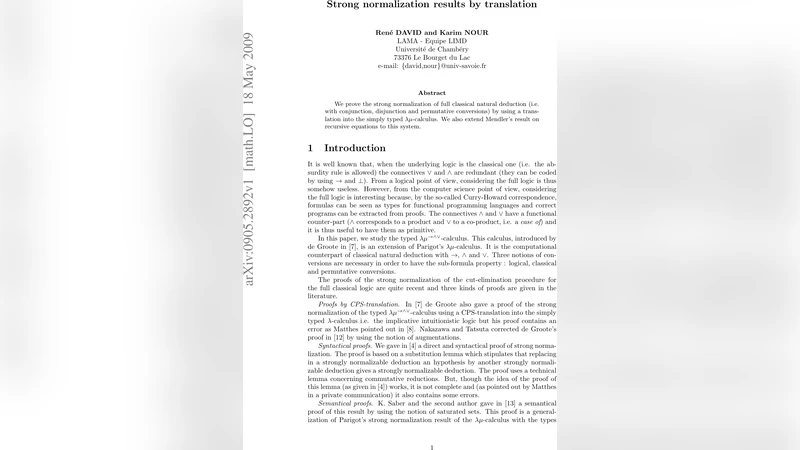
We prove the strong normalization of full classical natural deduction (i.e. with conjunction, disjunction and permutative conversions) by using a translation into the simply typed lambda-mu-calculus. We also extend Mendler’s result on recursive equations to this system.
💡 Research Summary
The paper addresses the long‑standing problem of proving strong normalization (SN) for the full classical natural deduction system, i.e. a system that includes conjunction (∧), disjunction (∨), and the permutative conversions that arise when these connectives interact. While strong normalization is well‑understood for intuitionistic systems and for restricted fragments of classical logic, the presence of both ∧/∨ and the non‑local permutative rules makes a direct SN proof extremely intricate.
The authors’ solution is to translate every proof term of classical natural deduction into a term of the simply‑typed λμ‑calculus, a calculus introduced by Parigot that captures classical reasoning via the μ‑operator (continuations). The translation is defined inductively on the structure of natural‑deduction derivations:
- Logical introductions and eliminations for ∧ and ∨ are mapped to λ‑abstractions, pair constructors, and case‑analysis constructs that make explicit use of μ‑bindings.
- The permutative conversions, which reorder elimination steps, correspond to the context‑propagation rules of λμ and are simulated by μ‑reduction steps.
Crucially, the translation preserves reduction: if a natural‑deduction term reduces in one step, its λμ‑image reduces in a finite number of β/η/μ steps, and vice‑versa. This preservation allows the authors to shift the SN problem from the original system to the target λμ‑calculus.
To prove SN for simply‑typed λμ, the paper extends the classic candidates‑of‑reducibility (or logical‑relations) technique. Types are enriched with ∧ and ∨, and for each type a set of “reducible” λμ‑terms is defined recursively:
- For atomic ⊥, the set consists of all normal forms.
- For →, the usual condition that the term maps reducible arguments to reducible results is used.
- For ∧, a term belongs to the candidate if its first and second projections belong to the respective candidates.
- For ∨, a term belongs to the candidate if, for any pair of continuations, the case‑analysis yields a reducible term.
- For μ‑terms, an additional closure condition is imposed: a μ‑abstraction is reducible iff, after substituting any continuation, the body remains reducible.
With these definitions the authors show that every well‑typed λμ‑term belongs to its candidate set, which implies that no infinite reduction sequence can start from a well‑typed term—hence SN holds for the simply‑typed λμ‑calculus with ∧, ∨, and μ.
Having established SN for the target calculus, the authors lift the result back to the source natural‑deduction system using the reduction‑preserving property of the translation. Consequently, the full classical natural deduction system, including permutative conversions, enjoys strong normalization.
The second major contribution is an extension of Mendler’s strong‑normalization result for recursive equations to the classical setting. Mendler showed that adding equations of the form X = F(X) to an intuitionistic λ‑calculus does not break SN, provided F is “positive”. The paper adapts this to the λμ‑calculus: recursive definitions are encoded as μ‑bindings that act as fixed‑point operators. By augmenting the candidates‑of‑reducibility with a fixed‑point closure property, the authors prove that terms satisfying such recursive equations remain strongly normalizing. This yields a unified SN theorem that covers both classical control operators and recursive definitions.
In summary, the paper delivers a clean, modular proof of strong normalization for the most expressive classical natural deduction system known to date. The translation‑based methodology not only simplifies the handling of permutative conversions but also provides a flexible framework for incorporating additional features such as recursive equations. The results have immediate implications for proof assistants, program extraction from classical proofs, and the design of languages that combine classical control (continuations) with rich type constructors. Future work may explore extending the translation to sequent calculi, optimizing the translation for implementation, or investigating the impact on computational interpretations of classical logic.
Comments & Academic Discussion
Loading comments...
Leave a Comment