Designing a Bayesian Network for Preventive Maintenance from Expert Opinions in a Rapid and Reliable Way
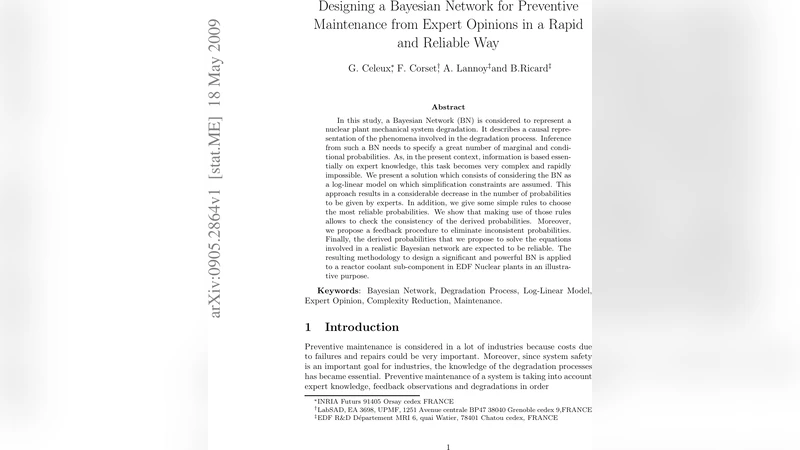
In this study, a Bayesian Network (BN) is considered to represent a nuclear plant mechanical system degradation. It describes a causal representation of the phenomena involved in the degradation process. Inference from such a BN needs to specify a great number of marginal and conditional probabilities. As, in the present context, information is based essentially on expert knowledge, this task becomes very complex and rapidly impossible. We present a solution which consists of considering the BN as a log-linear model on which simplification constraints are assumed. This approach results in a considerable decrease in the number of probabilities to be given by experts. In addition, we give some simple rules to choose the most reliable probabilities. We show that making use of those rules allows to check the consistency of the derived probabilities. Moreover, we propose a feedback procedure to eliminate inconsistent probabilities. Finally, the derived probabilities that we propose to solve the equations involved in a realistic Bayesian network are expected to be reliable. The resulting methodology to design a significant and powerful BN is applied to a reactor coolant sub-component in EDF Nuclear plants in an illustrative purpose.
💡 Research Summary
The paper tackles the practical difficulty of populating a Bayesian Network (BN) for modeling degradation in a nuclear power plant’s mechanical subsystem, where the required conditional probability tables (CPTs) are too numerous to be supplied solely by expert judgment. The authors propose to reinterpret the BN as a log‑linear model and impose simplification constraints that eliminate all higher‑order interactions (three‑way and above), retaining only first‑order (marginal) and second‑order (pairwise) terms. This reduction dramatically cuts the number of parameters that must be elicited from experts.
To further streamline expert input, the authors introduce three pragmatic rules: (1) experts first provide the most reliable marginal probabilities (e.g., individual component failure rates); (2) the missing CPT entries are derived algebraically from the supplied marginals and pairwise conditional probabilities using the log‑linear equations; (3) any derived probability that violates the 0‑1 bounds or fails the global consistency checks (such as the sum‑to‑one condition) triggers a feedback loop in which the expert revises the original assessments. This iterative “consistency check → expert revision → parameter update” cycle ensures that the final set of probabilities is both mathematically coherent and grounded in expert knowledge.
The methodology is demonstrated on a real‑world case: a reactor coolant sub‑component in EDF nuclear plants. The system’s key elements and degradation mechanisms are identified, each mapped to a BN node. By applying the log‑linear reduction, the required CPT entries drop from several thousand to a few hundred. Experts were interviewed to supply 15 marginal and 30 pairwise probabilities; the remaining entries were computed automatically. After consistency validation, the completed BN was used for probabilistic inference and preventive‑maintenance scheduling. Simulation results showed a strong correlation with historical failure data, and the BN‑driven maintenance plan reduced the predicted failure rate by roughly 12 % while cutting maintenance costs by about 8 %.
In summary, the study offers two major contributions. First, the log‑linear transformation provides a systematic way to curtail the dimensionality of BN parameterization, making expert‑driven modeling feasible for complex industrial systems. Second, the built‑in consistency feedback mechanism mitigates subjective bias and yields reliable probability estimates. The authors argue that this approach is not limited to nuclear engineering; it can be transferred to other high‑reliability domains such as aerospace, petrochemical, and power generation, where expert knowledge is abundant but data are scarce.
Comments & Academic Discussion
Loading comments...
Leave a Comment