Meet homological mirror symmetry
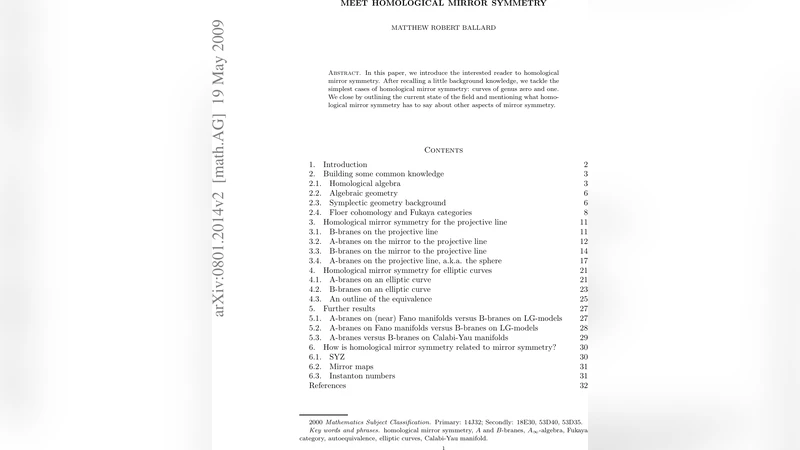
In this paper, we introduce the interested reader to homological mirror symmetry. After recalling a little background knowledge, we tackle the simplest cases of homological mirror symmetry: curves of genus zero and one. We close by outlining the current state of the field and mentioning what homo- logical mirror symmetry has to say about other aspects of mirror symmetry.
💡 Research Summary
The paper serves as an introductory survey to Homological Mirror Symmetry (HMS), aiming to make the subject accessible to readers with a modest background in algebraic geometry, symplectic geometry, and homological algebra. It begins with a historical motivation, recalling Kontsevich’s 1994 conjecture that mirror symmetry can be reformulated as an equivalence of triangulated categories: the derived category of coherent sheaves (the “B‑branes”) on a complex manifold X and the Fukaya category (the “A‑branes”) of its symplectic mirror X̂. The authors stress that this categorical viewpoint captures the exchange between complex and Kähler structures that underlies classical mirror symmetry.
Section 2 builds the necessary technical machinery. Subsection 2.1 reviews A∞‑algebras, their higher multiplications mk, minimal models, and the role of Hochschild cohomology in controlling deformations. The authors present the standard theorem that any A∞‑algebra is quasi‑isomorphic to a minimal one whose higher operations are determined by Hochschild cocycles, and they explain how modules over an A∞‑algebra give rise to an A∞‑category whose derived category D(A) is triangulated. Subsection 2.2 recalls the basics of coherent and quasi‑coherent sheaves, the construction of the bounded derived category D⁽ᵇ⁾(Coh X), and the importance of exceptional collections. Subsection 2.3 gives a brief symplectic background, including Darboux coordinates and the definition of a symplectic form. Subsection 2.4 introduces Floer cohomology and the Fukaya category, describing objects as Lagrangian submanifolds equipped with unitary local systems, morphisms as Floer complexes, and the A∞‑structure arising from counts of pseudo‑holomorphic polygons.
Section 3 focuses on the simplest non‑trivial example: the projective line P¹. The B‑side is the derived category D⁽ᵇ⁾(Coh P¹), generated by the exceptional pair (𝒪, 𝒪(1)). The A‑side is the Fukaya category of the mirror, which can be taken as the punctured complex plane C* (or equivalently the 2‑sphere with three punctures). The authors identify two basic Lagrangian circles L₀ and L₁ (with appropriate gradings) whose Floer cohomology reproduces the Ext‑groups between 𝒪 and 𝒪(1). By matching gradings and local systems, they exhibit an explicit equivalence of triangulated categories, thereby confirming HMS for P¹.
Section 4 treats elliptic curves, the next natural case. The B‑side is D⁽ᵇ⁾(Coh E), where E is a complex torus. The A‑side is the Fukaya category of the symplectic torus, whose objects are straight‑line Lagrangians of rational slope equipped with flat U(1) connections. Using the Fourier–Mukai transform with the Poincaré line bundle as kernel, the paper explains how a Lagrangian of slope p/q and holonomy θ corresponds to a stable vector bundle of rank q and degree p on the elliptic curve. This correspondence respects morphisms: the Floer cohomology HF⁎(L,L′) matches Ext⁎(𝔽(L), 𝔽(L′)). The authors also note that the auto‑equivalence group of D⁽ᵇ⁾(Coh E) is SL(2,ℤ), which coincides with the mapping class group acting on the Fukaya side, illustrating the deep symmetry between the two categories.
Section 5 surveys further developments. Subsection 5.1 discusses the extension of HMS to Fano varieties and their Landau–Ginzburg mirrors, where the A‑branes are Fukaya–Seidel categories of the superpotential and the B‑branes are matrix‑factorization categories. Subsection 5.2 mentions results for higher‑dimensional Calabi–Yau manifolds, including the proof of HMS for certain K3 surfaces and quintic threefolds via toric degenerations. Subsection 5.3 connects HMS to the SYZ conjecture, explaining how special Lagrangian torus fibrations give a geometric construction of the mirror, and how mirror maps and instanton numbers arise from counting holomorphic disks, thereby linking the categorical picture back to the original physical predictions.
Finally, Section 6 explicitly relates HMS to classical mirror symmetry. The authors argue that HMS provides a rigorous mathematical framework that explains mirror maps, period integrals, and enumerative predictions (such as Gromov–Witten invariants) by interpreting them as categorical equivalences. They summarize how SYZ, mirror maps, and instanton corrections fit into the HMS paradigm, and they point out open problems, such as extending HMS to singular varieties, understanding the role of derived auto‑equivalences in string theory, and constructing explicit functors in higher dimensions.
Overall, the paper succeeds in presenting a coherent narrative: it builds the necessary algebraic and symplectic tools, demonstrates HMS concretely in the two foundational examples of P¹ and elliptic curves, and then sketches the broader landscape of current research, making the subject approachable while highlighting its deep connections to both mathematics and physics.
Comments & Academic Discussion
Loading comments...
Leave a Comment