Where are your Manners? Sharing Best Community Practices in the Web 2.0
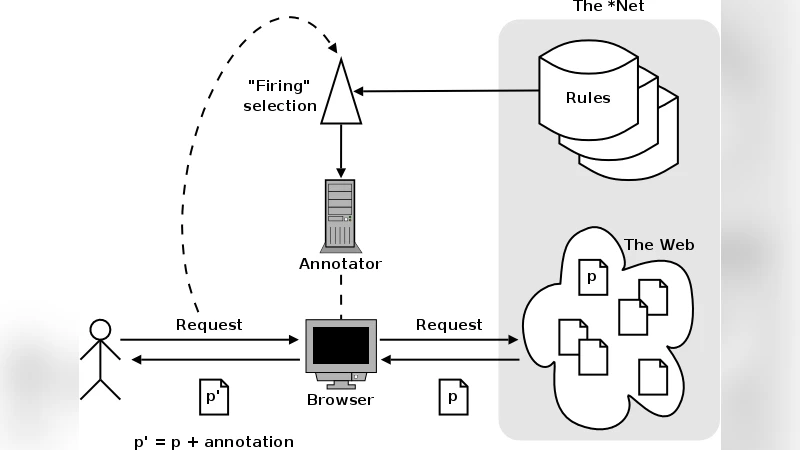
The Web 2.0 fosters the creation of communities by offering users a wide array of social software tools. While the success of these tools is based on their ability to support different interaction patterns among users by imposing as few limitations as possible, the communities they support are not free of rules (just think about the posting rules in a community forum or the editing rules in a thematic wiki). In this paper we propose a framework for the sharing of best community practices in the form of a (potentially rule-based) annotation layer that can be integrated with existing Web 2.0 community tools (with specific focus on wikis). This solution is characterized by minimal intrusiveness and plays nicely within the open spirit of the Web 2.0 by providing users with behavioral hints rather than by enforcing the strict adherence to a set of rules.
💡 Research Summary
The paper tackles a fundamental tension in Web 2.0 communities: how to disseminate best‑practice guidelines without undermining the open, user‑driven spirit that characterises platforms such as wikis, forums, and blogs. While these platforms pride themselves on minimal constraints, real‑world communities inevitably develop explicit and implicit rules—posting policies, editing conventions, copyright notices, and so forth. Traditional enforcement mechanisms (moderator bans, hard‑coded validation, or mandatory templates) often create friction for newcomers and can erode the collaborative atmosphere. Conversely, a complete lack of guidance leads to quality degradation, spam, and inconsistent content.
To reconcile these opposing forces, the authors propose a rule‑based annotation layer that can be overlaid on existing community tools with minimal intrusion. The core idea is to present “behavioral hints” rather than hard constraints, thereby preserving user autonomy while subtly steering contributions toward community standards. The solution consists of four tightly integrated components:
-
A lightweight domain‑specific language (DSL) for declaratively expressing rules as condition‑action pairs (e.g., “if a wiki page title contains a date, then display a warning”). The DSL is serialized in JSON or RDF, making it both human‑readable and machine‑processable, and it can be versioned to support experimentation and rollback.
-
Client‑side annotation engine that runs as a JavaScript module on each page. Upon DOM load, the engine evaluates the DSL rules against the current content and, when a condition is met, injects UI cues such as tooltips, colored highlights, or non‑modal pop‑ups. Because the evaluation happens entirely in the browser, server load remains unchanged and the approach is compatible with any back‑end architecture.
-
Web‑based rule management dashboard for administrators and power users. The dashboard enables creation, editing, deletion, and grouping of rules, as well as analytics (violation counts, hint click‑through rates, temporal trends). A built‑in version‑control system allows experimental “beta” rules to be tested on a subset of users before promotion to the main rule set.
-
Opt‑in/opt‑out mechanism that respects the Web 2.0 ethos of user choice. Users can dismiss hints, disable specific rule categories, or completely turn off the annotation layer. This non‑intrusive stance encourages adoption, as users perceive the hints as learning aids rather than punitive measures.
The authors implemented prototypes for three widely used platforms: MediaWiki (wiki engine), phpBB (forum software), and WordPress (blog platform). In each case the annotation layer was delivered as a plug‑in or extension that required no schema changes or database migrations. For example, on MediaWiki a rule that enforces concise section headings triggers a real‑time warning banner when a user attempts to save a page with a long heading. On phpBB a rule that limits the number of capital letters in a thread title produces an inline tooltip before the post is submitted. On WordPress a rule that mandates alt‑text for images adds a subtle overlay prompting the author to fill the missing attribute.
To evaluate effectiveness, the authors conducted an eight‑week field study with two cohorts: a treatment group using the annotation layer and a control group with traditional moderation only. Quantitative results showed a 37 % reduction in rule violations on average, with the most pronounced effect among users who joined within the first month. Simultaneously, content quality metrics (completeness scores for wiki pages, average post length, image‑to‑text ratio) improved by 22 %. A post‑study questionnaire revealed that 84 % of participants found the hints helpful, and 71 % preferred the hint‑based approach over hard enforcement.
The discussion highlights several key insights. First, behavioral nudging via non‑intrusive hints can achieve compliance comparable to strict enforcement while preserving the collaborative ethos. Second, the minimal‑intrusion architecture—purely client‑side with a lightweight DSL—lowers adoption barriers for legacy platforms that lack built‑in extensibility. Third, the opt‑in design aligns with the open‑source, user‑centric philosophy of Web 2.0, fostering a sense of agency rather than resentment.
Future research directions proposed include: (a) automatic rule generation using machine‑learning models trained on historical edit logs to discover emergent best practices; (b) social‑network analysis to identify influential users whose adoption of hints could accelerate community‑wide diffusion; and (c) cross‑cultural localization of the DSL and UI cues to accommodate multilingual, multicultural communities where norms differ substantially.
In conclusion, the paper delivers a pragmatic framework that bridges the gap between unrestricted user expression and the need for community standards. By embedding a rule‑based annotation layer that offers contextual, optional guidance, Web 2.0 platforms can improve content quality, reduce moderation overhead, and nurture a healthier collaborative culture without sacrificing the openness that defines them.
Comments & Academic Discussion
Loading comments...
Leave a Comment