Introduction to papers on astrostatistics
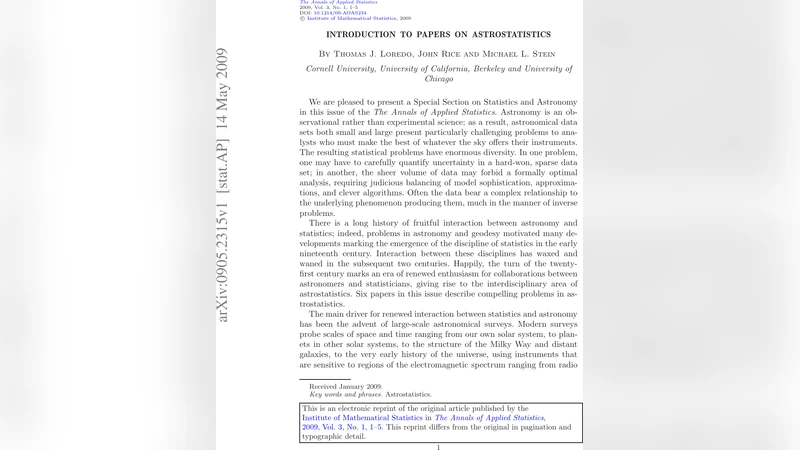
We are pleased to present a Special Section on Statistics and Astronomy in this issue of the The Annals of Applied Statistics. Astronomy is an observational rather than experimental science; as a result, astronomical data sets both small and large present particularly challenging problems to analysts who must make the best of whatever the sky offers their instruments. The resulting statistical problems have enormous diversity. In one problem, one may have to carefully quantify uncertainty in a hard-won, sparse data set; in another, the sheer volume of data may forbid a formally optimal analysis, requiring judicious balancing of model sophistication, approximations, and clever algorithms. Often the data bear a complex relationship to the underlying phenomenon producing them, much in the manner of inverse problems.
💡 Research Summary
The paper serves as the introductory editorial for a Special Section titled “Statistics and Astronomy” in The Annals of Applied Statistics. It frames astronomy as an inherently observational science, where the lack of experimental control forces researchers to work with data that can be either extremely sparse or overwhelmingly massive. This duality creates a spectrum of statistical challenges that demand both rigorous uncertainty quantification and computational pragmatism.
First, the authors discuss the problem of sparse, high‑cost observations such as spectra of distant galaxies or light curves of rare supernovae. Traditional frequentist methods often falter because the sample size is too small to support reliable confidence intervals. In these settings, Bayesian approaches become indispensable: informative priors encode astrophysical knowledge, while Markov chain Monte Carlo (MCMC) or variational inference provide full posterior distributions. Non‑parametric techniques, including bootstrap and resampling, are also highlighted as valuable tools for assessing variability when parametric assumptions are questionable.
Second, the editorial turns to the era of big data in astronomy, driven by next‑generation facilities like the Large Synoptic Survey Telescope (LSST), the James Webb Space Telescope (JWST), and large‑scale space missions. Data volumes now reach terabytes to petabytes, rendering exact, full‑sample analyses computationally infeasible. The authors advocate for a balanced strategy that blends model sophistication with algorithmic efficiency. Distributed computing frameworks (e.g., Spark, Hadoop) and streaming algorithms enable real‑time processing, while stochastic gradient descent and online variational Bayes allow approximate inference at scale. Machine‑learning pipelines, particularly deep neural networks for feature extraction, are presented as pragmatic compromises that capture complex patterns without the prohibitive cost of fully Bayesian hierarchical models.
Third, the paper emphasizes the prevalence of inverse problems in astronomical data analysis. Observables—such as gravitational lensing shear, spectral line profiles, or time‑domain variability—are indirect manifestations of underlying physical quantities like mass distributions, chemical abundances, or stellar interiors. Recovering these latent parameters requires regularization and prior information to stabilize the solution against noise and ill‑posedness. Techniques ranging from Tikhonov regularization to sparsity‑promoting priors and Bayesian hierarchical modeling are discussed as modern solutions that integrate physical constraints with statistical rigor.
The editorial also notes that many astronomical datasets exhibit multi‑wavelength, temporal, and spatial dependencies simultaneously. To address this complexity, the authors point to multivariate time‑series models, hierarchical Bayesian frameworks, and spatio‑temporal Gaussian processes as powerful tools that respect the intrinsic correlations across dimensions. Such integrated models improve predictive performance and enable more nuanced scientific inference.
Finally, the authors call for a cultural shift toward deeper collaboration between astronomers and statisticians. They argue that successful analysis hinges on mutual understanding: astronomers must articulate the scientific questions and data acquisition nuances, while statisticians must tailor methods to the peculiarities of astronomical measurements. The paper highlights ongoing initiatives—joint workshops, interdisciplinary graduate programs, and open‑source software projects—that aim to bridge this gap and foster a vibrant community of astro‑statisticians.
In sum, the Special Section showcases a broad array of contemporary statistical methodologies applied to the unique challenges of astronomical data. By juxtaposing the demands of precise inference from scarce observations with the necessity of scalable algorithms for massive surveys, and by addressing the intrinsic inverse‑problem nature of many measurements, the editorial sets the stage for a new era of collaborative, methodologically sophisticated astro‑statistics.
Comments & Academic Discussion
Loading comments...
Leave a Comment