First Stars -- Type Ib Supernovae Connection
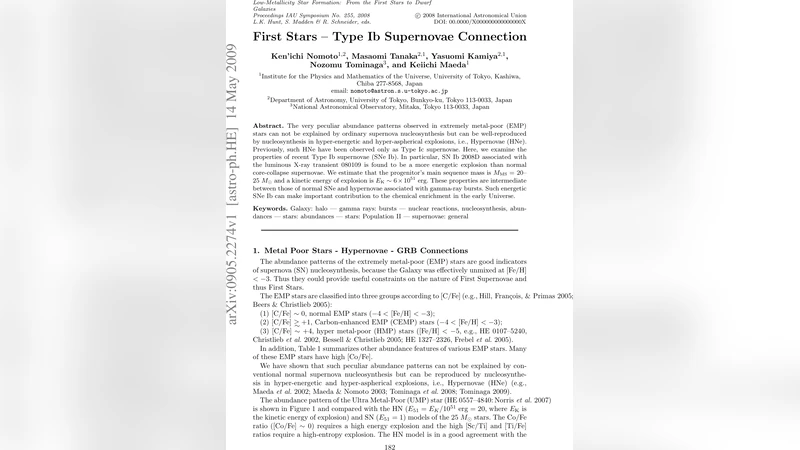
The very peculiar abundance patterns observed in extremely metal-poor (EMP) stars can not be explained by ordinary supernova nucleosynthesis but can be well-reproduced by nucleosynthesis in hyper-energetic and hyper-aspherical explosions, i.e., Hypernovae (HNe). Previously, such HNe have been observed only as Type Ic supernovae. Here, we examine the properties of recent Type Ib supernovae (SNe Ib). In particular, SN Ib 2008D associated with the luminous X-ray transient 080109 is found to be a more energetic explosion than normal core-collapse supernovae. We estimate that the progenitor’s main sequence mass is 20–25 M_sun and a kinetic energy of explosion is ~ 6 x 10^{51} erg. These properties are intermediate between those of normal SNe and hypernovae associated with gamma-ray bursts. Such energetic SNe Ib can make important contribution to the chemical enrichment in the early Universe.
💡 Research Summary
The paper addresses a long‑standing problem in Galactic archaeology: the unusual abundance patterns observed in extremely metal‑poor (EMP) stars cannot be reproduced by nucleosynthesis yields from ordinary core‑collapse supernovae (CCSNe). EMP stars show an overabundance of light elements such as carbon, nitrogen, and oxygen, together with enhanced iron‑peak elements (Zn, Co, V) that are characteristic of hyper‑energetic, highly aspherical explosions known as hypernovae (HNe). Historically, HNe have been identified only with Type Ic supernovae—events that have lost both their hydrogen and helium envelopes—and are often linked to long gamma‑ray bursts (GRBs) originating from very massive progenitors (>30 M☉).
The authors turn their attention to a recent Type Ib supernova, SN 2008D, which was discovered in association with the luminous X‑ray transient 080109. By analyzing the early X‑ray flash, the optical light curve, and the evolution of spectral line velocities, they infer a kinetic energy of roughly 6 × 10^51 erg, significantly higher than the canonical 1 × 10^51 erg of normal CCSNe but lower than the ≈10^52 erg typical of classical HNe. They estimate the progenitor’s main‑sequence mass to be in the range 20–25 M☉, placing it between the usual mass range for normal SNe and that of GRB‑associated HNe.
Detailed nucleosynthesis calculations are performed for an explosion with this intermediate energy and a modest degree of asymmetry (jet‑like outflows). The high temperatures (>5 × 10^9 K) and densities achieved in the jet channel drive an efficient α‑process and complete silicon burning, producing large amounts of Zn, Co, and V while also leaving a substantial helium envelope. The presence of the helium layer allows for the mixing of CNO‑rich material into the ejecta, naturally reproducing the C, N, O excesses seen in EMP stars. The model predicts a characteristic abundance pattern: elevated
Comments & Academic Discussion
Loading comments...
Leave a Comment