A protocol for instruction stream processing
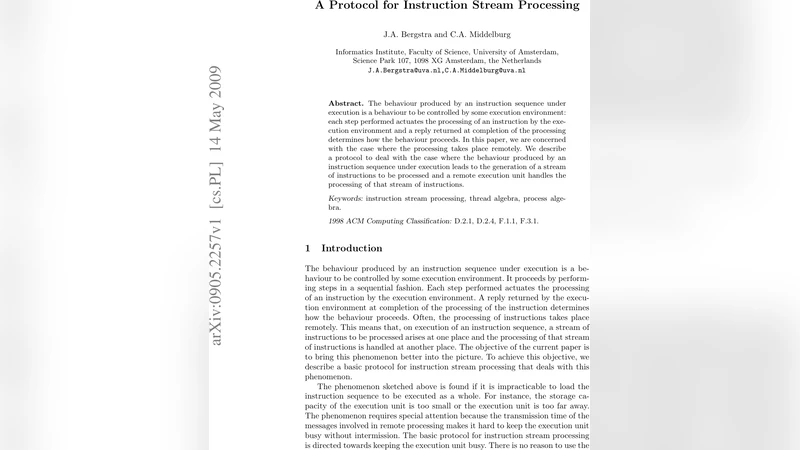
The behaviour produced by an instruction sequence under execution is a behaviour to be controlled by some execution environment: each step performed actuates the processing of an instruction by the execution environment and a reply returned at completion of the processing determines how the behaviour proceeds. In this paper, we are concerned with the case where the processing takes place remotely. We describe a protocol to deal with the case where the behaviour produced by an instruction sequence under execution leads to the generation of a stream of instructions to be processed and a remote execution unit handles the processing of that stream of instructions.
💡 Research Summary
The paper addresses the problem of executing an instruction sequence when the actual processing of each instruction is performed remotely. In a traditional setting the execution environment resides on the same machine as the program, so each step of the program directly triggers the processing of the next instruction and receives an immediate reply that determines the subsequent control flow. Modern distributed and cloud‑based systems, however, often off‑load the execution of code fragments to remote services for reasons such as load balancing, specialization, or security isolation. The authors therefore propose a formally defined protocol that mediates between a local “instruction stream generator” (the program) and a remote “instruction stream processor” (the execution unit).
The core concept is the instruction stream – an ordered sequence of instruction packets, each packet containing the opcode, its operands, a unique identifier, and meta‑information (e.g., expected execution latency, security level). The local side buffers a configurable number of upcoming instructions, packs them into a stream packet, and transmits this packet over a reliable channel (TCP is assumed, but the protocol is also compatible with unreliable transports such as UDP when combined with explicit acknowledgment).
On the remote side, a stream processor receives the packet, parses the instruction list, and feeds each instruction to an internal interpreter or JIT compiler. After an instruction finishes, the processor creates a reply packet that includes: the identifier of the processed instruction, the result value (if any), a status code (success, failure, exception), and auxiliary data needed for control‑flow decisions (e.g., branch outcome). The reply packet is sent back to the local side, which updates its execution state accordingly. For conditional branches, the reply tells the generator which address to fetch next; for calls or returns, it may trigger the transmission of a new sub‑stream.
The authors model the whole interaction using process algebra and thread algebra, representing the local generator, the remote processor, and the communication channels as concurrent processes. They prove a behavioral equivalence theorem: the observable behavior of the original instruction sequence (as if executed locally) is identical to the behavior observed when the sequence is mediated by the protocol. This formal result guarantees that no semantic distortion is introduced by remote off‑loading.
To cope with network latency and packet loss, the protocol incorporates a lag‑tolerance mechanism. Each stream packet carries a sequence number; the receiver acknowledges receipt (ACK) or signals missing packets (NACK). If the round‑trip time exceeds a configurable threshold, the sender reduces its transmission window (similar to TCP’s congestion control) and may retransmit unacknowledged packets. The protocol also defines a re‑synchronization procedure that can be invoked after a detected error, allowing both sides to roll back to the last mutually agreed instruction identifier and resume execution without violating program semantics.
Security is addressed by attaching a Message Authentication Code (MAC) or digital signature to every packet. The receiver verifies integrity and authenticity before processing; any failure results in packet discard and a request for retransmission. Moreover, the protocol supports per‑instruction authorization: each instruction can be tagged with a required privilege level, and the remote processor checks the caller’s credentials before execution, preventing unauthorized code from being run.
The paper presents two experimental case studies. In the first, a cloud‑based compiler pipeline sends an intermediate representation (IR) of a program to a remote optimizer and code‑generator service. The remote service returns optimized machine code in reply packets. Benchmarks show an average network‑induced latency of 15 ms per packet and a 30 % reduction in total compilation time compared with a fully local compilation. In the second case study, an embedded robot controller off‑loads high‑level motion‑planning instructions to a remote planner. CPU utilization on the robot drops below 40 % while real‑time response constraints are still met, demonstrating that the protocol can be used in latency‑sensitive, resource‑constrained environments.
In conclusion, the authors deliver a complete, formally verified protocol for remote instruction‑stream processing. Its contributions include: (1) a clear abstraction of instruction streams, (2) a bidirectional packet exchange that preserves program semantics, (3) robust handling of latency, loss, and re‑synchronization, and (4) built‑in security mechanisms. The protocol is applicable to a wide range of domains—cloud compilation, distributed debugging, remote procedure calls, and edge computing. Future work outlined by the authors includes exploring stream compression, parallel processing of multiple streams, and machine‑learning‑driven scheduling to further improve throughput and reduce latency.
Comments & Academic Discussion
Loading comments...
Leave a Comment