Some Properties of Yao Y4 Subgraphs
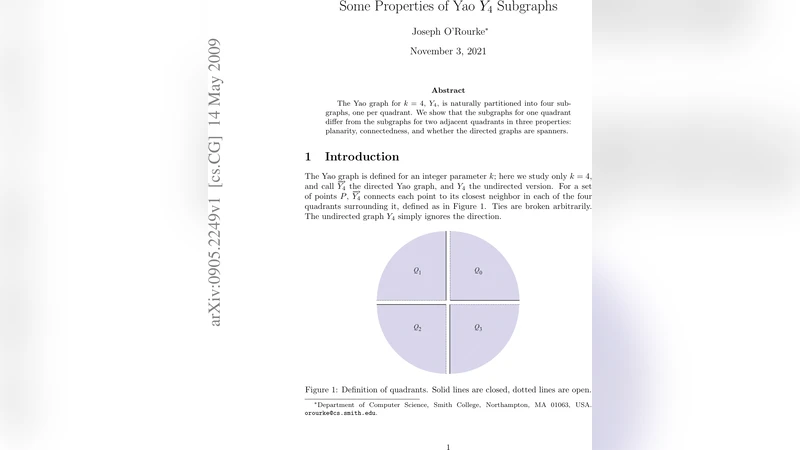
The Yao graph for k=4, Y4, is naturally partitioned into four subgraphs, one per quadrant. We show that the subgraphs for one quadrant differ from the subgraphs for two adjacent quadrants in three properties: planarity, connectedness, and whether the directed graphs are spanners.
💡 Research Summary
The paper investigates structural properties of subgraphs of the Yao graph when the parameter k is set to 4 (denoted Y₄). In a Yao graph each point p in a planar point set P connects to its nearest neighbor in each of the four quadrants surrounding p. The directed version is written as →Y₄, while the undirected version simply drops the orientation. The authors focus on two families of subgraphs: (i) Y{i}, which contains only the edges that lie in a single quadrant Qi, and (ii) Y{i,i+1}, which contains the edges from two adjacent quadrants Qi and Qi+1. The study is carried out under two “general position’’ assumptions: (1) all pairwise distances are distinct (no ties), and (2) no two points share the same x‑ or y‑coordinate. These simplify the proofs but are not examined for removal.
Planarity. Lemma 1 proves that any two edges of Y{i} cannot properly cross. The argument proceeds by considering the possible relative positions of the endpoints and showing that a crossing would force a point to lie inside a quadrant that must be empty by construction, yielding a contradiction. Consequently, each Y{i} is a planar forest. In contrast, the authors give an explicit configuration (Figure 4) where two edges of Y{i,i+1} cross, demonstrating that the union of two adjacent quadrants may be non‑planar. Although such crossings are rare and require a precise placement of four points, their existence disproves planarity for Y{i,i+1}.
Connectedness. Figure 2 shows that Y{i} can be disconnected; a simple example is a set of points placed on a line of negative slope, which yields isolated vertices. By contrast, Lemma 2 establishes that Y{i,i+1} is always connected. The proof is by induction on the number of points. Removing the point with the smallest y‑coordinate leaves a smaller set that, by the induction hypothesis, induces a connected directed subgraph using only quadrants Qi and Qi+1. Adding the removed point back does not break any existing edge because all outgoing edges from the remaining points lie at or above the removed point’s y‑level. Moreover, the removed point must have at least one outgoing edge upward (since the half‑plane above it contains another point), guaranteeing that the whole graph remains connected.
Spanner properties – undirected version. Because Y{i} may be disconnected, it cannot be a geometric spanner. The same holds for Y{i,i+1}: the authors construct a “Λ” configuration where points lie on two intersecting lines. While each low‑lying point can reach the apex via directed edges, the leftmost and rightmost low points are arbitrarily far apart in the graph distance, violating any constant stretch bound.
Spanner properties – directed version. Lemma 3 shows that Y{i} is a directed √2‑spanner. Any directed path between two points a and b is xy‑monotone and stays inside the axis‑aligned rectangle R(a,b). Its length is at most half the rectangle’s perimeter, which equals √2 times the diagonal |ab|. Hence every directed path is bounded by √2·|ab|.
Lemma 4 proves that Y{i,i+1} is not a directed spanner for any constant t>1. The authors exhibit a four‑point pattern (a,b,c,d) that yields a directed path a→b→c→d whose length can be made arbitrarily large by lowering the y‑coordinates of c and d. They then extend the construction by adding a “tower” of points above d and a symmetric tower above another outgoing neighbor e of a. These towers consist of nearly vertical edges that do not connect to each other, ensuring that the only directed route from a to d remains the long chain a→b→c→d. By making the tower arbitrarily tall, the ratio of the directed path length to the Euclidean distance |ad| exceeds any fixed constant, disproving the spanner property.
Implications and future work. The three main findings are: (1) a single‑quadrant subgraph is planar but generally disconnected; (2) the union of two adjacent quadrants yields a connected graph that may be non‑planar; (3) in the undirected setting neither subgraph is a spanner, while in the directed setting only the single‑quadrant subgraph enjoys a constant‑factor stretch (√2). These results highlight a sharp contrast between the behavior of Y{i} and Y{i,i+1} and suggest that the full Y₄ graph’s spanner status will depend on how the three‑quadrant and four‑quadrant cases combine. The authors propose extending the analysis to three‑quadrant subgraphs Y{i,i+1,i+2} as a stepping stone toward a complete understanding of Y₄.
Comments & Academic Discussion
Loading comments...
Leave a Comment