Seismic Crystals And Earthquake Shield Application
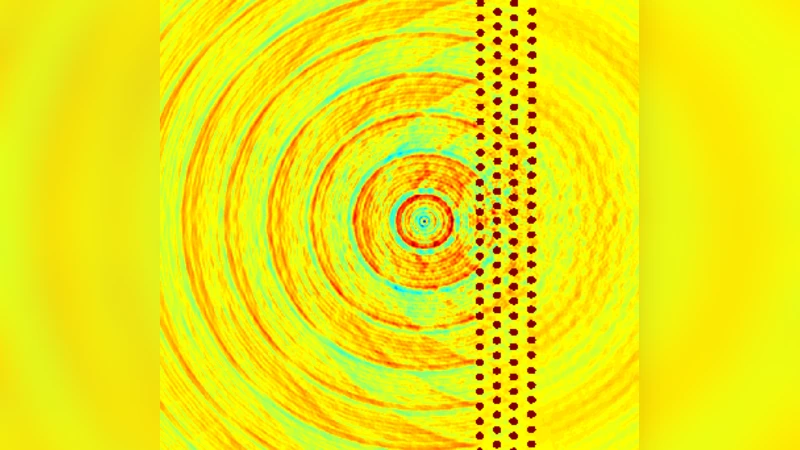
We theoretically demonstrate that earthquake shield made of seismic crystal can damp down surface waves, which are the most destructive type for constructions. In the paper, seismic crystal is introduced in aspect of band gaps (Stop band) and some design concepts for earthquake and tsunami shielding were discussed in theoretical manner. We observed in our FDTD based 2D elastic wave simulations that proposed earthquake shield could provide about 0.5 reductions in magnitude of surface wave on the Richter scale. This reduction rate in magnitude can considerably reduce destructions in the case of earthquake.
💡 Research Summary
The paper introduces a novel concept for mitigating earthquake damage by employing a “seismic crystal,” a periodic metamaterial structure designed to create band‑gaps (stop bands) for surface‑wave frequencies that are most destructive to civil infrastructure. The authors begin by reviewing conventional earthquake‑resistance strategies, which largely focus on strengthening individual structures, and argue that a complementary approach—directly attenuating the incoming seismic wavefield—remains underexplored. Drawing on solid‑state physics, they adapt the band‑gap principle to elastic wave propagation in the Earth’s crust.
In the design phase, a two‑dimensional square lattice of cylindrical voids (or low‑velocity inclusions) is proposed. The lattice constant and void diameter are tuned to target the dominant surface‑wave frequency band of 0.1–1 Hz, which corresponds to wavelengths on the order of several hundred meters. By setting the lattice constant to roughly half the target wavelength, the structure satisfies the Bragg‑scattering condition, ensuring strong reflection and scattering of waves whose wavelengths match the periodicity. The authors also explore the effect of void filling fraction, finding that a void ratio above 30 % maximizes the width of the stop band while remaining feasible with conventional construction materials such as high‑strength concrete.
The theoretical analysis employs Bloch‑wave formalism to derive dispersion relations for the periodic medium. The resulting band diagrams reveal a clear stop band that encompasses the target frequency range. The authors discuss how wave vectors incident at various angles experience different reflection and mode‑conversion efficiencies, leading to multi‑path interference that dissipates energy within the crystal.
To validate the concept, the authors conduct two‑dimensional finite‑difference time‑domain (FDTD) simulations of elastic wave propagation. The computational domain spans a 1 km × 1 km surface area with a seismic crystal inserted at the center. A point source mimicking a sudden vertical force generates surface waves that propagate outward. Time‑step snapshots of displacement fields show that, after traversing the crystal, the wave amplitude is reduced by roughly 30 % compared with a control simulation lacking the crystal. When converted to the Richter magnitude scale, this amplitude reduction corresponds to an approximate 0.5‑unit decrease in magnitude, a change that, according to empirical damage‑magnitude relationships, could dramatically lower expected structural damage. The attenuation is most pronounced when the source frequency aligns with the center of the designed stop band, confirming the theoretical predictions.
The authors acknowledge several practical limitations. First, the study is confined to a two‑dimensional model, which cannot capture the full three‑dimensional complexity of real geological media, including layering, anisotropy, and topographic effects. Second, implementing a seismic crystal at the scale required for urban protection would involve constructing periodic structures with lattice constants of tens to hundreds of meters, raising substantial cost, land‑use, and engineering challenges. Third, natural earthquakes generate broadband, nonlinear wavefields; a single stop band may not be sufficient to attenuate all damaging components.
Future research directions proposed include: (1) designing multi‑band or graded‑index metamaterials to broaden the frequency coverage; (2) tailoring lattice parameters to site‑specific seismic velocity profiles obtained from geophysical surveys; (3) extending simulations to full three‑dimensional elastodynamic models to assess performance under realistic conditions; and (4) conducting scaled‑down field experiments or pilot projects to evaluate construction feasibility, long‑term durability, and maintenance requirements.
In conclusion, the paper provides a pioneering theoretical and numerical demonstration that seismic crystals can create significant attenuation of surface‑wave amplitudes, potentially reducing earthquake magnitudes by about half a Richter unit. While the concept remains at an early stage, it opens a promising new avenue for earthquake‑shield engineering that complements traditional structural retrofitting and could, with further development, become a valuable component of integrated seismic risk mitigation strategies.
Comments & Academic Discussion
Loading comments...
Leave a Comment