The bitwisted Cartesian model for the free loop fibration
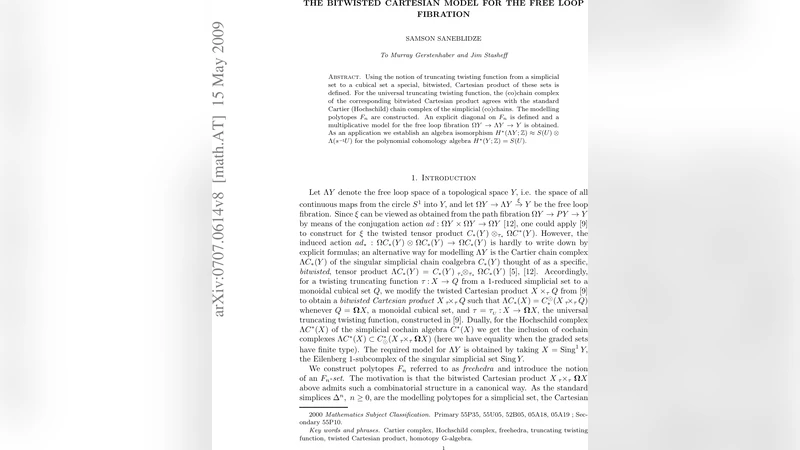
Using the notion of truncating twisting function from a simplicial set to a cubical set a special, bitwisted, Cartesian product of these sets is defined. For the universal truncating twisting function, the (co)chain complex of the corresponding bitwisted Cartesian product agrees with the standard Cartier (Hochschild) chain complex of the simplicial (co)chains. The modelling polytopes $F_n$ are constructed. An explicit diagonal on $F_n$ is defined and a multiplicative model for the free loop fibration $\Omega Y\to \Lambda Y\to Y$ is obtained. As an application we establish an algebra isomorphism $H^(\Lambda Y;\mathbb{Z}) \approx S(U)\otimes \Lambda(s^{_{-1}}U)$ for the polynomial cohomology algebra $H^(Y;\mathbb{Z})=S(U).$
💡 Research Summary
The paper introduces a novel combinatorial framework for modeling the free loop fibration ΩY → ΛY → Y by exploiting a “truncating twisting function” τ that maps a simplicial set S to a cubical set C. Unlike classical twisting functions, which merely encode a non‑trivial action of a simplicial set on a cubical one, a truncating twisting function explicitly cuts off higher‑dimensional information, thereby aligning the simplicial and cubical structures in a way that respects their respective face and degeneracy operators.
Using τ, the authors define a “bitwisted Cartesian product” S⊠_τ C. An element of this product in degree n is a pair (s,c)∈S_n×C_n satisfying a compatibility condition dictated by τ(s) and the cubical face structure of c. This construction can be viewed as a simultaneous Cartesian product equipped with a twist that depends on both factors, hence the term “bitwisted.”
A central object of the study is the universal truncating twisting function τ̄, which exists for any simplicial set S and its standard cubical subdivision C(S). When τ=τ̄, the chain complex C_(S⊠_{τ̄} C) is shown to be canonically isomorphic to the classical Cartier (or Hochschild) chain complex of the simplicial cochains C^(S). In other words, the bitwisted product provides a concrete cubical‑simplicial model whose homology reproduces the well‑known Hochschild‑Cartier homology, but with a much more transparent combinatorial description.
To make the construction explicit, the authors introduce a family of polytopes F_n, each of which can be thought of as a hybrid of an n‑cube and an n‑simplex. The faces of F_n are indexed by the data of τ̄, and the authors give a closed‑form formula for a diagonal map Δ: F_n → F_n ⊗ F_n. This diagonal is compatible with the cellular chain structure and respects the bitwisted product’s twist, thereby endowing the cellular chains of F_n with a coassociative coproduct. The existence of such an explicit diagonal is crucial for constructing multiplicative models of loop spaces.
Armed with the diagonal on F_n, the paper proceeds to build a multiplicative cellular model for the free loop fibration. Let K be a simplicial model of Y and C(K) its cubical subdivision. The bitwisted product K⊠_{τ̄} C(K) serves as a cellular model for ΛY, and the diagonal Δ on the associated polytopes induces a product on cellular cochains that coincides with the Pontryagin product on ΩY after passing to homology. Consequently, the fibration ΩY → ΛY → Y is modeled by a short exact sequence of differential graded algebras, making the algebraic structure of the free loop space completely explicit at the chain level.
As a concrete application, the authors consider spaces Y whose integral cohomology algebra is a polynomial algebra S(U) on a graded vector space U (e.g., classifying spaces of tori or complex projective spaces). Using the bitwisted model, they compute the cohomology of the free loop space and obtain an isomorphism of graded algebras:
\
Comments & Academic Discussion
Loading comments...
Leave a Comment