The 3D velocity structure of the planetary nebula NGC 7009
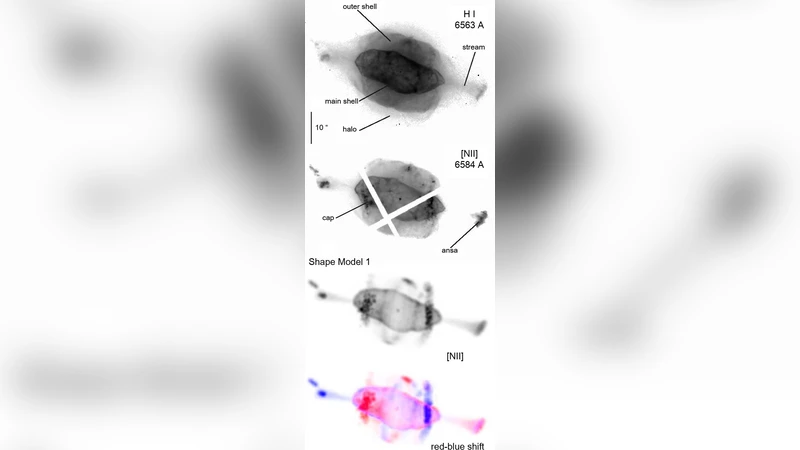
In search for deviations from homologous expansion in planetary nebulae we present a 3D morphokinematical model of NGC 7009. The model has been constructed with {\em Shape} based on PV diagrams from the literature and HST images. We find that the data are consistent with a radial velocity field with increased gradient at high latitudes compared to the equatorial region (Model 1). In a second model we assume a linearly increasing radial velocity component with an added poloidal component of order 10 km/s at latitudes around $70^\circ$. The true velocity field is likely to be in between these two limiting cases. We also find that the expansion of the ansae is non-radial with reference to the central star. Their velocity field is focused near the apparent exit points from the main shell. We predict the proper motion pattern for the model with a non-zero poloidal velocity component.
💡 Research Summary
The paper presents a detailed three‑dimensional morpho‑kinematic study of the planetary nebula NGC 7009 (the “Saturn Nebula”), aiming to test the widely used assumption of homologous (radial, linearly increasing) expansion. Using the interactive modelling tool Shape, the authors combine archival Hubble Space Telescope (HST) narrow‑band images with published position‑velocity (PV) diagrams obtained from long‑slit spectroscopy in the
Comments & Academic Discussion
Loading comments...
Leave a Comment