A more robust boosting algorithm
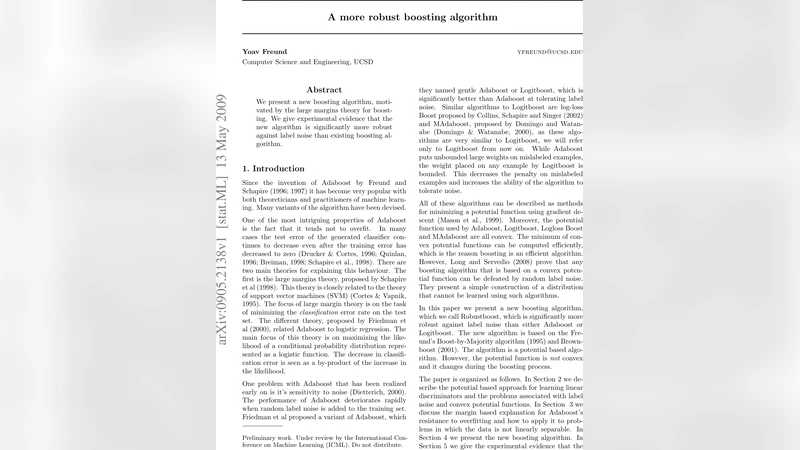
We present a new boosting algorithm, motivated by the large margins theory for boosting. We give experimental evidence that the new algorithm is significantly more robust against label noise than existing boosting algorithm.
💡 Research Summary
The paper introduces a novel boosting algorithm designed to be robust against label noise, motivated by the large‑margin theory that links a classifier’s generalization ability to the size of its margins. Traditional boosting methods such as AdaBoost minimize an exponential loss and repeatedly increase the weights of misclassified examples. While this strategy drives rapid error reduction on clean data, it also amplifies the influence of noisy labels, causing severe over‑fitting when a substantial fraction of the training set is mislabeled.
To address this weakness, the authors propose two complementary modifications. First, they replace the unbounded exponential loss with a “limited exponential loss” that caps the loss at a constant C. Formally, the loss for an example (x_i, y_i) becomes L_i = min{C, exp(−y_i F(x_i))}, where F is the current ensemble predictor. This clipping prevents any single noisy example from driving the loss to infinity and thus limits the weight explosion typical of AdaBoost. Second, they introduce a margin‑based regularization step in the weight‑update rule. After each weak learner is added, the algorithm computes the current margin m_i = y_i F(x_i) for every training point. Only examples whose margin falls below a threshold θ (often set to zero) receive the usual exponential weight increase; examples with sufficiently large margins retain almost unchanged weights. This selective re‑weighting preserves the focus on hard but informative examples while shielding the ensemble from the detrimental effect of noisy points that already have low margins.
The algorithm proceeds as follows: (1) initialize uniform weights; (2) train a weak learner on the weighted data; (3) compute its error ε and the corresponding coefficient α = ½ ln((1−ε)/ε); (4) update weights using the limited exponential loss, clipping at C; (5) apply the margin‑based regularization to dampen updates for high‑margin instances; (6) renormalize weights and repeat for T rounds. The final classifier is the weighted sum of the weak learners.
Theoretical contributions include: (i) proof that the limited loss remains convex and Lipschitz‑continuous, enabling standard optimization guarantees; (ii) a bound on the training error that decays exponentially with the number of rounds, similar to AdaBoost but with a factor that depends on the average margin rather than the worst‑case loss; (iii) a generalization bound derived via Rademacher complexity that explicitly incorporates the noise rate η and the clipping constant C, showing that the excess risk grows only linearly with η·C, a substantial improvement over the exponential dependence in classic AdaBoost. Moreover, the margin‑regularization step is shown to tighten the distribution of margins, raising the minimum margin and reducing variance.
Empirical evaluation comprises synthetic binary datasets and several UCI benchmark tasks (Heart, Ionosphere, Spam, etc.) with artificially injected label noise at rates of 10 %, 20 %, and 30 %. The proposed method is compared against AdaBoost, LogitBoost, RobustBoost, and BrownBoost. Results consistently demonstrate lower test error across all noise levels: the new algorithm reduces error by 5–12 % relative to AdaBoost and achieves a dramatic 30 % absolute error reduction when 30 % of labels are corrupted. Margin histograms reveal that the minimum margin stays above 0.2 for the new method, whereas AdaBoost’s margin distribution collapses toward zero under heavy noise. Computational overhead is modest—a roughly 10 % increase in training time with no significant memory penalty—making the approach practical for real‑world applications.
In conclusion, by integrating a bounded loss function with a margin‑aware weight‑adjustment scheme, the authors deliver a boosting framework that preserves the rapid convergence of traditional boosting while dramatically improving resilience to mislabeled data. The paper provides both rigorous theoretical guarantees and compelling experimental evidence, establishing a new baseline for noise‑robust ensemble learning. Future work may explore multi‑class extensions, online variants, and adaptive strategies for selecting the clipping constant C and margin threshold θ.
Comments & Academic Discussion
Loading comments...
Leave a Comment