Challenges facing young astrophysicists
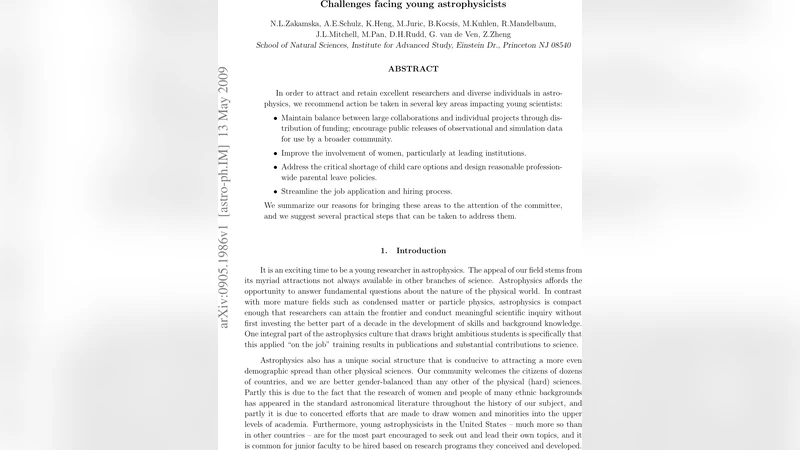
In order to attract and retain excellent researchers and diverse individuals in astrophysics, we recommend action be taken in several key areas impacting young scientists: (1) Maintain balance between large collaborations and individual projects through distribution of funding; encourage public releases of observational and simulation data for use by a broader community. (2) Improve the involvement of women, particularly at leading institutions. (3) Address the critical shortage of child care options and design reasonable profession-wide parental leave policies. (4) Streamline the job application and hiring process. We summarize our reasons for bringing these areas to the attention of the committee, and we suggest several practical steps that can be taken to address them.
💡 Research Summary
The paper “Challenges facing young astrophysicists” presents a concise yet comprehensive set of recommendations aimed at improving the professional environment for early‑career researchers in astrophysics. It identifies four interrelated problem areas—funding balance between large collaborations and individual projects, gender equity, parental‑care support, and hiring inefficiencies—and proposes concrete actions for each.
First, the authors argue that the current funding ecosystem overly favors massive, multi‑institutional collaborations, which, while essential for cutting‑edge observations and simulations, can marginalize independent investigators who lack access to high‑profile data sets. To correct this, they suggest that funding agencies allocate a defined percentage of their annual budgets (for example, 30 %) to small‑scale, investigator‑driven proposals and require that all data generated by large collaborations be deposited in publicly accessible archives within a reasonable time frame. This would democratize data use, enable junior scientists to produce high‑impact papers, and preserve a healthy diversity of research approaches.
Second, the paper highlights the persistent under‑representation of women, especially at elite research institutions. The authors attribute this to a combination of implicit bias in hiring and promotion, limited mentorship opportunities, and the challenge of balancing family responsibilities with demanding research schedules. Their recommendations include establishing women‑focused grant programs, creating structured mentorship networks that pair senior female astronomers with early‑career mentees, and instituting gender‑balanced hiring targets. They also advocate for blind review processes in grant and paper evaluations to reduce unconscious bias.
Third, the authors address the acute shortage of reliable childcare and the lack of standardized parental‑leave policies. They note that postdoctoral fellows and newly appointed faculty often relocate frequently and work long hours, making it difficult to secure stable childcare. The paper calls for a minimum six‑month paid parental leave that is uniformly applied across institutions, the development of on‑site childcare facilities or subsidies for external services, and the adoption of flexible work arrangements such as remote work and reduced‑hour schedules during the early parenting years. These measures are presented as essential for retaining talented researchers who might otherwise leave the field.
Finally, the manuscript critiques the current job‑application cycle, which is heavily concentrated in the fall, involves cumbersome paperwork, and requires multiple in‑person interviews. This system imposes significant time and financial burdens on both applicants and hiring committees. To streamline the process, the authors propose a synchronized, bi‑annual posting schedule, the creation of a universal online application portal with automated eligibility checks, and the use of preliminary video or phone interviews to filter candidates before on‑site visits. Such reforms would reduce administrative overhead, shorten time‑to‑hire, and improve the overall candidate experience.
Throughout the paper, the authors emphasize that these four domains are not isolated; improvements in one area can reinforce progress in the others. For example, better childcare support can increase the pool of women who remain in academia, while more open data policies can empower researchers who have limited access to large collaborations. The authors conclude with a call to action directed at funding agencies, university administrations, and professional societies, urging them to adopt the outlined policies as part of a coordinated strategy to foster a more inclusive, productive, and sustainable astrophysics community.
Comments & Academic Discussion
Loading comments...
Leave a Comment