Complexity of atriodic continua
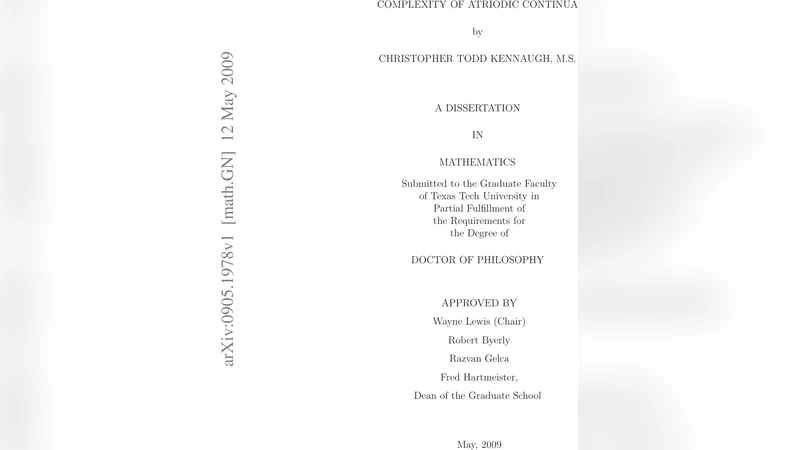
This dissertation investigates the relative complexity between a continuum and its proper subcontinua, in particular, providing examples of atriodic n-od-like continua. Let X be a continuum and n be an integer greater than or equal to three. If X is homeomorphic to an inverse limit of simple-n-od graphs with simplicial bonding maps and is simple-(n-1)-od-like, it is shown that the bonding maps can be simplicially factored through a simple-(n-1)-od. This implies, in particular, that X is homeomorphic to an inverse limit of simple-(n-1)-od graphs with simplicial bonding maps. This factoring is subsequently used to show that a specific inverse limit of simple-n-ods with simplicial bonding maps, having the property of every proper nondegenerate subcontinuum being an arc, is not simple-(n-1)-od-like.
💡 Research Summary
The dissertation investigates the relative topological complexity of a continuum and its proper subcontinua, focusing on atriodic continua—those that contain no subcontinuum homeomorphic to a triangle (a 3‑od). The author works within the framework of inverse limits of simple n‑od graphs with simplicial bonding maps, where an n‑od is a graph consisting of a central vertex with n arcs radiating outward.
The main theorem states that if a continuum X can be represented as an inverse limit of simple n‑od graphs and, in addition, X is simple (n‑1)‑od‑like (i.e., at arbitrarily small scales X resembles a (n‑1)‑od), then every bonding map in the inverse system can be factored simplicially through a simple (n‑1)‑od. Concretely, for each bonding map f_i : G_{i+1} → G_i there exist a simple (n‑1)‑od H_i and simplicial maps q_i : G_{i+1} → H_i and p_i : H_i → G_i such that f_i = p_i ∘ q_i. The proof proceeds by a careful analysis of the branch‑point structure of the graphs, exploiting the (n‑1)‑od‑like condition to show that the image of each bonding map essentially lives on at most (n‑1) branches. A new intermediate graph H_i is constructed to capture exactly this reduced branch structure, and the required factorisation follows from the simplicial nature of the maps.
An immediate corollary is that X itself is homeomorphic to an inverse limit of simple (n‑1)‑od graphs with simplicial bonding maps; thus the (n‑1)‑od‑like property forces a genuine reduction in the combinatorial complexity of the inverse system.
To demonstrate that the converse does not hold in general, the author builds a specific example of an atriodic continuum Y that is an inverse limit of simple n‑od graphs but whose proper non‑degenerate subcontinua are all arcs. The bonding maps in this construction are deliberately chosen so that no factorisation through a (n‑1)‑od is possible; each map distributes the n branches in a way that prevents any reduction to (n‑1) branches at any stage. Consequently, Y is not simple (n‑1)‑od‑like, providing a concrete counterexample to any naïve expectation that atriodic continua automatically inherit lower‑order od‑likeness.
The dissertation situates these results within the broader literature on continuum theory, referencing classic work by Mioduszewski, Rogers, Bellamy, and Lewis on inverse limits of graphs and od‑like classifications. By linking the combinatorial structure of bonding maps to the topological notion of od‑likeness, the work offers a new criterion for distinguishing levels of complexity among continua.
In the concluding discussion, the author emphasizes several implications: (1) the factorisation theorem gives a precise mechanism for detecting when an n‑od‑like continuum can be simplified to a (n‑1)‑od‑like one; (2) atriodic continua can occupy higher complexity levels than previously recognized, as shown by the constructed counterexample; (3) the methodology suggests avenues for extending the analysis to more general graph families (e.g., graphs with loops or higher‑valence vertices) and to non‑simplicial bonding maps, potentially enriching the hierarchy of continuum complexity.
Overall, the dissertation advances our understanding of how the internal branching structure of inverse limit representations governs the global topological complexity of continua, and it establishes a clear, constructive distinction between n‑od‑like and (n‑1)‑od‑like atriodic spaces.
Comments & Academic Discussion
Loading comments...
Leave a Comment