Image and Transfer Functions
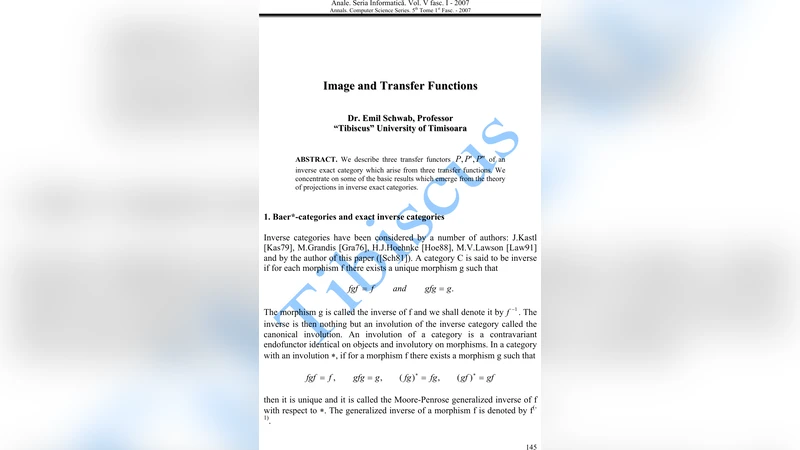
We describe three transfer functors P, P’, P" of an inverse exact category which arise from three transfer functions. We concentrate on some of the basic results which emerge from the theory of projections in inverse exact categories.
💡 Research Summary
The paper investigates three transfer functors, denoted P, P′, and P″, that arise naturally in an inverse exact category. An inverse exact category is a category in which every morphism f possesses a unique pseudo‑inverse f⁻¹ and where kernels, cokernels, images and coimages behave analogously to those in an abelian setting, but with the added structure that every idempotent (projection) splits. The authors begin by defining three elementary transfer functions on projections:
1. τ_f(p) = f p f⁻¹, which “pushes forward’’ a projection p along f;
2. τ′_f(p) = f⁻¹ p f, which “pulls back’’ a projection along f;
3. τ″_f(p) = τ_f(p) ∧ τ′_f(p) = f p f⁻¹ ∧ f⁻¹ p f, the meet of the forward and backward transfers.
These functions are then lifted to the categorical level, giving rise to the functors P, P′, and P″. For each object A, the functor P assigns the set of all projections on A, i.e. P(A) = {p ∈ End(A) | p² = p}. On a morphism f:A→B, P acts by sending a projection q ∈ P(B) to τ_f(q) ∈ P(A). Consequently, P is a contravariant functor that preserves meets (∧) of projections. Dually, P′ is covariant, defined by the pull‑back τ′, and it preserves joins (∨). The third functor P″ combines both behaviours: for any projection p, P″(p) = P(p) ∧ P′(p), so it simultaneously respects both meet and join operations.
The core of the paper consists of a series of structural theorems. The first theorem establishes that P preserves finite meets and P′ preserves finite joins, i.e. P(p ∧ q) = P(p) ∧ P(q) and P′(p ∨ q) = P′(p) ∨ P′(q). The second theorem shows a duality: P′ ∘ P = Id_{P} and P ∘ P′ = Id_{P′}, meaning that forward and backward transfers are inverse to each other on the lattice of projections. The third theorem proves that P″ is precisely the meet of P and P′, so it inherits both meet‑preserving and join‑preserving properties.
A significant portion of the work is devoted to the interaction between these functors and the lattice of projections that exists in any inverse exact category. The authors demonstrate that the projection lattice is complete: arbitrary meets and joins exist and are preserved by the appropriate transfer functors. Moreover, every morphism f can be factored uniquely (up to isomorphism) as a composition f = i ∘ p ∘ r where i is a monomorphism, r is an epimorphism, and p is a projection. This factorisation mirrors the classical image‑kernel decomposition in abelian categories but is adapted to the inverse exact setting.
To illustrate the theory, the paper presents several examples. In the category of partial equivalence relations (a prototypical inverse exact category), the transfer functors correspond to familiar operations on relations: forward image, inverse image, and their intersection. In the power‑set category, P and P′ act as direct and inverse image maps on subsets, while P″ yields the intersection of forward and inverse images, capturing the notion of “stable” subsets under a relation. The authors also discuss connections with Baer*‑categories, showing that when the underlying category satisfies the Baer* condition, the transfer functors respect the additional *‑involution on projections.
Finally, the paper outlines potential applications. Because the transfer functors preserve the lattice structure of projections, they provide a categorical framework for reasoning about subobject classifiers, logical predicates, and state spaces in quantum logic, where projections play the role of propositions. In database theory, the functors model forward and backward propagation of constraints across schema morphisms, and P″ captures the set of tuples that remain invariant under a transformation. The authors suggest that the systematic study of P, P′, and P″ could lead to new algorithms for computing image‑kernel decompositions in computer algebra systems and for designing reversible transformations in programming language semantics.
In summary, the paper offers a coherent and detailed treatment of three transfer functors in inverse exact categories, establishes their fundamental algebraic properties, connects them with the lattice of projections, and demonstrates their relevance through concrete examples and prospective applications.
Comments & Academic Discussion
Loading comments...
Leave a Comment