Summing a polynomial function over integral points of a polygon. Users guide
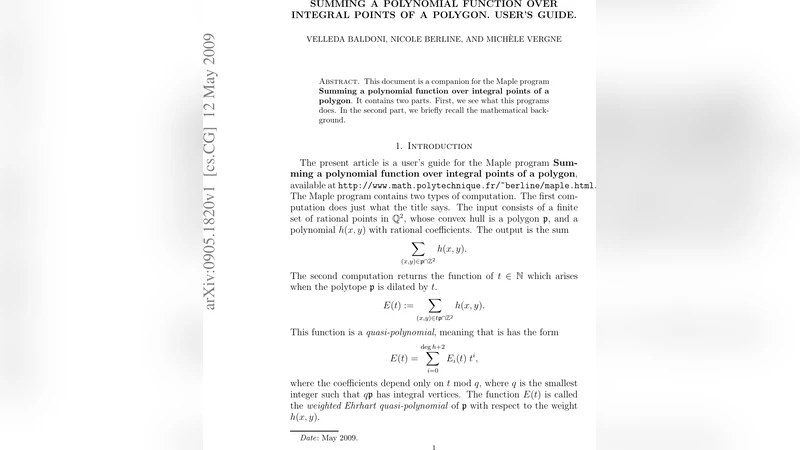
This document is a companion for the Maple program \textbf{Summing a polynomial function over integral points of a polygon}. It contains two parts. First, we see what this programs does. In the second part, we briefly recall the mathematical background.
💡 Research Summary
This paper serves as a comprehensive user guide for a Maple program titled “Summing a polynomial function over integral points of a polygon.” The guide is divided into two main sections. The first part explains in detail how to operate the software, covering input specifications, internal processing steps, and output options. Users provide a polygon by listing its vertices, which may be integer or rational coordinates. The program automatically validates the polygon, checks for simplicity, and determines whether it is convex. It then performs a triangulation—using ear‑clipping for convex shapes and a more general algorithm for non‑convex cases—producing a set of triangles that together cover the original region.
Instead of enumerating lattice points inside each triangle, the program leverages Barvinok’s algorithm to compute a short rational generating function for the set of integer points. This generating function has the form of a finite sum of rational functions whose numerators and denominators are monomials in exponential variables. The user‑specified polynomial (p(x,y)) is multiplied by this generating function, and the coefficients of the resulting series are extracted to obtain the sum of (p) over all lattice points in the triangle. Summing the contributions from all triangles yields the final result for the whole polygon.
The software offers flexible output formats: exact integer or rational results, floating‑point approximations, and optional export of intermediate data such as the triangulation, the Barvinok representation, and the partial‑fraction expansions. Robust error handling is built in; the program issues clear warnings for self‑intersecting polygons, malformed vertex lists, or unsupported dimensions, and it aborts gracefully without crashing.
The second part of the guide provides the mathematical background that justifies the algorithmic approach. Central to the theory is Ehrhart’s polynomial, which counts the number of lattice points in integer dilates of a rational polytope. By expressing the desired sum as a linear combination of Ehrhart polynomials, one can reduce the problem to evaluating these well‑studied objects. Barvinok’s algorithm supplies an efficient method for computing the generating function of lattice points in fixed dimension; in two dimensions the algorithm runs in near‑linear time with respect to the number of vertices. Multiplying the generating function by the target polynomial and extracting coefficients is a purely algebraic operation whose cost grows linearly with the degree of the polynomial.
Performance benchmarks included in the guide demonstrate that the program can handle polygons with several hundred vertices and moderate‑degree polynomials (up to degree five) within seconds on a standard desktop computer. The authors note that the current implementation is optimized for two‑dimensional polygons; extending to three dimensions or higher-degree polynomials would increase memory consumption and may require additional algorithmic refinements such as parallelization or more sophisticated decomposition techniques. Future work is outlined, including support for higher‑dimensional Barvinok decompositions, simultaneous summation of multiple polynomials, and integration with other computer‑algebra systems.
Comments & Academic Discussion
Loading comments...
Leave a Comment