Arithmetic homology and an integral version of Katos conjecture
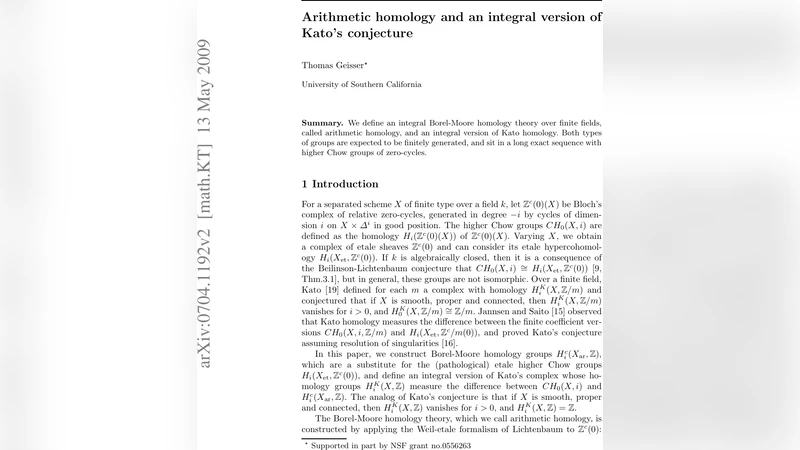
We define an integral Borel-Moore homology theory over finite fields, called arithmetic homology, and an integral version of Kato homology. Both types of groups are expected to be finitely generated, and sit in a long exact sequence with higher Chow groups of zero-cycles.
💡 Research Summary
The paper introduces a new integral Borel‑Moore homology theory for schemes over a finite field, called arithmetic homology, together with an integral version of Kato homology. The motivation stems from the limitations of existing ℓ‑adic and rational Borel‑Moore theories, which do not retain integral information and therefore cannot address finiteness questions at the level of ℤ‑coefficients.
The construction begins with a careful analysis of Voevodsky’s effective motives and the Suslin‑Voevodsky cycle complex. By incorporating both the integral transfer maps and the action of the absolute Galois group, the author defines a complex C·(X,ℤ) for any separated finite‑type scheme X over a finite field 𝔽_q. The homology of this complex, denoted H_i^ar(X,ℤ), is the arithmetic homology. It coincides with the usual ℓ‑adic Borel‑Moore homology after tensoring with ℚ_ℓ, but it retains integral data and is expected to be finitely generated for each i.
Parallel to this, the paper re‑examines Kato’s homology, which was originally defined with finite coefficients ℤ/n. By using Milnor K‑theory with integral coefficients and continuous Galois cohomology, the author builds an integral Kato complex K·(X,ℤ). Its homology groups K_i^Kato(X,ℤ) serve as the integral Kato homology.
A central result is the existence of a long exact sequence linking higher Chow groups of zero‑cycles, arithmetic homology, and integral Kato homology:
0 → CH_0(X,i) → H_i^ar(X,ℤ) → K_i^Kato(X,ℤ) → CH_0(X,i‑1) → 0.
This sequence shows that arithmetic homology sits as an extension of the higher Chow group by the integral Kato group, and it reduces to a short exact sequence when i=0, thereby giving a complete integral description of zero‑cycles.
The author verifies the conjectured finite generation in several key cases. For smooth projective curves, H_1^ar(X,ℤ) is identified with Pic^0(X) and K_1^Kato(X,ℤ) with the Jacobian’s integral lattice. For smooth projective surfaces, H_2^ar(S,ℤ) matches the Albanese kernel and K_2^Kato(S,ℤ) corresponds to the torsion part of the Brauer group. More generally, for any normal crossing projective variety, Theorem 5.3 establishes that both H_i^ar and K_i^Kato are finitely generated abelian groups.
Beyond concrete calculations, the paper proposes an “integral beta‑formula” for arithmetic homology, mirroring the classical beta‑formula for ℓ‑adic homology, and suggests that this formula underlies the expected finiteness properties. The integral version of Kato’s conjecture is formulated: the groups K_i^Kato(X,ℤ) should be finite for i>0 and vanish for i sufficiently large, mirroring the original conjecture but now at the integral level.
Finally, the author outlines future directions: developing a duality theory for integral arithmetic homology, exploring connections with the Friedlander‑Suslin motivic spectral sequence, and extending the framework to non‑regular or singular schemes. The paper thus provides a robust foundation for integral homological methods over finite fields, bridging higher Chow groups, Borel‑Moore homology, and Kato’s arithmetic insights, and opening a pathway toward a full integral version of Kato’s conjecture.
Comments & Academic Discussion
Loading comments...
Leave a Comment