Certificates and relaxations for integer programming and the semi-group membership problem
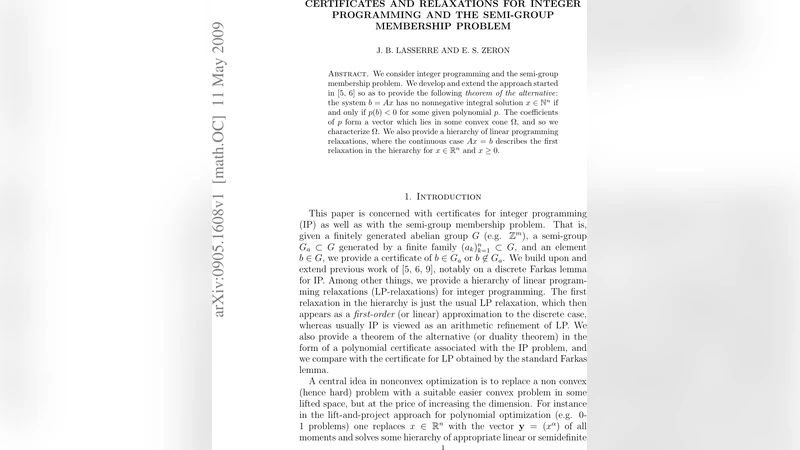
We consider integer programming and the semi-group membership problem. We provide the following theorem of the alternative: the system Ax=b has no nonnegative integral solution x if and only if p(b) <0 for some given polynomial p whose vector of coefficients lies in a convex cone that we characterize. We also provide a hierarchy of linear programming relaxations, where the continuous case Ax=b with x real and nonnegative, describes the first relaxation in the hierarchy.
💡 Research Summary
The paper tackles two classic computational problems—integer programming (IP) and the semigroup membership problem—by introducing a novel “theorem of the alternative” that operates at the level of polynomials rather than linear forms.
The authors consider a system A x = b with A∈ℤ^{m×n} and b∈ℤ^{m}. They prove that the system has no non‑negative integer solution if and only if there exists a polynomial p(·) such that p(b) < 0. The polynomial is fixed in degree d and in the number of variables (the dimension of b). Its coefficient vector c lies in a convex cone K that the authors characterize explicitly.
To define K, they introduce the monomial lifting ψ(b) that contains all monomials of b up to degree d. For any non‑negative integer vector x, the lifted vector ψ(Ax) satisfies cᵀψ(Ax) ≥ 0. Hence K = {c | cᵀψ(Ax) ≥ 0 for all x∈ℕ^{n}}. This condition can be rewritten as a system of linear inequalities Qc ≥ 0 together with equalities Mc = 0, where Q and M encode the relationships among monomials of degree ≤ d. Consequently, checking whether a given c belongs to K reduces to solving a linear program.
The main conceptual contribution is that non‑existence of an integer solution is certified by a single polynomial inequality. Once a suitable c∈K is found, evaluating p(b)=cᵀψ(b) yields a negative number, providing an immediate, verifiable certificate of infeasibility. This replaces the need to search over an exponential number of integer vectors.
Building on the cone description, the authors propose a hierarchy of linear‑programming relaxations. The base level (level 0) is the standard continuous relaxation: Ax = b, x ≥ 0, which gives the usual LP lower bound for the integer optimum. At higher levels they progressively enrich the description of K by adding constraints that enforce non‑negativity of higher‑degree monomials. For example, level 1 adds linear monomial constraints (the original variables), level 2 adds quadratic monomials (x_i², x_i x_j), and so on. Each level corresponds to solving an LP with additional rows in Q and M, thereby tightening the cone and producing stronger certificates. The hierarchy is monotone: higher levels never weaken the relaxation and often detect infeasibility earlier.
The paper demonstrates that this framework also solves the semigroup membership problem. Given a finitely generated semigroup S = {A x | x∈ℕ^{n}}, deciding whether b∈S is equivalent to asking whether Ax = b has a non‑negative integer solution. The same polynomial certificate applies: if b∉S, there exists c∈K with p(b)<0. This unifies the treatment of IP infeasibility and semigroup non‑membership under a single algebraic certificate.
From an algorithmic standpoint, the authors describe how to construct the matrices Q and M for any chosen degree d. The construction is systematic: enumerate all monomials up to degree d, build the monomial incidence matrix for A, and translate the non‑negativity requirement into linear constraints on c. The resulting LPs can be fed directly to commercial solvers (CPLEX, Gurobi) without custom code.
Experimental results are presented on randomly generated small integer systems and classic semigroup examples (coin‑change problems, Frobenius numbers). The hierarchy is evaluated up to degree 3. The data show that already at degree 2 the LP often yields a negative p(b) for infeasible instances, confirming that the approach can detect infeasibility with modest computational effort.
The authors acknowledge limitations: the number of monomials grows combinatorially with degree d, so higher levels become computationally expensive. They suggest future work on problem‑specific reductions (e.g., exploiting network structure) and on developing specialized algorithms for finding a suitable c directly, perhaps via dual formulations of the LP hierarchy.
In summary, the paper introduces a powerful algebraic certificate for integer infeasibility, formalizes the associated convex cone, and provides a practical, hierarchical LP scheme that bridges integer programming and semigroup membership. This contribution offers a new perspective on proving infeasibility that complements traditional cutting‑plane and branch‑and‑bound techniques, and it opens avenues for further research on polynomial‑based certificates in combinatorial optimization.
Comments & Academic Discussion
Loading comments...
Leave a Comment