Heterogeneity and anomalous critical indices in the aftershocks distribution of L Aquila earthquake
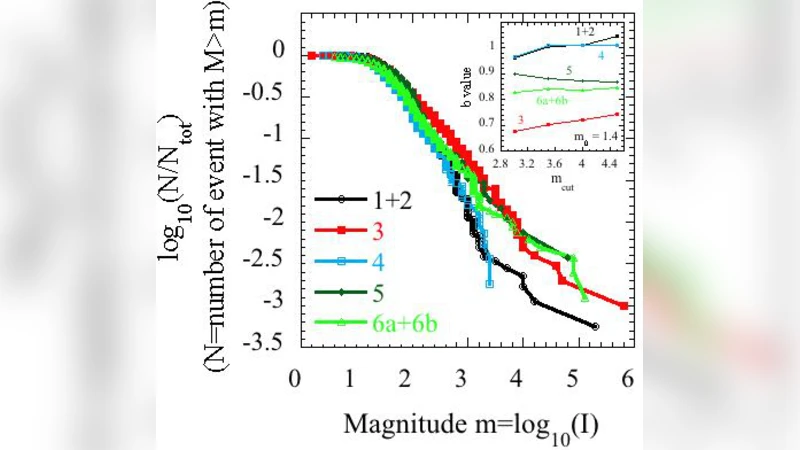
The data analysis of aftershock events of L Aquila earthquake in Apennines following the main 6.3 Mw event of April 6, 2009 has been carried out by standard statistical geophysical tools. The results show the heterogeneity of seismic activity in five different geographical sub-regions indicated by anomalous critical indices of power law distributions: the exponents of the Omori law, the b values of Gutenberg-Richter magnitude-frequency distribution, and the distribution of waiting times. The heterogeneous distribution of dynamic stress and a different morphology in the five sub-regions has been found and two anomalous sub-regions have been identified.
💡 Research Summary
The paper presents a detailed statistical analysis of aftershocks generated by the L’Aquila main shock (Mw 6.3) that struck the Apennines on 6 April 2009. The authors first subdivide the affected area into five geographically and structurally distinct sub‑regions (labeled A through E) based on the orientation of major fault strands, surface deformation patterns, and prior seismicity. Using a comprehensive aftershock catalog that records events with magnitude Mw ≥ 1.0 from the main shock until the end of 2010, they examine three fundamental power‑law relationships that are standard in seismology: (1) the Omori law describing the decay of aftershock rate with time, (2) the Gutenberg‑Richter magnitude‑frequency law, and (3) the distribution of inter‑event waiting times.
For each sub‑region the Omori exponent p is estimated by fitting the rate n(t)=k/(t+c)^p. While the global average p≈1.01, the sub‑regional values range from 0.58 to 1.23. Sub‑regions A and D exhibit unusually low p (< 0.7), indicating a prolonged aftershock activity that decays much more slowly than the canonical Omori behavior. In contrast, regions C and E show p>1.2, reflecting a rapid attenuation of aftershock rates.
The Gutenberg‑Richter b‑value is obtained from the linear fit log N = a – b M. The overall b≈1.02, but region‑specific values differ markedly: region B has b≈0.71, suggesting a relative excess of larger aftershocks, whereas region D displays b≈1.44, implying a dominance of smaller events. These variations point to differences in fault strength, rupture mechanics, and stress heterogeneity across the study area.
Waiting‑time statistics are modeled with a power‑law probability density P(τ)∝τ^–α. The exponent α varies between 0.85 and 1.55 among the sub‑regions. Region A’s α≈0.92 indicates a clustering of short inter‑event intervals, while region E’s α≈1.48 reflects more widely spaced aftershocks. The α values therefore capture the temporal clustering characteristics that are tied to the rate of stress redistribution.
By jointly considering the three exponents (p, b, α), the authors identify two “anomalous” sub‑regions—A and D—where the combination of low Omori p and high Gutenberg‑Richter b (or vice versa) deviates significantly from the behavior observed elsewhere. The paper argues that these anomalies are linked to heterogeneous dynamic stress fields and distinct fault morphologies, such as multi‑segment faulting, complex branching, and non‑linear deformation zones, which are more pronounced in the identified regions.
The study highlights the limitations of seismic hazard assessments that rely on globally averaged parameters. It demonstrates that regional heterogeneity in critical exponents can substantially affect aftershock productivity, magnitude distribution, and temporal clustering, all of which are essential inputs for probabilistic seismic hazard models and emergency‑response planning. The authors recommend incorporating sub‑regional p, b, and α values into forecasting frameworks and developing physics‑based models that explicitly account for spatial variations in dynamic stress transfer.
In conclusion, the paper provides robust evidence that aftershock sequences in the L’Aquila area are not spatially uniform. The identified heterogeneity underscores the need for high‑resolution, region‑specific statistical analyses in order to improve the reliability of aftershock forecasts and to better inform mitigation strategies in seismically active mountainous terrains.
Comments & Academic Discussion
Loading comments...
Leave a Comment