Cyclic theory for commutative differential graded algebras and s-cohomology
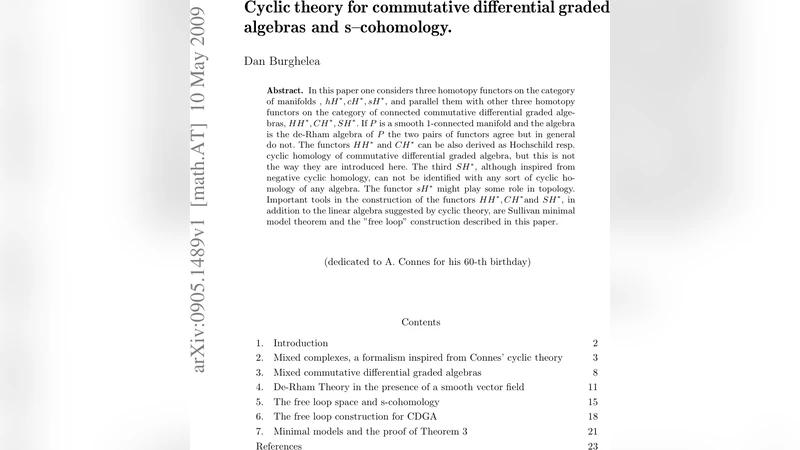
In this paper one considers three homotopy functors on the category of manifolds, $hH^\ast, cH^\ast, sH^\ast,$ and parallel them with other three homotopy functors on the category of connected commutative differential graded algebras, $HH^\ast, CH^\ast, SH^\ast.$ If $P$ is a smooth 1-connected manifold and the algebra is the de-Rham algebra of $P$ the two pairs of functors agree but in general do not. The functors $ HH^\ast $ and $CH^\ast$ can be also derived as Hochschild resp. cyclic homology of commutative differential graded algebra, but this is not the way they are introduced here. The third $SH^\ast ,$ although inspired from negative cyclic homology, can not be identified with any sort of cyclic homology of any algebra. The functor $sH^\ast$ might play some role in topology. Important tools in the construction of the functors $HH^\ast, CH^\ast $and $SH^\ast ,$ in addition to the linear algebra suggested by cyclic theory, are Sullivan minimal model theorem and the “free loop” construction described in this paper.
💡 Research Summary
The paper introduces three homotopy‐type functors on the category of smooth manifolds—denoted (hH^{}, cH^{}, sH^{})—and constructs parallel functors on the category of connected commutative differential graded algebras (CDGAs), namely (HH^{}, CH^{}, SH^{}). The motivation is to compare the algebraic invariants that arise from Hochschild and cyclic homology with topological invariants coming from free loop spaces.
Construction on manifolds.
For a manifold (P) the authors consider the free loop space (LX = \operatorname{Map}(S^{1},P)). The singular chain complex (C_{}(LX)) carries a natural (S^{1})–action by rotating the domain circle. Taking the homology of the total complex yields the functor (hH^{}(P)). The (S^{1})–fixed point subcomplex gives rise to (cH^{}(P)). Finally, by adjoining a formal variable (u) of degree (-2) and using Connes’ operator (B), they define a third complex whose homology is denoted (sH^{}(P)). The three groups fit into a long exact sequence reminiscent of the standard Connes periodicity sequence:
\
Comments & Academic Discussion
Loading comments...
Leave a Comment