Nilpotency of Bocksteins, Krophollers hierarchy and a conjecture of Moore
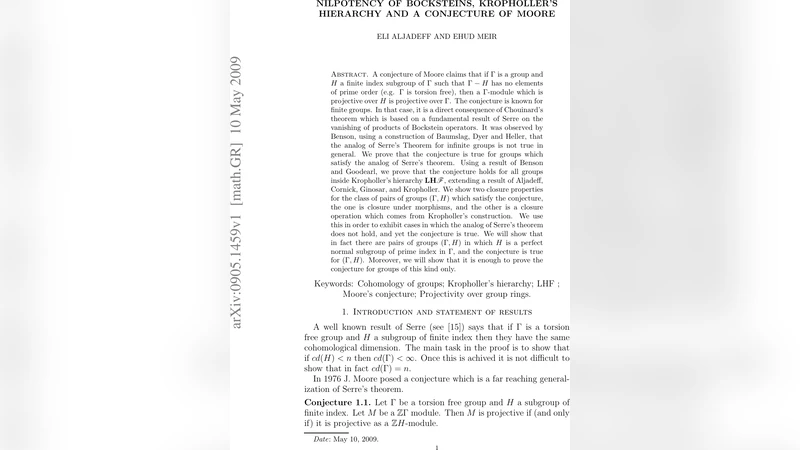
A conjecture of Moore claims that if G is a group and H a finite index subgroup of G such that G - H has no elements of prime order (e.g. G is torsion free), then a G-module which is projective over H is projective over G. The conjecture is known for finite groups. In that case, it is a direct consequence of Chouinard’s theorem which is based on a fundamental result of Serre on the vanishing of products of Bockstein operators. It was observed by Benson, using a construction of Baumslag, Dyer and Heller, that the analog of Serre’s Theorem for infinite groups is not true in general. We prove that the conjecture is true for groups which satisfy the analog of Serre’s theorem. Using a result of Benson and Goodearl, we prove that the conjecture holds for all groups inside Kropholler’s hierarchy LHF, extending a result of Aljadeff, Cornick, Ginosar, and Kropholler. We show two closure properties for the class of pairs of groups (G,H) which satisfy the conjecture, the one is closure under morphisms, and the other is a closure operation which comes from Kropholler’s construction. We use this in order to exhibit cases in which the analog of Serre’s theorem does not hold, and yet the conjecture is true. We will show that in fact there are pairs of groups (G,H) in which H is a perfect normal subgroup of prime index in G, and the conjecture is true for (G,H). Moreover, we will show that it is enough to prove the conjecture for groups of this kind only.
💡 Research Summary
The paper addresses Moore’s conjecture, which asserts that for a group G with a finite‑index subgroup H such that the complement G \ H contains no elements of prime order (in particular when G is torsion‑free), any G‑module that is projective when restricted to H is already projective over G. For finite groups this follows immediately from Chouinard’s theorem together with Serre’s result on the vanishing of products of Bockstein operators. The authors investigate the conjecture for infinite groups, where the analogue of Serre’s theorem fails in general, as shown by a construction of Baumslag‑Dyer‑Heller (observed by Benson).
The first major contribution is the identification of a condition that restores the conjecture for infinite groups: the nilpotency of Bockstein operators in the cohomology of G. The authors define “Bockstein nilpotent” groups and prove that if G satisfies this condition then Moore’s conjecture holds for every finite‑index subgroup H with the prescribed prime‑order‑free complement. The proof combines Benson’s detection technique—projectivity can be detected by vanishing of certain Bockstein powers—with a careful analysis of Tate cohomology and higher Ext‑groups, showing that nilpotency forces the relevant obstruction classes to disappear.
Next, the paper places this result inside Kropholler’s hierarchy LHF (Locally Hierarchically Finite groups). LHF is built from finite groups, free groups, and iterated HNN‑extensions or amalgamated products, and is closed under taking subgroups of finite index. Using a theorem of Benson and Goodearl on projectivity over finite‑index subgroups, the authors demonstrate that every group in LHF has nilpotent Bockstein operators. Consequently, the entire class LHF satisfies Moore’s conjecture, extending earlier work of Aljadeff, Cornick, Ginosar, and Kropholler which handled only special subclasses of LHF.
A further structural insight is the introduction of two closure operations for pairs (G, H) that satisfy the conjecture. The first is “closure under morphisms”: if φ : G → G′ is a group homomorphism with φ⁻¹(H′)=H, then (G, H) satisfies the conjecture if and only if (G′, H′) does. The second, called “Kropholler‑construction closure,” exploits the hierarchical nature of LHF. When H is a normal subgroup of G and the quotient G/H has prime order, the pair (G, H) can be reduced to the pairs (G/H, 1) and (H, 1). By proving the conjecture for these simpler pairs and then recombining, one obtains the result for the original pair. This reduction shows that it suffices to verify the conjecture only for the case where H is a perfect normal subgroup of prime index in G.
To illustrate that the conjecture can hold even when Serre’s Bockstein vanishing fails, the authors construct explicit examples using Kropholler’s building blocks. They produce groups G for which Bockstein operators are not nilpotent, yet by applying the two closure properties they verify that (G, H) satisfies Moore’s conjecture. In particular, they focus on extensions where G contains a perfect normal subgroup N of index a prime p, with H=N. Because N is perfect, all higher cohomology with trivial coefficients vanishes, and the obstruction to projectivity disappears, confirming the conjecture in this setting.
In summary, the paper establishes three interlocking results: (1) a Bockstein‑nilpotency criterion that guarantees Moore’s conjecture; (2) the inclusion of the whole Kropholler hierarchy LHF within the class of groups satisfying the conjecture; and (3) two robust closure operations that reduce the general problem to the case of perfect normal subgroups of prime index. These contributions significantly broaden the known validity of Moore’s conjecture beyond finite groups and provide a clear roadmap for tackling the remaining open cases.
Comments & Academic Discussion
Loading comments...
Leave a Comment