An index theorem for manifolds with boundary
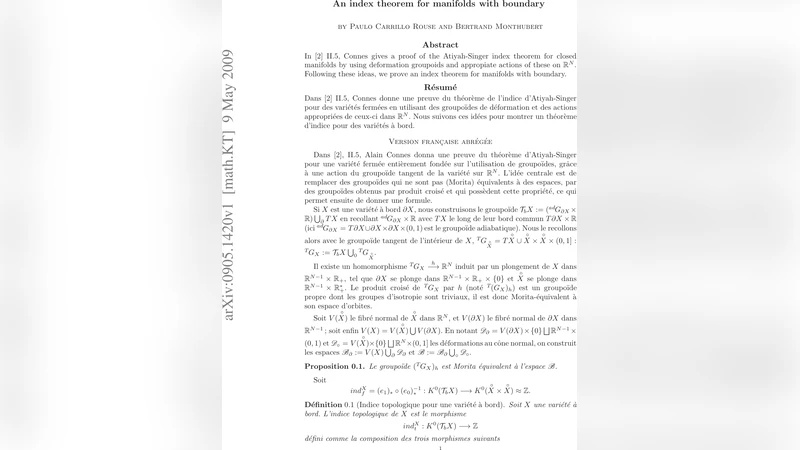
In his book (II.5), Connes gives a proof of the Atiyah-Singer index theorem for closed manifolds by using deformation groupoids and appropiate actions of these on R^N. Following these ideas, we prove an index theorem for manifolds with boundary.
💡 Research Summary
The paper extends Alain Connes’ groupoid‑based proof of the Atiyah‑Singer index theorem to manifolds with boundary. Connes’ original argument uses the tangent groupoid, a Lie groupoid that interpolates between the pair groupoid M×M (for t>0) and the tangent bundle TM (at t=0). By letting the groupoid act on a high‑dimensional Euclidean space ℝⁿ, one obtains a continuous family of C*‑algebras whose K‑theory identifies the analytic index of an elliptic operator with its topological index.
To treat a compact manifold M with non‑empty boundary ∂M, the authors introduce the b‑tangent groupoid 𝔾ᵇ. This groupoid coincides with the ordinary tangent groupoid in the interior of M but, near the boundary, it is built from the b‑tangent bundle bTM, i.e., the bundle of vector fields that are tangent to the boundary. In concrete terms, 𝔾ᵇ = (M×M×(0,1]) ∪ (bTM×{0}), equipped with the natural smooth structure that makes the source and target maps submersions. The b‑structure automatically encodes the geometry of the boundary without imposing external boundary conditions.
The central technical device is an adiabatic deformation 𝔾ᵃ𝑑ᵢᵃb of 𝔾ᵇ parametrised by s∈
Comments & Academic Discussion
Loading comments...
Leave a Comment