Status and first results of the ANTARES neutrino telescope
The ANTARES (Astronomy with a Neutrino Telescope and Abyss environmental RESearch) Collaboration constructed and deployed the world’s largest operational underwater neutrino telescope, optimised for the detection of Cherenkov light produced by neutrino-induced muons. The detector has an effective area of about 0.1 square km and it is a first step towards a kilometric scale detector. The detector consists of a three-dimensional array of 884 photomultiplier tubes, arranged in 12 lines anchored at a depth of 2475 m in the Mediterranean Sea, 40 km offshore from Toulon (France). An additional instrumented line is used for environmental monitoring and for neutrino acoustic detection R&D. ANTARES is taking data with its full twelve line configuration since May 2008 and had been also doing so for more than a year before a five and ten line setups. First results obtained with the 5 line setup are presented.
💡 Research Summary
The ANTARES (Astronomy with a Neutrino Telescope and Abyss environmental RESearch) collaboration has built and deployed the world’s largest operational underwater neutrino telescope, optimized for detecting the Cherenkov light emitted by muons produced in charged‑current interactions of high‑energy neutrinos. Situated 2 475 m below the surface of the Mediterranean Sea, about 40 km off the coast of Toulon, France, the detector consists of a three‑dimensional array of 884 10‑inch photomultiplier tubes (PMTs) arranged on 12 vertical detection lines. Each line carries 25 “storeys” spaced 14.5 m apart; every storey hosts three PMTs, a power‑distribution unit and a data‑acquisition module. An additional instrumented line is dedicated to environmental monitoring and acoustic‑neutrino R&D. The full twelve‑line configuration has been taking data continuously since May 2008, following a period of operation with five and ten lines that provided the first physics data sets.
Technical architecture and calibration
The detector’s effective area is roughly 0.1 km² for muon neutrinos with energies above a few TeV. Precise timing (≤ 1 ns) is achieved through a GPS‑referenced master clock and fiber‑optic delay calibration, while the three‑dimensional positions of the optical modules are tracked in real time with an acoustic positioning system supplemented by tilt‑compass sensors, yielding sub‑10 cm accuracy. The optical properties of deep Mediterranean water (absorption length ≈ 60 m, scattering length ≈ 30 m) are favourable for Cherenkov photon propagation, but the background is dominated by continuous ⁴⁰K decay and episodic bioluminescence bursts. To monitor these effects, the environmental line carries dedicated optical background sensors, conductivity‑temperature‑depth (CTD) probes, and hydrophones.
Trigger and data acquisition
ANTARES employs a two‑level trigger scheme. A global trigger fires when a minimum of five PMTs across the whole array register hits within a 2 µs window, while a local trigger on each line activates on three or more coincident hits within a shorter time window. This design efficiently suppresses the overwhelming atmospheric muon background while preserving high efficiency for up‑going muons from neutrino interactions. The data stream is transmitted via a sea‑floor fiber to shore, where a farm of CPUs performs real‑time filtering, reconstruction, and storage.
Early physics with the 5‑line configuration
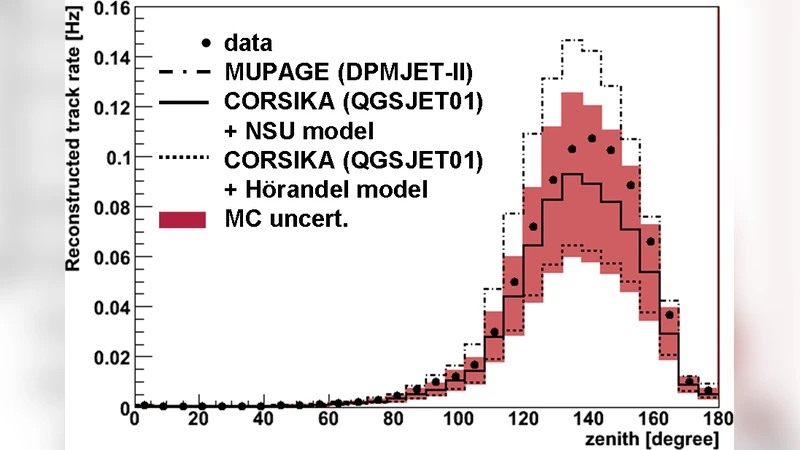
During the 2007–2008 period the detector operated with five lines (295 PMTs). About 10⁶ atmospheric muon events and a few dozen up‑going neutrino‑candidate events were recorded. Analyses focused on (i) validating the reconstruction algorithms, (ii) measuring the atmospheric muon flux as a function of depth and zenith angle, and (iii) searching for point‑like sources by correlating the reconstructed muon directions with known astrophysical objects (e.g., active galactic nuclei, supernova remnants). No statistically significant excess was observed; however, 90 % confidence level upper limits on the neutrino flux were set, comparable to those from the IceCube and Baikal detectors at similar energies.
Environmental and acoustic R&D
The dedicated monitoring line provides continuous records of water temperature, salinity, currents, and bioluminescence activity, essential for long‑term modeling of the optical background. In parallel, an array of hydrophones is being used to explore acoustic detection of ultra‑high‑energy neutrinos, a technique that could complement optical methods in future km³‑scale detectors.
Impact and outlook
ANTARES has demonstrated that a large‑scale, deep‑sea optical array can be deployed, calibrated, and operated with the required precision for neutrino astronomy. The experience gained—particularly in timing synchronization, acoustic positioning, background characterization, and trigger optimization—directly informs the design of the next‑generation KM3NeT telescope, which aims for a multi‑km³ instrumented volume. Continued data taking with the full twelve‑line configuration is expected to improve point‑source sensitivity by roughly a factor of two over the five‑line results, while the accumulated exposure (several thousand ton·years) will enable increasingly stringent tests of astrophysical neutrino models and searches for exotic phenomena such as dark‑matter annihilation in the Sun or Earth.
In summary, the paper reports the successful construction, deployment, and commissioning of the ANTARES neutrino telescope, presents the first physics results obtained with the initial five‑line setup, and outlines the detector’s performance, environmental monitoring capabilities, and its role as a stepping stone toward a cubic‑kilometer scale neutrino observatory in the Mediterranean Sea.
Comments & Academic Discussion
Loading comments...
Leave a Comment