On persistence and cascade decompositions of chemical reaction networks
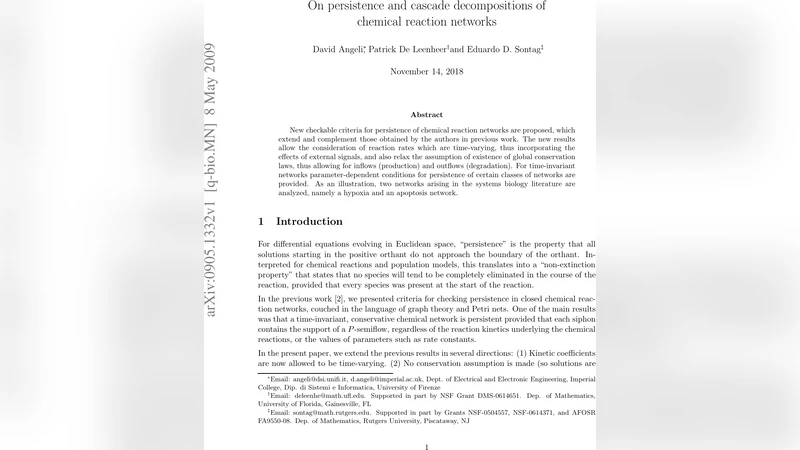
New checkable criteria for persistence of chemical reaction networks are proposed, which extend and complement those obtained by the authors in previous work. The new results allow the consideration of reaction rates which are time-varying, thus incorporating the effects of external signals, and also relax the assumption of existence of global conservation laws, thus allowing for inflows (production) and outflows (degradation). For time-invariant networks parameter-dependent conditions for persistence of certain classes of networks are provided. As an illustration, two networks arising in the systems biology literature are analyzed, namely a hypoxia and an apoptosis network.
💡 Research Summary
This paper introduces new, readily checkable criteria for establishing persistence in chemical reaction networks (CRNs) that significantly broaden the scope of earlier results by the same authors. Persistence, the property that every species with a strictly positive initial concentration remains bounded away from zero for all future times, is a crucial indicator of robust behavior in biochemical systems. Traditional persistence theorems relied on two restrictive assumptions: (i) the existence of global conservation laws (linear invariants that keep the total mass constant) and (ii) time‑invariant reaction rates. Both assumptions are often violated in realistic biological contexts where external signals modulate reaction kinetics and where species can be produced or degraded (inflows and outflows).
The authors first generalize the dynamical model to allow each reaction rate (r_k(t,x)) to be an arbitrary continuous function of time, subject only to a uniform lower bound (\varepsilon>0) and an upper bound (M<\infty). This “bounded positivity” condition guarantees that no reaction can be completely switched off for an extended period. Under this assumption, they prove a Time‑Varying Persistence Theorem: if the underlying reaction graph is strongly connected, then the network remains persistent regardless of how the rates vary in time, provided the lower bound holds. The proof employs a Lyapunov‑like function built from logarithmic terms, showing that the function is non‑increasing and bounded, which forces each species concentration to stay away from zero.
To eliminate the need for global conservation laws, the paper introduces a Cascade Decomposition Framework. The network is partitioned into a hierarchy of layers (or cascades) where each layer receives inputs from higher layers and supplies outputs to lower ones. The authors demonstrate that if every layer individually satisfies the persistence conditions and the inter‑layer flows are non‑negative (i.e., no layer completely starves a downstream layer), then the entire network is persistent. This result is established through graph‑theoretic arguments about the existence of directed paths from “core complexes” to “exit complexes” and by constructing invariant sets for each layer.
A further contribution is the derivation of parameter‑dependent persistence conditions. By treating kinetic constants and external signal amplitudes as parameters, the authors identify regions in parameter space where the lower‑bound condition on the rates is guaranteed. Consequently, persistence can be asserted for whole families of networks rather than for a single fixed parameter set.
The theoretical developments are illustrated with two biologically relevant examples.
- Hypoxia Network – The model captures the oxygen‑dependent stabilization and degradation of HIF‑1α, including downstream activation of VEGF. External oxygen concentration is modeled as a time‑varying signal, leading to time‑dependent rate functions. Applying the cascade decomposition shows that the core HIF‑VEGF pathway forms a persistent subnetwork, and numerical simulations reveal a minimal oxygen level below which persistence is lost, matching the analytical lower‑bound (\varepsilon).
- Apoptosis Network – This system involves production and degradation of Bcl‑2 family proteins, caspases, and other regulators of programmed cell death. Because of explicit inflows (synthesis) and outflows (degradation), no global mass conservation holds. Nevertheless, the network can be split into a “death‑signal” cascade and a “survival‑signal” cascade. Each cascade satisfies the persistence criteria, and the full model therefore remains persistent even under time‑varying stress signals. Simulations confirm that key apoptotic species never vanish, supporting the theoretical prediction.
In conclusion, the paper provides a robust, mathematically rigorous toolbox for assessing persistence in CRNs that experience time‑varying kinetics and lack conserved quantities. The results have immediate implications for systems biology, synthetic biology, and drug development, where guaranteeing that essential molecular species do not disappear is often a design requirement. Future work suggested by the authors includes extending the framework to stochastic reaction kinetics, spatially distributed systems, and multi‑scale networks, thereby further bridging the gap between abstract chemical reaction theory and complex living systems.
Comments & Academic Discussion
Loading comments...
Leave a Comment