We study a fading linear finite-field relay network having multiple source-destination pairs. Because of the interference created by different unicast sessions, the problem of finding its capacity region is in general difficult. We observe that, since channels are time-varying, relays can deliver their received signals by waiting for appropriate channel realizations such that the destinations can decode their messages without interference. We propose a block Markov encoding and relaying scheme that exploits such channel variations. By deriving a general cut-set upper bound and an achievable rate region, we characterize the sum capacity for some classes of channel distributions and network topologies. For example, when the channels are uniformly distributed, the sum capacity is given by the minimum average rank of the channel matrices constructed by all cuts that separate the entire sources and destinations. We also describe other cases where the capacity is characterized.
Deep Dive into Sum capacity of multi-source linear finite-field relay networks with fading.
We study a fading linear finite-field relay network having multiple source-destination pairs. Because of the interference created by different unicast sessions, the problem of finding its capacity region is in general difficult. We observe that, since channels are time-varying, relays can deliver their received signals by waiting for appropriate channel realizations such that the destinations can decode their messages without interference. We propose a block Markov encoding and relaying scheme that exploits such channel variations. By deriving a general cut-set upper bound and an achievable rate region, we characterize the sum capacity for some classes of channel distributions and network topologies. For example, when the channels are uniformly distributed, the sum capacity is given by the minimum average rank of the channel matrices constructed by all cuts that separate the entire sources and destinations. We also describe other cases where the capacity is characterized.
Characterizing the capacity region of wireless relay networks is one of the fundamental problems. However, if the network has multiple unicast sessions, the problem of finding its capacity region becomes much more challenging since the transmission of other sessions acts as interference and, in general, the cut-set upper bound is not tight. Even for the twouser Gaussian interference channel, an approximate capacity region was recently characterized [1].
For wireless networks, there exist three fundamental issues, i.e., broadcast, interference, and fading. In this paper, we consider a multi-source fading linear finite-field relay network, which captures these three key characteristics of wireless environment. There have been related works dealing with wireless networks assuming interference-free receptions [2], [3] and assuming no broadcast nature [4]. The works in [5], [6] have considered deterministic relay networks and the work in [7] has studied finite-field erasure networks.
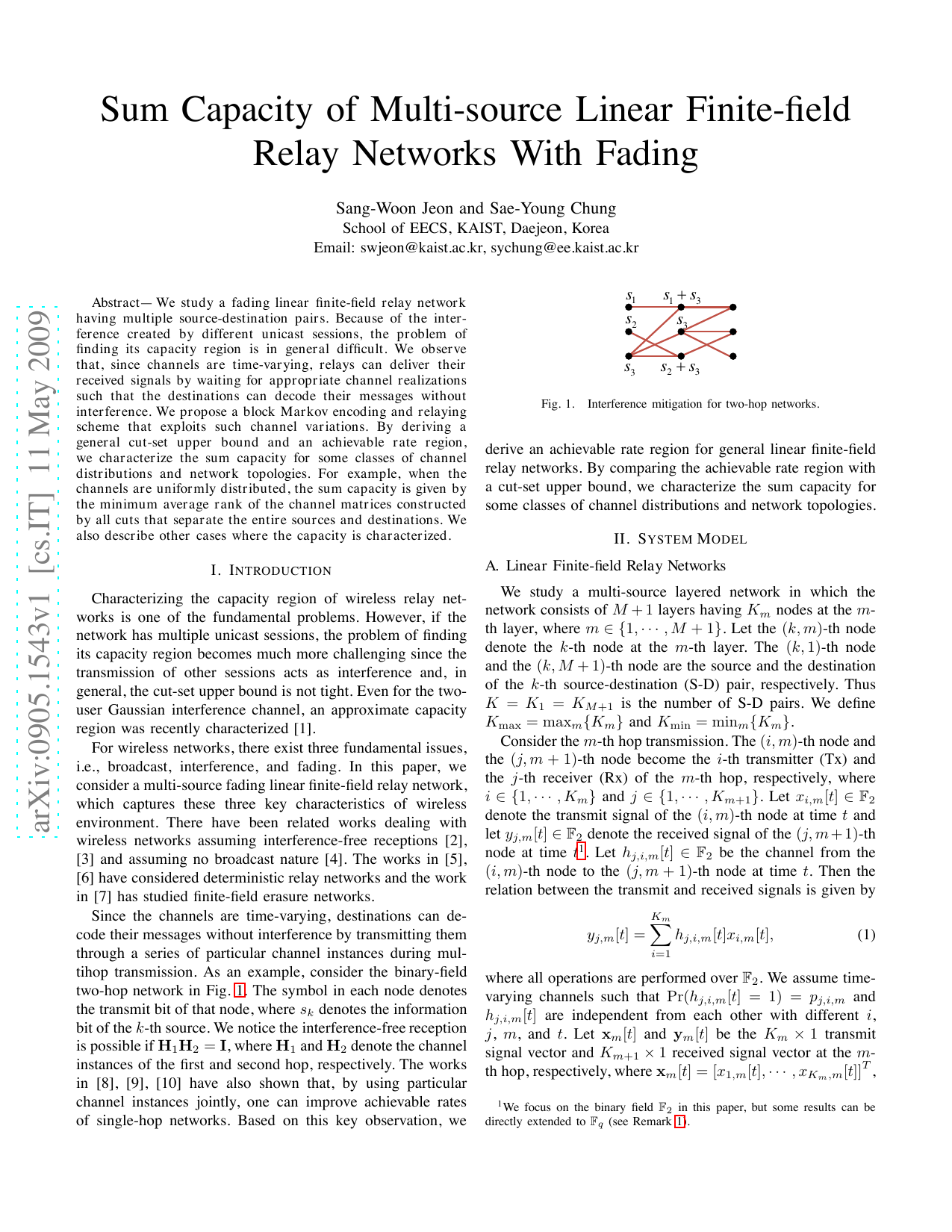
Since the channels are time-varying, destinations can decode their messages without interference by transmitting them through a series of particular channel instances during multihop transmission. As an example, consider the binary-field two-hop network in Fig. 1. The symbol in each node denotes the transmit bit of that node, where s k denotes the information bit of the k-th source. We notice the interference-free reception is possible if H 1 H 2 = I, where H 1 and H 2 denote the channel instances of the first and second hop, respectively. The works in [8], [9], [10] have also shown that, by using particular channel instances jointly, one can improve achievable rates of single-hop networks. Based on this key observation, we derive an achievable rate region for general linear finite-field relay networks. By comparing the achievable rate region with a cut-set upper bound, we characterize the sum capacity for some classes of channel distributions and network topologies.
We study a multi-source layered network in which the network consists of M + 1 layers having K m nodes at the mth layer, where m ∈ {1, • • • , M + 1}. Let the (k, m)-th node denote the k-th node at the m-th layer. The (k, 1)-th node and the (k, M + 1)-th node are the source and the destination of the k-th source-destination (S-D) pair, respectively. Thus K = K 1 = K M+1 is the number of S-D pairs. We define
Consider the m-th hop transmission. The (i, m)-th node and the (j, m + 1)-th node become the i-th transmitter (Tx) and the j-th receiver (Rx) of the m-th hop, respectively, where
denote the transmit signal of the (i, m)-th node at time t and let y j,m [t] ∈ F 2 denote the received signal of the (j, m + 1)-th node at time t1 . Let h j,i,m [t] ∈ F 2 be the channel from the (i, m)-th node to the (j, m + 1)-th node at time t. Then the relation between the transmit and received signals is given by
where all operations are performed over F 2 . We assume timevarying channels such that Pr(h j,i,m [t] = 1) = p j,i,m and h j,i,m [t] are independent from each other with different i, j, m, and t. Let x m [t] and y m [t] be the K m × 1 transmit signal vector and K m+1 × 1 received signal vector at the mth hop, respectively, where
T . Thus the transmission at the m-th hop can be represented as
where H m [t] is the K m+1 × K m channel matrix of the m-th hop having h j,i,m [t] as the (j, i)-th element. We assume that at time t both Txs and Rxs of the m-th hop know
Consider a set of length n block codes. Let W k be the message of the k-th source uniformly distributed over {1, 2, • • • , 2 nR k }, where R k is the rate of the k-th source. For simplicity, we assume that nR k is an integer. A 2 nR1 , • • • , 2 nRK ; n code consists of the following encoding, relaying, and decoding functions.
the set of relaying functions of the (k, m)-th node is given by {f k,m,t } n t=1 :
). If M = 1, the sources transmit directly to the intended destinations without relays. The probability of error at the kth destination is given by P
The achievable sum-rate is given by R sum = K k=1 R k and the sum capacity is the supremum of the achievable sum-rates.
The considered network can be represented as a directed graph G = (V, E) consisting of a vertex set V and a directed edge set E. Let v k,m denote the (k, m)-th node and V m = {v k,m } Km k=1 denote the set of nodes in the m-th layer. Then V is given by ∪ m∈{1,••• ,M+1} V m . There exists a directed edge (v i,m , v j,m+1 ) from v i,m to v j,m+1 if p j,i,m > 0. Let H V ′ ,V ′′ be the channel matrix from the nodes in V ′ ⊆ V to the nodes in V ′′ ⊆ V.
- Sets of channel instances and nodes: Suppose V′ ⊆ V ′ , V′′ ⊆ V ′′ , and G is a | V′′ | × | V′ | matrix. We define the following set:
i.e., H F V ′ ,V ′′ G, V′ , V′′ is the set of all instances of H V ′ ,V ′′ that contain G in H V′ , V′′ and have the same rank as G. We further define the following sets:
where a and b are positive integers satisfying a
) consists of all ( V′ , V′′ ) such tha
…(Full text truncated)…
This content is AI-processed based on ArXiv data.