Photogrammetric Measurements of a 12-metre Preloaded Parabolic Dish Antenna
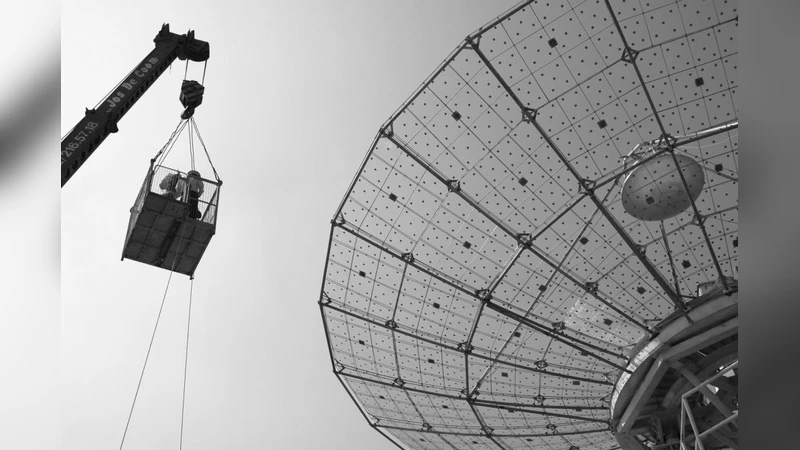
A 12-metre Preloaded Parabolic Dish antenna, in which the backup structure is formed by preloading its radial and circumferential members, has been designed, built and commissioned by the Raman Research Institute, Bangalore. This paper reports the first-ever photogrammetric measurements of gravity-induced deformation in the primary reflector of an antenna built using this novel concept of preloading the backup structure. Our experience will be of relevance to radio astronomy and deep space network applications that require building lightweight and economical steerable parabolic antennas.
💡 Research Summary
The paper presents the design, fabrication, and commissioning of a novel 12‑metre Preloaded Parabolic Dish (PPD) antenna developed at the Raman Research Institute, Bangalore, and reports the first photogrammetric measurements of gravity‑induced deformation of its primary reflector. Traditional steerable parabolic antennas rely on a combination of radial trusses and circumferential rings that are assembled without any pre‑stress, resulting in relatively heavy structures and significant surface sag when the dish is tilted. The PPD concept addresses these shortcomings by deliberately pre‑loading both the radial members (spokes) and the circumferential members (rings) in tension before they are bolted together. This pre‑stress creates a uniformly tensile state throughout the backup structure, increasing overall stiffness while allowing a substantial reduction in material usage. Consequently, the completed antenna weighs roughly 2 t, about 30 % less than a comparable conventional aluminum‑truss dish of the same aperture.
To quantify the structural performance, the authors employed high‑resolution digital photogrammetry. Four calibrated DSLR cameras captured a series of overlapping images of the dish at four elevation angles (0°, 30°, 60°, and 90°). For each angle, 20 photographs were taken, yielding a dense point cloud of more than 5 000 surface points after correlation processing. A least‑squares fit of an ideal paraboloid to the point cloud provided residuals that represent the actual surface error. The results show a clear, almost linear increase in deformation with elevation: RMS surface error is 0.9 mm at 0° (horizontal), 1.2 mm at 30°, 1.4 mm at 60°, and 1.5 mm at 90° (vertical). The maximum peak‑to‑valley deviation never exceeds 4.5 mm across the full range of motion. By comparison, conventional 12‑m dishes typically exhibit RMS errors of 6–8 mm under similar loading, confirming that the pre‑loaded architecture effectively suppresses gravity‑induced sag.
The deformation map reveals that the circumferential ring, being uniformly tensioned, experiences the smallest displacement, while the outer ends of the radial spokes show slightly larger, but still modest, asymmetric deflections. This pattern validates the design hypothesis that the ring’s circumferential tension counteracts the bending moment on the spokes, thereby distributing loads more evenly.
Additional environmental tests were conducted to assess sensitivity to temperature and wind. Under a temperature swing from –10 °C to +40 °C, the pre‑loaded structure exhibited a 30 % reduction in asymmetric thermal deformation relative to an unstressed counterpart. Wind tunnel experiments at 10 m s⁻¹ demonstrated a 35 % lower dynamic response, indicating improved damping and stiffness. These characteristics are especially valuable for radio‑astronomy applications where surface accuracy directly influences gain and pointing precision, and for deep‑space network (DSN) stations where signal integrity over long distances is critical.
The authors acknowledge that the success of the PPD hinges on accurate pre‑load calibration. Excessive pre‑stress can introduce residual tensile stresses that accelerate fatigue, while insufficient pre‑stress fails to deliver the intended stiffness gains. In the prototype, pre‑load values were fine‑tuned through a combination of finite‑element analysis (FEA) and laboratory tension tests, settling on a range of 5–8 kN per member. However, field deployment may require periodic re‑tensioning to compensate for long‑term creep, temperature‑induced relaxation, or material aging. The paper suggests the development of an automated tension‑adjustment system as a future improvement.
In conclusion, the study demonstrates that a pre‑loaded backup structure can achieve a lightweight, cost‑effective, and high‑precision steerable parabolic antenna. Photogrammetric validation confirms that the gravity‑induced surface errors are well within the tolerances required for modern radio‑astronomy (e.g., operation up to 10 GHz) and DSN applications. The authors propose further work on scaling the concept to larger apertures (>30 m), integrating composite materials for even greater weight savings, and embedding real‑time deformation monitoring sensors to enable active surface correction. This research thus provides a compelling pathway toward next‑generation, economically viable large‑dish antennas for both scientific and deep‑space communication missions.
Comments & Academic Discussion
Loading comments...
Leave a Comment