Cubical Homology of Asynchronous Transition Systems
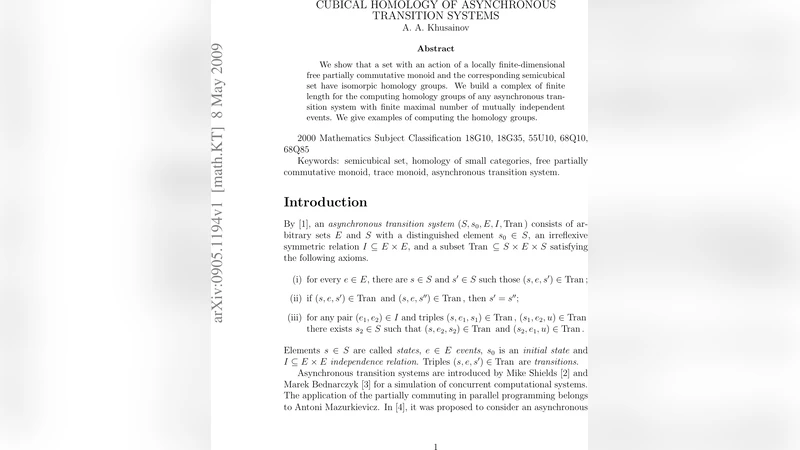
We show that a set with an action of a locally finite-dimensional free partially commutative monoid and the corresponding semicubical set have isomorpic homology groups. We build a complex of finite length for the computing homology groups of any asynchronous transition system with finite maximal number of mutually independent events. We give examples of computing the homology groups.
💡 Research Summary
The paper develops a cubical homology framework for asynchronous transition systems (ATS) by exploiting the algebraic structure of free partially commutative monoids (FPCMs). The authors begin by recalling that an FPCM is generated by a set of events together with a commutation relation that specifies which pairs of events may occur concurrently. When the monoid is locally finite‑dimensional—meaning that any state can involve only finitely many mutually independent events—its action on a set X can be encoded by a semicubical set S(X). The n‑dimensional cubes of S(X) correspond to ordered selections of n independent events from X, and the boundary operators delete one event at a time. A central theorem proves that the homology of the semicubical set S(X) is naturally isomorphic to the “diagonal” homology defined directly from the monoid action on X. This establishes that the combinatorial cubical structure faithfully captures the homological information of the underlying asynchronous system.
Next, the authors model an ATS as a state space S equipped with an action of an FPCM M generated by the system’s events E. The transition relation τ ⊆ S × E × S is precisely the action of the generators. The crucial assumption is that the system has a finite maximal concurrency degree k: no state admits more than k pairwise independent events. Under this hypothesis the authors construct a finite chain complex Cₙ(S) for 0 ≤ n ≤ k. Each chain group Cₙ is a direct sum of free abelian groups indexed by n‑tuples of independent events, and the boundary maps coincide with those of the associated semicubical set. Consequently, the homology groups Hₙ(C) compute the ATS’s diagonal homology, and they coincide with the classical cellular homology of the transition graph: H₀ counts connected components, H₁ detects cycles (loops) in the transition structure, and higher Hₙ (n ≥ 2) encode higher‑order concurrency patterns such as simultaneous execution of n independent events.
The paper then illustrates the theory with concrete examples. In a simple system with two independent events, the complex has only C₀ and C₁, and the resulting H₁ ≅ ℤ₂ reflects a single non‑trivial loop. A second example with three mutually independent events yields a complex up to C₂; the computation shows a non‑trivial H₂, indicating a genuine two‑dimensional concurrency region. A third, more intricate example mixes commuting and non‑commuting events, demonstrating that the finite‑length complex still captures the correct homology: H₁ ≅ ℤ and H₂ ≅ ℤ₂, revealing both a basic cycle and a higher‑dimensional concurrency class.
From a practical standpoint, the authors argue that the finite‑length nature of the constructed complex dramatically reduces computational overhead compared with traditional approaches that often require infinite or unbounded chain complexes. Because the maximal concurrency degree k is a property of the system’s specification, the algorithm can be implemented directly in verification tools, model‑checking frameworks, or concurrency analysis software. The paper also discusses possible extensions: relaxing the local finiteness condition, incorporating weighted transitions, and interpreting the construction categorically (e.g., as a functor from ATS to cubical sets). These directions point toward a broader homological toolkit for reasoning about distributed and concurrent systems.
In summary, the work establishes a rigorous isomorphism between monoid‑action homology and cubical homology for asynchronous systems, provides an explicit finite chain complex for computing these invariants under a natural finiteness assumption, and demonstrates the method’s applicability through detailed examples. The results open a pathway for efficient homological analysis of concurrent processes and suggest several promising avenues for future research.
Comments & Academic Discussion
Loading comments...
Leave a Comment