(Infinity,2)-Categories and the Goodwillie Calculus I
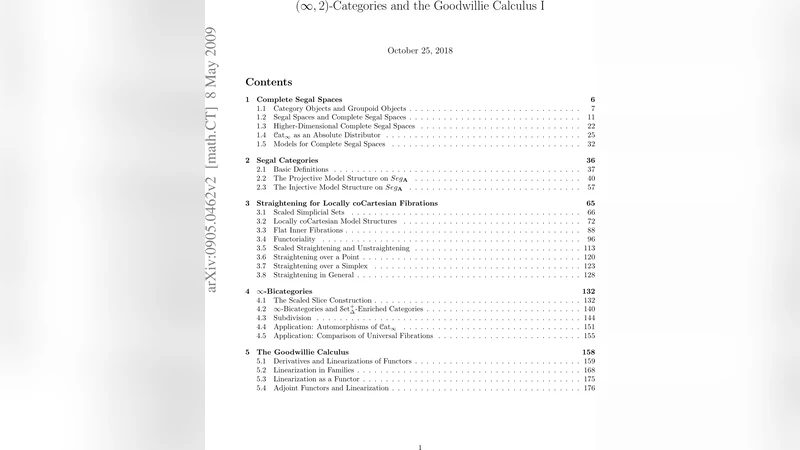
The bulk of this paper is devoted to the comparison of several models for the theory of (infinity,2)-categories: that is, higher categories in which all k-morphisms are invertible for k > 2 (the case of (infinity,n)-categories is also considered). Our ultimate goal is to lay the foundations for a study of Tom Goodwillie’s calculus of functors. To this end, we have included some simple applications to the theory of first derivatives.
💡 Research Summary
The paper undertakes a systematic comparison of the main models that have been proposed for the theory of (∞,2)-categories—higher categories in which all k‑morphisms are invertible for k > 2. Four principal models are examined in depth: the Segal‑space model, the complete Segal object model, the Θ₂‑set model, and the marked simplicial‑category model. For each, the authors construct a cofibrantly generated model structure, describe fibrant‑cofibrant replacement procedures, and explain how the respective homotopy‑coherent nerves encode composition of 2‑morphisms. The core technical achievement of the first part is the establishment of Quillen equivalences between all four models, together with Dwyer–Kan equivalences that guarantee the underlying (∞,2)-category is the same regardless of the chosen presentation. The comparison is made explicit by constructing bias functors and by showing how the homotopy‑coherent nerve of a Θ₂‑set recovers a Segal space, and vice versa. This network of equivalences ensures that any computational or conceptual work can be carried out in the most convenient model without loss of generality.
Having secured a robust model‑independent foundation, the authors turn to Goodwillie calculus, a powerful framework for studying functorial “derivatives” in homotopy theory. Traditionally Goodwillie’s theory lives in the (∞,1)-categorical world, where the first derivative of a functor F : C → D is a spectrum‑valued linear approximation D₁F, and higher derivatives are built from cross‑effects. The novelty of this work is to lift the first derivative to the (∞,2)-categorical setting. By viewing D₁F as a 2‑morphism (a natural transformation equipped with higher coherence data) in an (∞,2)-category of functors, the authors are able to encode the linearization process as a module object over a suitable monoidal (∞,2)-category. This perspective makes the chain rule and the interaction of cross‑effects manifest at the level of 2‑morphisms, rather than merely at the level of homotopy classes.
To illustrate the theory, the paper presents a concrete calculation: the first derivative of the suspension functor between stable ∞‑categories. Using the Θ₂‑set model, the authors construct the relevant 2‑morphism, verify that its underlying spectrum agrees with the classical D₁F, and demonstrate that the higher coherence data satisfy the expected compatibility conditions. This example confirms that the (∞,2)-categorical approach reproduces known results while providing additional structural insight.
The final section outlines a research program that extends Goodwillie calculus to full (∞,n)-categories, investigates higher derivatives as objects in stable (∞,2)-categories, and explores applications to equivariant homotopy theory and factorization homology. By establishing both a rigorous comparison of (∞,2)-category models and a first concrete link to Goodwillie calculus, the paper lays essential groundwork for a higher‑categorical differential calculus, opening the door to new computations and conceptual advances in homotopy theory.
Comments & Academic Discussion
Loading comments...
Leave a Comment