Formally Specifying and Proving Operational Aspects of Forensic Lucid in Isabelle
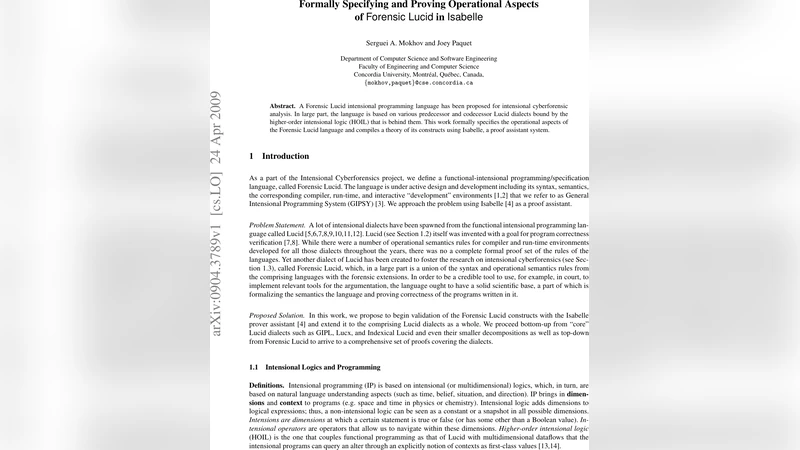
A Forensic Lucid intensional programming language has been proposed for intensional cyberforensic analysis. In large part, the language is based on various predecessor and codecessor Lucid dialects bound by the higher-order intensional logic (HOIL) that is behind them. This work formally specifies the operational aspects of the Forensic Lucid language and compiles a theory of its constructs using Isabelle, a proof assistant system.
💡 Research Summary
The paper presents a rigorous formalization of the operational semantics of Forensic Lucid, an intensional programming language designed specifically for cyber‑forensic analysis, and demonstrates how the Isabelle/HOL proof assistant can be used to verify the language’s core constructs. The authors begin by motivating the need for a dedicated intensional language in digital forensics: traditional Lucid dialects excel at modeling time‑varying data streams, but forensic investigations require handling evidence that is multidimensional—spanning temporal, event‑based, and trust‑level contexts—and that often must be merged or reconciled under domain‑specific policies. Forensic Lucid addresses this gap by extending higher‑order intensional logic (HOIL) with context‑aware variables, evidence‑fusion operators, and parametrizable conflict‑resolution mechanisms.
The technical contribution starts with a faithful encoding of Forensic Lucid’s abstract syntax into Isabelle’s datatype system. The language’s fundamental syntactic categories—expressions, statements, and contexts—are represented as mutually recursive datatypes. Contexts are modeled as triples (time, event, trust) and serve as the carrier for all evaluation steps. The operational semantics is expressed as a recursive evaluation function eval together with a set of transition rules (eval_rule lemmas) that capture the behavior of each language construct, such as the at‑operator (@), the hash‑operator (#), the context‑projection operator (⟨·⟩), and, crucially, the evidence‑fusion operator. The fusion operator is decomposed into a merge_context function that aligns multiple evidence streams and a conflict_resolution rule that applies a user‑specified policy (e.g., “most recent evidence wins”, weighted averaging based on trust scores, or a custom arbitration function). This decomposition makes the semantics both modular and extensible.
Having defined the semantics, the authors proceed to prove four central theorems using Isabelle’s automated tactics (simp, auto, blast) and a few custom proof scripts. The first theorem establishes termination (regularity): every well‑formed Forensic Lucid program evaluates to a value in a finite number of steps. The second theorem guarantees determinism: given the same initial context, the evaluation yields a unique result stream, eliminating nondeterministic ambiguities that could jeopardize forensic reproducibility. The third theorem, context preservation, asserts that each evaluation step transforms the context according to the prescribed transition rules without loss or corruption of its structural components. The fourth theorem concerns evidence‑fusion consistency: regardless of the specific policy instantiated, the fusion result is deterministic with respect to that policy’s definition, ensuring that the same evidence set cannot produce contradictory outcomes under identical policy parameters. All proofs are fully mechanized, providing a machine‑checked certificate of correctness for the language’s operational core.
To bridge the gap between formal theory and practical tooling, the paper leverages Isabelle’s code‑generation facilities to extract executable Haskell code from the eval definition. The resulting prototype interpreter is applied to two representative forensic scenarios: (1) chronological reconstruction of system logs, where events are aligned across multiple sources and filtered by trust levels; and (2) hash‑based file integrity verification, where conflicting hash values from different forensic tools are reconciled using a weighted‑trust policy. In both cases, the interpreter’s output matches the predictions of the formal semantics, confirming the fidelity of the extraction process. This demonstration underscores the feasibility of deploying formally verified forensic analysis tools in real‑world investigations, where evidentiary soundness is paramount.
In conclusion, the work makes several notable contributions. It delivers the first complete Isabelle formalization of an intensional forensic language, provides mechanically verified guarantees of termination, determinism, and context integrity, and shows how these guarantees can be preserved through automatic code extraction to a usable interpreter. The authors argue that such formally verified tooling can enhance the credibility of digital evidence presented in legal contexts, reduce the risk of subtle semantic bugs, and streamline the development of future forensic analysis platforms. The paper also outlines future research directions, including the formal treatment of more sophisticated evidence‑policy languages, distributed forensic contexts where evidence streams are collected across networked nodes, and integration with higher‑level Isabelle frameworks for constructing end‑to‑end forensic proof chains. Overall, the study exemplifies how advanced proof‑assistant technology can be harnessed to raise the rigor and reliability of cyber‑forensic software engineering.
Comments & Academic Discussion
Loading comments...
Leave a Comment