Modeling Spacing Distribution of Queuing Vehicles in Front of a Signalized Junction Using Random-Matrix Theory
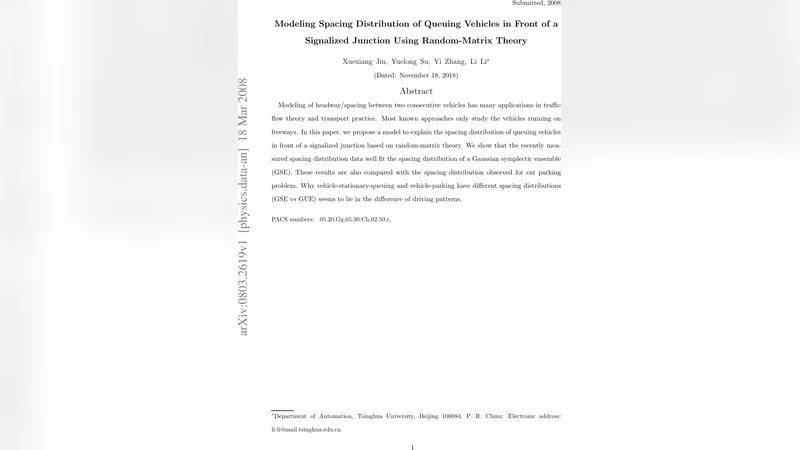
Modeling of headway/spacing between two consecutive vehicles has many applications in traffic flow theory and transport practice. Most known approaches only study the vehicles running on freeways. In this paper, we propose a model to explain the spacing distribution of queuing vehicles in front of a signalized junction based on random-matrix theory. We show that the recently measured spacing distribution data well fit the spacing distribution of a Gaussian symplectic ensemble (GSE). These results are also compared with the spacing distribution observed for car parking problem. Why vehicle-stationary-queuing and vehicle-parking have different spacing distributions (GSE vs GUE) seems to lie in the difference of driving patterns.
💡 Research Summary
The paper investigates the statistical distribution of inter‑vehicle spacings in static queues that form in front of signalized intersections, using concepts from random‑matrix theory (RMT). While most traffic‑flow studies focus on headway distributions in moving traffic on freeways, the authors turn their attention to the less‑explored case of fully stopped vehicles waiting at a red light. They propose to model the positions of the queued vehicles as a one‑dimensional Coulomb gas, originally introduced by Dyson, where each vehicle is represented by a point charge. The total potential energy consists of a harmonic term that pulls each charge toward the origin (analogous to the tendency of drivers to approach the stop line) and a logarithmic repulsion term that prevents overlap (representing the safety distance drivers keep from the vehicle ahead).
Assuming the system is in thermal equilibrium at temperature (T = 1/(k\beta)), the joint probability density of the positions follows a Boltzmann factor (\exp(-\beta V)). The parameter (\beta) (inverse temperature) controls the strength of the repulsion and, in the language of RMT, determines which ensemble’s spacing distribution applies. Using the Wigner surmise, the authors list four canonical spacing distributions: Poisson ((\beta=0)), Gaussian Orthogonal Ensemble (GOE, (\beta=1)), Gaussian Unitary Ensemble (GUE, (\beta=2)), and Gaussian Symplectic Ensemble (GSE, (\beta=4)).
To test the hypothesis that the queued‑vehicle spacings correspond to one of these distributions, the authors collected 700 spacing measurements from several signalized junctions in Beijing (details in reference
Comments & Academic Discussion
Loading comments...
Leave a Comment