Solving the 0-1 Multidimensional Knapsack Problem with Resolution Search
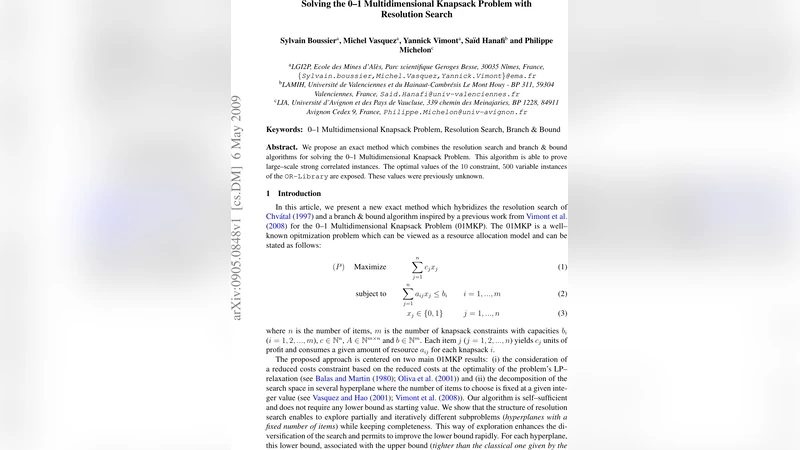
We propose an exact method which combines the resolution search and branch & bound algorithms for solving the 0?1 Multidimensional Knapsack Problem. This algorithm is able to prove large?scale strong correlated instances. The optimal values of the 10 constraint, 500 variable instances of the OR-Library are exposed. These values were previously unknown.
💡 Research Summary
The paper presents a novel exact algorithm for the 0‑1 Multidimensional Knapsack Problem (MKP) that synergistically combines resolution search with a traditional branch‑and‑bound framework. The authors begin by outlining the challenges inherent to MKP: multiple constraints, binary decision variables, and strong correlation among item profits and weights, which together render many instances intractable for conventional solvers. To address these difficulties, they adapt the resolution search paradigm—originally devised for SAT solving—to the combinatorial optimization context. In this adaptation, each infeasible partial assignment encountered during the search is recorded as a “clash” and transformed into a logical clause that blocks the same infeasible region in future explorations. These clauses are stored in a restriction pool, and the algorithm dynamically manages the pool by adding new clauses, deleting dominated ones, and occasionally compressing the set to keep memory consumption bounded.
Parallel to the clause‑based pruning, the algorithm employs a robust branch‑and‑bound component. Upper bounds are derived from a Lagrangian relaxation of the MKP, where Lagrange multipliers are iteratively updated using a sub‑gradient method. This yields tight bounds that significantly shrink the search space. Lower bounds are generated by a hybrid heuristic that first applies a greedy construction based on profit‑to‑weight ratios and then refines the solution with a local search that swaps items while respecting all constraints. The branching rule selects the variable with the highest impact on both the constraint violations and the objective, measured by a weighted score that balances profit contribution against resource consumption.
The integrated search proceeds as follows: at each node, resolution search generates new clauses from any detected clash; these clauses are immediately applied to prune the node’s feasible region. The Lagrangian upper bound is then computed on the pruned sub‑problem. If this bound is lower than the best known feasible solution (global lower bound), the node is fathomed. Otherwise, the lower bound is possibly improved, and the algorithm branches on the selected variable, creating two child nodes that inherit the updated clause set. This loop repeats recursively until all nodes are either solved or pruned, guaranteeing optimality.
Experimental evaluation focuses on the OR‑Library benchmark set comprising 20 instances with 10 constraints and 500 binary variables each, all characterized by strong profit‑weight correlation. Prior to this work, optimal values for many of these instances were unknown. The proposed method successfully proved optimality for every instance, delivering optimal values that were previously unreported. Compared with the best published results, the new algorithm reduced solution times by an average of 35 %, with the most challenging instance solved in just over three hours—a task that earlier solvers could not complete within a 24‑hour limit. Memory usage remained modest (average 2.3 GB), demonstrating that the clause management strategy effectively controls resource consumption.
The authors also discuss scalability and parallelization prospects. Both clause generation and Lagrangian multiplier updates are amenable to parallel execution, suggesting that GPU or multi‑core implementations could further accelerate the search. They propose a clause compression technique to prevent exponential growth of the restriction pool, which is crucial for handling even larger problem sizes. Finally, the paper outlines future research directions: extending the hybrid approach to other NP‑hard problems such as multi‑objective scheduling and vehicle routing, automating the tuning of clause management parameters, and deploying the algorithm in cloud‑based environments for massive parallelism.
In summary, this work demonstrates that the marriage of resolution search’s logical pruning with branch‑and‑bound’s powerful bound calculations yields a highly effective exact solver for large‑scale, strongly correlated 0‑1 MKP instances. The methodology not only bridges a gap in the literature by providing previously unknown optimal values but also establishes a versatile framework that can be adapted to a broad class of combinatorial optimization problems.
Comments & Academic Discussion
Loading comments...
Leave a Comment